

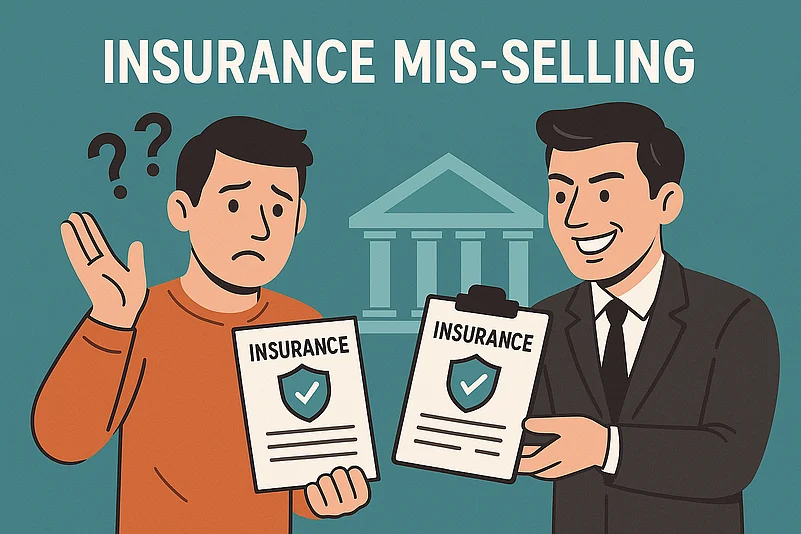
| The 73-year-old professor alleged the bank presented the policy as a one-time investment without her free and informed consent. |
The Hyderabad District Consumer Disputes Redressal Commission has held a bank and an insurance company jointly responsible for allegedly mis-selling a ₹10 lakh insurance policy to a 73-year-old retired associate professor.
In its August 27, 2026 order, the commission found that the policy was not obtained with the woman’s free will and informed consent and held the bank and insurer guilty of deficiency in service and unfair trade practice. It directed the insurer to close the policy and refund the ₹10 lakh invested. The bank and insurer were also directed to jointly and severally pay ₹50,000 as compensation and ₹10,000 towards costs.
The ruling is significant for bancassurance, where banks act as a major distribution channel for insurance products.
₹10 Lakh Policy Allegedly Presented as Investment
According to the complaint, the woman visited a bank on September 4, 2023, to transfer money to her son in the US. Bank officials allegedly introduced her to two agents who presented an insurance product as a ₹10 lakh one-time investment.
She alleged that the agents assured her that she would receive ₹2.67 lakh a year after four years. She also claimed that her salary was recorded as ₹1 crore in the proposal form, despite her being a retired associate professor receiving a monthly pension of ₹57,000.
The woman further alleged that she has no intention of buying insurance and that bank officials obtained her signatures on loan-related documents before investing the ₹10 lakh in the policy. She said the product was presented as a one-time investment even though it required annual payments.
She later sought cancellation of the policy. According to her complaint, bank officials initially told her that cancellation would be possible in September 2024. After she returned from the US in March 2024, she was allegedly told that the policy could only be cancelled in September 2025.
The bank denied taking signatures on blank papers and argued that the insurance transaction was between the woman and the insurer. The insurer maintained that the policy had been issued with her request and approval and said the physical policy pack had been dispatched and delivered to her address on September 18, 2023.
Policy Documents Sent While the Woman was Abroad
The insurer sent the policy documents to her permanent address while she was abroad.
The commission held that simply sending the policy documents was not sufficient if the consumer did not have a meaningful opportunity to examine them and exercise the cancellation option.
The commission also observed that a senior citizen and retired person cannot automatically be presumed to understand complex insurance terms and conditions. The bank and insurer should have explained the relevant terms and requirements to her.
It concluded that the policy was not obtained with free will and informed consent and that the bank’s and insurer’s conduct amounted to a deficiency in service and an unfair trade practice.
Why the Ruling Matters for Bancassurance
The case is notable because the bank could not shift responsibility to the insurer by arguing that the insurance contract was between the customer and the insurance company.
Banks are a major channel for selling life insurance. Corporate agents, including banks, accounted for nearly 53% of private life insurers’ individual new business premium in FY25, while banks alone contributed more than 49%.
Meanwhile, IRDAI recorded 26,667 mis-selling complaints in FY25, an increase of 14%.
The regulatory focus on mis-selling is also tightening. RBI’s new rules, effective January 1, 2027, require clear and informed customer consent and provide for a full refund where mis-selling is established. IRDAI is also set to introduce salesperson tagging.
The Sabka Bima Sabki Raksha (Amendment of Insurance Laws) Act, 2025 has strengthened regulatory powers, including provisions concerning commission caps and licence action.
What Policyholders can Do?
Policyholders should verify the premium, payment frequency, policy term, benefits, exclusions, surrender conditions and cancellation rights. They should also retain the proposal form, policy document, payment records, loan papers and relevant communications.
If a policy has been mis-sold, the policyholder can first approach the insurer through its grievance mechanism. The free-look facility may also allow cancellation within the applicable period. If the issue remains unresolved, the policyholder can approach IRDAI’s Bima Bharosa mechanism. Complaints concerning the bank can be taken through the RBI Ombudsman route, with the consumer commission available as a further remedy.
Aggrieved consumers may also reach out to the National Consumer Helpline at 1915 for assistance or the helpline in their respective state.
| Learn more about insurance mis-selling with MyRupia. |
Disclaimer: Allegations made by the complainant are presented as allegations and do not constitute established facts unless specifically stated as findings of the commission.