

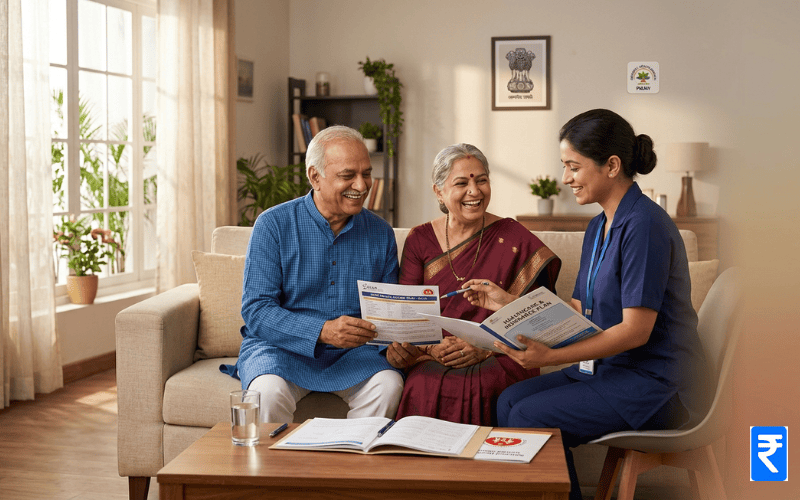
India’s senior citizen population is growing fast. By 2050, people aged 60 and above could make up over 20% of the country’s population, according to the United Nations Population Fund (UNFPA).
As people grow older, healthcare needs also increase. Chronic conditions such as diabetes, heart disease, and arthritis become more common with age. Treating these conditions can be expensive. And many retired individuals rely on pensions or savings. A sudden hospital bill can quickly create financial stress.
To address this, the Government of India and several state governments have introduced dedicated health insurance schemes for senior citizens.
These schemes help reduce out-of-pocket medical expenses. More importantly, they ensure that elderly citizens can get the treatment they need without exhausting their life savings.
Why Senior Citizens Need Health Insurance
As per the Longitudinal Ageing Study in India, almost 75% of senior citizens in India live with one or more chronic diseases. These conditions require continuous medical care.
- Hospitalisation in private hospitals is expensive. Even the most common treatments can cost ₹50,000 to several lakhs.
- Most seniors live on fixed incomes. They depend on pensions, savings, or family support after retirement.
- Large medical bills can quickly exhaust retirement savings. This creates financial stress for both seniors and their families.
- Private health insurance premiums rise sharply with age. Many plans also require a 20–30% co-payment.
Major Government Health Insurance Schemes for Senior Citizens
The table below summarizes the key schemes covered in this article:
| Scheme | Primary Beneficiary | Coverage Amount | Premium / Cost |
| AB PM-JAY (General) | BPL / economically vulnerable families | ₹5 lakh per family/year | Free (government-funded) |
| AB PM-JAY (70+ Expansion) | All citizens aged 70+ | ₹5 lakh per year (separate card) | Free |
| CGHS | Central govt employees & pensioners | OPD + IPD (no fixed cap) | Subscription-based (nominal) |
| ECHS | Ex-servicemen & dependents | OPD + IPD (no fixed cap) | One-time contribution at retirement |
| NPHCE | All elderly citizens 60+ (not insurance; care programme) | Free geriatric care at government hospitals | Free |
| State Schemes (varies) | State-specific criteria | ₹30,000–₹5 lakh depending on the state | Subsidized or free |
1. Ayushman Bharat Pradhan Mantri Jan Arogya Yojana (AB PM-JAY)
Launched in 2018, AB PM-JAY is the largest government-funded health insurance scheme in the world. It provides cashless hospitalization to economically vulnerable families across India.
Key features
- Coverage of ₹5 lakh per family per year for hospitalization
- Covers 1,900+ medical procedures across 24 specialties
- 3 days pre-hospitalization and 15 days post-hospitalization expenses covered
- Pre-existing diseases covered from Day 1
- Cashless treatment at 28,000+ empanelled hospitals
- Portable across India (treatment allowed outside home state)
- Eligibility based on the SECC 2011 database
2024 expansion for senior citizens
In September 2024, the Government of India expanded the scheme for all citizens aged 70+.
- Covers all Indians aged 70 and above, regardless of income
- Expected to benefit around 6 crore seniors
- Eligible seniors receive the Ayushman Vay Vandana Card
- Seniors in PM-JAY families get an extra ₹5 lakh cover exclusively for themselves
- Those already under schemes like the Central Government Health Scheme or the Ex-Servicemen Contributory Health Scheme must choose one scheme
- Seniors with private insurance can still use PM-JAY benefits
- Registration via pmjay.gov.in or Common Service Centres
2. Central Government Health Scheme (CGHS)
Started in 1954, CGHS provides healthcare for central government employees and pensioners. It currently covers around 42 lakh beneficiaries in 80 cities. Who can use it
- Serving and retired central government employees
- Central government pensioners and family pensioners
- Members of Parliament and Governors
- Supreme Court and High Court judges
- Freedom fighters and notified categories
(Railway employees are covered under a separate system.)
Key benefits
- OPD consultations and medicines at CGHS wellness centres
- Specialist treatment at empanelled hospitals
- Cashless hospitalization at network hospitals
- Diagnostic services, including tests and imaging
- AYUSH treatments like Ayurveda and Homeopathy
- Coverage for hearing aids and certain medical devices
As per 2024 guidelines, beneficiaries can access major government hospitals like All India Institute of Medical Sciences and Tata Memorial Centre without referral.
Contribution
- Pensioners can choose monthly payments or a lifetime contribution
- Lifetime fee ranges from ₹30,000 to ₹1,20,000, based on pension
- Digital CGHS cards are available through the myCGHS app and DigiLocker
3. Ex-Servicemen Contributory Health Scheme (ECHS)
It provides healthcare for retired personnel of the Indian armed forces and their dependents. It is managed by the Ministry of Defence.
Key points
- Eligibility: retired personnel from the Army, Navy, and Air Force
- One-time contribution at retirement (₹30,000–₹1,20,000 depending on rank)
- OPD care at ECHS polyclinics
- Specialist consultations and hospital treatment
- Diagnostic tests, medicines, and follow-up care included
- Cashless treatment at empanelled hospitals (or reimbursement)
Seniors 70+ under ECHS must choose between ECHS and PM-JAY expansion.
4. National Programme for Health Care of the Elderly (NPHCE)
NPHCE is not insurance. It is a government healthcare support program for seniors.
Launched in 2010 by the Ministry of Health and Family Welfare.
What it provides
- Free geriatric care at district hospitals
- Treatment for conditions like dementia, arthritis, and osteoporosis
- Dedicated geriatric wards in hospitals
- Regional geriatric centres at medical colleges
- Physiotherapy, rehabilitation, and health check-ups
- Home-based care for bedridden elderly
The programme is available to all citizens aged 60+.
5. State Health Insurance Schemes
Many states run their own health insurance programs for residents. These schemes often complement central schemes like PM-JAY.
They are useful for:
- People not eligible under the central schemes
- Families needing additional coverage
- Residents seeking state-specific healthcare benefits
| State Scheme | State | Coverage | Key Feature |
| Mukhya Mantri Chiranjeevi Yojana | Rajasthan | ₹5 lakh per family | Cashless at empanelled hospitals |
| Karunya Arogya Suraksha Padhathi (KASP) | Kerala | ₹5 lakh per family | Covers PEDs; EWS-focused |
| Mahatma Jyotiba Phule Jan Arogya Yojana | Maharashtra | Up to ₹5 lakh | Low-income families are now integrated with PM-JAY |
| Yeshasvini Health Insurance | Karnataka | Surgical care packages | Cooperative society members |
| Mukhyamantri Amrutum Yojana | Gujarat | ₹5 lakh for major illness | BPL families; government-funded premium |
| Biju Swasthya Kalyan Yojana (BSKY) | Odisha | Up to ₹5–10 lakh | Odisha joined PM-JAY in April 2025 |
Note: State schemes are subject to change, and eligibility criteria, coverage limits, and hospital networks vary. Senior citizens should verify current scheme details with their respective state health departments or district health offices.
Government Health Insurance for Senior Citizens: Eligibility and How to Apply
| Scheme | Eligibility Criteria | How to Apply |
| Ayushman Bharat Pradhan Mantri Jan Arogya Yojana (AB PM-JAY – General) | Families listed in the SECC 2011 rural deprivation databaseUrban occupational groups such as construction workers, domestic workers, rag pickers, beggars and street vendors Former RSBY beneficiariesASHA workers, Anganwadi workers, and helpers (included from 2024) Excludes households owning motorized vehicles, >5 acres of agricultural land, refrigerators, landlines, or government salaried members | 1. Visit pmjay.gov.in and click “Am I Eligible?” 2. Enter your mobile number and verify the OTP 3. Select state and scheme 4. Search using Aadhaar number, Family ID, or PMJAY ID 5. Download Ayushman Card or visit a Common Service Centre (CSC) |
| Ayushman Vay Vandana Card (AB PM-JAY 70+ Expansion) | All Indian citizens aged 70 years and above • No income or socio-economic restrictions Aadhaar required for enrollment Must choose between this scheme and CGHS/ECHS/Ayushman CAPF if already covered | Same application process as AB PM-JAY: 1. Visit pmjay.gov.in 2. Verify eligibility through the portal 3. Register and download Ayushman Vay Vandana Card or visit CSC |
| Central Government Health Scheme (CGHS) | Serving and retired central government employees and their dependentsPensioners are eligible even if they do not reside in CGHS-covered cities Available in 80 cities across India Dependents include spouse, unmarried children up to 25, unmarried/divorced daughters, and parents/parents-in-law with monthly income below ₹9,000 + DA | 1. Download form from cghs.gov.in or collect from CGHS Wellness Centre 2. Fill details including PPO and dependent information 3. Pay contribution via Bharatkosh portal 4. Submit form and documents at CGHS Wellness Centre 5. Receive CGHS card (physical or digital via myCGHS app or Digilocker) |
| Ex‑Servicemen Contributory Health Scheme (ECHS) | Retired personnel of the Indian Army, Navy, or Air Force Eligible dependents: spouse, dependent children, and parents Must have completed qualifying service; disability pensioners also eligible | Usually initiated at retirement through unit/record office Can also enroll at nearest ECHS Polyclinic or Station Headquarters |
| National Programme for Health Care of the Elderly (NPHCE) | All citizens aged 60 years and above No income or employment criteria Services available at government hospitals and medical colleges | No formal application required Senior citizens can directly visit the geriatric OPD at participating government district hospitals or medical colleges |
Limitations of Government Health Insurance for Senior Citizens
Government schemes offer strong support. But they also have a few limitations seniors should know.
Coverage cap
- Ayushman Bharat Pradhan Mantri Jan Arogya Yojana provides ₹5 lakh per family per year.
- Complex treatments like cancer care or organ surgeries can cost ₹10–20 lakh or more in private hospitals.
- Under the Central Government Health Scheme, reimbursements follow government package rates, which may be lower than actual hospital bills.
No OPD coverage under PM-JAY
- PM-JAY mainly covers hospitalization.
- Routine doctor visits, medicines, and regular tests are usually not included.
Limited availability in some areas
- CGHS services are available in around 80 cities only.
- Seniors in smaller towns may not have access to CGHS wellness centres.
- PM-JAY has 28,000+ hospitals, but coverage may still be limited in some rural districts.
Long wait times in public hospitals
- Hospitals under schemes like CGHS and National Programme for Health Care of the Elderly often handle large patient volumes.
- This can lead to delays in appointments or elective procedures.
Private hospital billing gaps
- CGHS pays hospitals based on fixed package rates.
- Some private hospitals charge more.
- Patients may need to pay the difference unless prior approval is taken.
Scheme choice for seniors aged 70+
- Seniors already covered under schemes like Ex-Servicemen Contributory Health Scheme or CGHS must choose one scheme.
- They cannot use both their existing scheme and PM-JAY’s 70+ expansion at the same time.
Limited hospital networks
- Not every hospital is part of a scheme’s cashless network.
- A preferred doctor or hospital may not be empanelled.
Tax Benefits Related to Health Insurance for Senior Citizens
Senior citizens and their families can benefit from significant tax deductions under Section 80D of the Income Tax Act, 1961.
These deductions are available only under the old tax regime and are not applicable if the taxpayer opts for the new regime under Section 115BAC.
| Taxpayer Scenario | Maximum 80D Deduction (Old Regime) |
| Self + spouse + dependent children (all below 60) | Up to ₹25,000 |
| Self + spouse + dependent children (self is 60+) | Up to ₹50,000 |
| Premium paid for parents (below 60) | Additional ₹25,000 |
| Premium paid for parents (one or both are 60+) | Additional ₹50,000 |
| Self (below 60) + parents (both 60+) | Up to ₹75,000 total |
| Self (60+) + parents (both 60+) | Up to ₹1,00,000 total |
| Senior citizen with no health insurance (medical expenses) | Up to ₹50,000 for actual medical expenses (non-cash payment only) |
| Preventive health check-up (any age) | Up to ₹5,000 (included within the above limits) |
| CGHS contributions | Eligible for deduction within 80D limits (for self) |
Important: Premiums must be paid in non-cash modes (UPI, debit/credit card, bank transfer) to qualify for deduction. Cash payments are allowed only for preventive health check-ups (up to ₹5,000). These deductions are applicable for Assessment Year 2025–26 under the old tax regime. Taxpayers should consult a qualified tax advisor before filing claims.
Conclusion
Government health insurance for senior citizens in India has improved in recent years. The expansion of Ayushman Bharat Pradhan Mantri Jan Arogya Yojana now covers all citizens aged 70 and above. This has made healthcare more accessible for many seniors.
However, these schemes still have limits. Coverage caps and hospital networks may not meet every need. Seniors should check their eligibility and enroll in schemes like Central Government Health Scheme or Ex-Servicemen Contributory Health Scheme. If needed, a supplemental private policy can provide extra financial protection.
FAQs
1. Do these schemes cover pre-existing diseases?
Yes. Most schemes do.
- Ayushman Bharat Pradhan Mantri Jan Arogya Yojana covers pre-existing diseases from Day 1.
- The Central Government Health Scheme also covers existing conditions.
Private insurance often has waiting periods up to 36 months.
2. Can seniors above 70 use PM-JAY if they have private insurance?
Absolutly. Seniors aged 70+ can still use Ayushman Bharat Pradhan Mantri Jan Arogya Yojana even if they have private insurance.
But seniors already under the Central Government Health Scheme or Ex-Servicemen Contributory Health Scheme must choose one government scheme.
3. What does it cost to enroll in govt health insurance?
Costs vary. Ayushman Bharat Pradhan Mantri Jan Arogya Yojana is free for eligible citizens. The Central Government Health Scheme requires monthly or lifetime contributions. Still, the costs are much lower than private insurance premiums.
4. Is government health insurance enough?
It depends on the person. Schemes like Ayushman Bharat Pradhan Mantri Jan Arogya Yojana and Central Government Health Scheme cover hospitalization well. But there are limits like the PM-JAY usually does not cover OPD care. So, some seniors may consider a private top-up policy.