

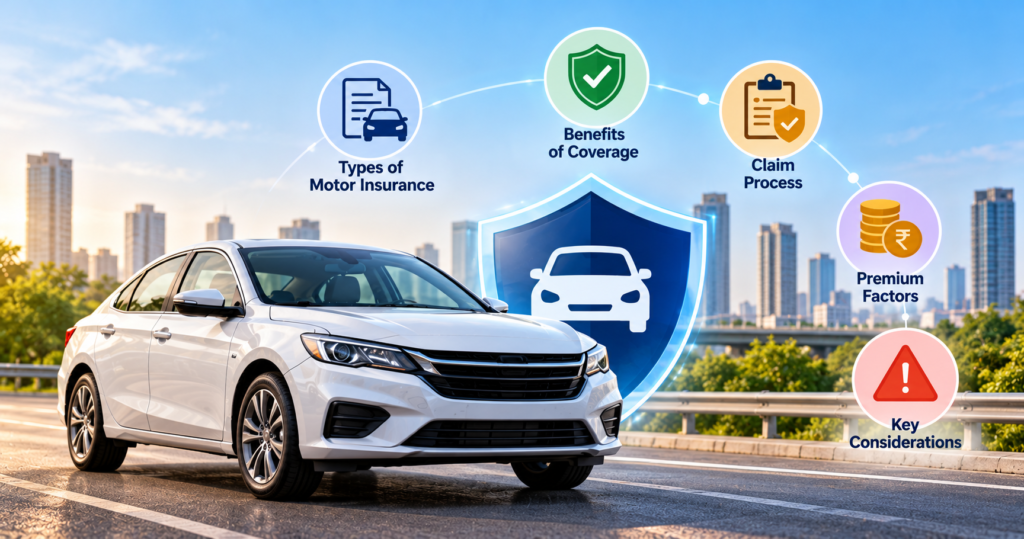
Motor insurance coverage is what stands between you and a potentially large financial loss if in case your vehicle is damaged. This can include damage in an accident, stolen, or involved in a situation that harms another person or their property. Understanding motor insurance coverage what it includes, what it costs, and how to claim is essential for every vehicle owner in India.
Legal Requirement in India: Under the Motor Vehicles Act, 1988, every vehicle owner in India must have at least a valid third-party motor insurance policy. Driving without one can result in a fine of up to ₹2,000 for a first offence and ₹4,000 for a subsequent offence, along with possible imprisonment of up to 3 months. |
In this guide, you will learn what motor insurance coverage includes, the three main types available in India, key benefits, and how to file a claim step by step.
What is Motor Insurance Coverage
Motor insurance coverage is an agreement between you and an insurance company. In exchange for a regular premium payment, the insurance company agrees to cover specified financial losses related to your vehicle, whether from an accident, theft, fire, natural disaster, or a third-party liability claim. In return, the insurance company agrees to help you if something goes wrong with your vehicle.
This help you get is mainly financial. If your vehicle gets damaged, stolen or is affected by fire or natural disasters, the insurer can cover the repair or loss costs. It can also protect you if your vehicle causes damage to another person, their vehicle, property etc.
What is IDV? The Insured Declared Value (IDV) is the current market value of your vehicle as assessed by the insurer. It represents the maximum compensation you can receive in the event of theft or total loss. A higher IDV means better cover but a slightly higher premium and vice versa. Setting an accurate IDV is important; undervaluing it to save on premium can result in a lower payout when you need it most. |
In India, third-party insurance is compulsory. It comes under the Motor Vehicles Act. This means you must at least cover damage caused to others. It does not cover damage to your own vehicle, but it makes sure that others are protected if an accident happens.
| Key Term | What It Means |
| Premium | The amount you pay (monthly or annually) to keep the policy active |
| Sum insured | The maximum amount the insurer will pay for a valid claim |
| Third-party liability | Covers damage or injury caused by your vehicle to another person or property |
| Own damage cover | Covers damage to your own vehicle |
| Deductible | The portion of the claim amount you agree to pay yourself |
Why is Motor Insurance Coverage Important
Owning a vehicle in India means sharing roads that see millions of accidents each year. Even if you drive carefully, accidents can still happen because of other vehicles, bad roads or sudden situations. Motor insurance coverage is what ensures that a road incident does not turn into a lasting financial setback for you or for someone else involved.
Fact to Know According to the Ministry of Road Transport and Highways, India records over 4 lakh road accidents annually, resulting in significant loss of life and property. This scale underscores why having adequate motor insurance coverage is not merely a legal formality, it is a practical financial necessity. |
Motor insurance coverage helps to protect you in different ways:
- Legal requirement: Having at least third-party insurance is required by law
- Financial protection: Repairs can be expensive and insurance helps you reduce this
- Support during emergencies: Insurers help and guide you during accidents
- Peace of mind: Knowing you are covered lets you drive without the constant worry of what-if scenarios
- Protection against uninsured third parties: If another uninsured driver causes damage to your vehicle, your own damage cover can still help you
- Coverage for natural events: India sees floods, cyclones, and hailstorms that can write off vehicles cover for these events is built into comprehensive plans
Without insurance, even a small accident can cost a lot of money.
Types of Motor Insurance Coverage
In India, motor insurance policies are available in three main forms and each suits to a different level of protection and budget. Understanding what each type covers helps you choose the one that fits your situation.
1. Third-Party Insurance
This is the most basic type of motor insurance and it is required by law. You cannot legally drive a vehicle on public roads without it. It mainly protects you against damages caused to others.
This includes:
- Injury or death of another person
- Damage to someone else’s property
However, it is important to know that this policy does not cover any damage to your own vehicle. It only takes care of third-party.
2. Comprehensive Insurance
Comprehensive insurance offers the broadest level of protection among the three types. It covers third-party liabilities as well as damage to your own vehicle. Plus, it covers losses caused because of theft, fire or natural disasters. It is more useful because it gives you complete protection.
3. Standalone Own Damage Insurance
This type of insurance focuses only on covering damage to your own vehicle. It is useful if you already have a third-party insurance policy and want additional protection for your vehicle.
It includes:
- Damage caused by accidents
- Losses due to fire or natural events
- Theft of the vehicle
To buy this policy, you must already have an active third-party insurance policy in place.
| Coverage Feature | Third-Party | Comprehensive | Standalone Own Damage |
| Third-party injury/death | ✓ | ✓ | ✗ |
| Third-party property damage | ✓ | ✓ | ✗ |
| Own vehicle damage | ✗ | ✓ | ✓ |
| Theft | ✗ | ✓ | ✓ |
| Natural disaster damage | ✗ | ✓ | ✓ |
| Fire damage | ✗ | ✓ | ✓ |
| Legally compulsory | ✓ | ✓ (includes third-party) | Requires active third-party policy |
| Add-ons available | Limited | Yes | Yes |
Two-Wheeler vs Four-Wheeler Cover
The same three types of motor insurance apply to both cars and two-wheelers in India. However, premium rates, IDV calculations, and add-on options may differ. Two-wheelers, which account for the largest share of registered vehicles in India often have significantly lower premiums than cars. This difference makes comprehensive cover a cost-effective choice.
What Does Motor Insurance Coverage Include
Motor insurance coverage includes many types of protection. Whether it is a small accident, a major loss or damage caused by nature, a good motor insurance policy is made to support you financially in difficult situations.
The following are the standard inclusions you can expect under a comprehensive motor insurance policy in India. These are included in your motor insurance coverage:
| Coverage Type | What It Includes | Applies To |
| Own vehicle damage | Repair costs after an accident | Comprehensive & Standalone Own Damage (OD) policies |
| Theft | Compensation up to IDV if the vehicle is stolen | Comprehensive & OD policies |
| Natural disasters | Floods, storms, earthquakes, landslides, cyclones | Comprehensive & OD policies |
| Fire damage | Damage from fire or explosion | Comprehensive & OD policies |
| Third-party liability | Injury, death, or property damage to others | All policy types |
| Personal accident cover | Compensation for owner-driver injury or death | Most comprehensive plans |
Optional Add-On Covers
| Add-On Cover | What It Covers | Why It’s Useful |
| Zero depreciation cover | Full repair cost without deducting depreciation on parts | Reduces out-of-pocket expenses, especially for newer vehicles |
| Engine protection cover | Engine damage due to water ingression or oil leakage | Helpful in flood-prone areas where engine risk is higher |
| Roadside assistance | Towing, fuel delivery, minor repairs, and emergency support | Useful during breakdowns or emergencies on the road |
| Return to invoice cover | Pays the original invoice value in case of total loss or theft | Ensures higher payout than depreciated IDV |
| NCB protection cover | Retains No Claim Bonus even after making a claim | Helps keep future premiums lower despite a claim |
What is Not Covered
It is also very important to know what your insurance does not cover. Every motor insurance policy has a defined list of exclusions situations where the insurer will not pay a claim. Being aware of these before you need to file a claim can prevent unexpected out-of-pocket expenses.
| Exclusion | What This Means |
| Normal wear and tear | Gradual deterioration of parts over time is not covered only sudden, accidental damage qualifies |
| Driving without a valid licence | Claims may be rejected if the driver did not hold a valid licence at the time of the incident |
| Driving under the influence | Accidents caused while the driver was under the influence of alcohol or drugs are not covered |
| Mechanical or electrical breakdown | Faults that develop over time without an external cause are excluded |
| War or nuclear risk | Damage arising from war, terrorism, or nuclear events is excluded under standard policies |
| Using vehicle for unlawful purposes | Claims linked to the vehicle being used for illegal activity will not be entertained |
| Using vehicle outside permitted use | If a private vehicle is used for commercial purposes (e.g., cab aggregator services) without appropriate endorsement, claims may be rejected |
You need to always read your policy wordings document. Read particularly the exclusions clause before purchasing a plan. If any term is unclear, ask your insurer or broker to clarify it in writing.
Benefits of Motor Insurance Coverage
Motor insurance coverage gives you several useful benefits. It helps you to be financially safe and legally protected. Whether you drive daily or occasionally, having the right coverage can make a big difference.
Financial Safety
Insurance helps you to reduce your burden. Covers major repair or replacement costs after accidents, theft, or damage. Without insurance, these expenses can easily run into tens of thousands of rupees, especially with rising vehicle and spare part prices in India.
Legal Protection
A valid motor insurance policy (at least third-party) is mandatory under the Motor Vehicles Act. It helps you avoid fines, licence suspension, or legal trouble during checks or after an accident.
Cashless Repairs
Many insurers have network garages. You can repair your vehicle without paying up front. The insurer directly settles the approved repair bill with the garage, reducing immediate financial stress.
Add-on Flexibility
You can add extra cover. It includes zero depreciation, engine protection, and roadside assistance based on your driving conditions, city, and vehicle age.
No Claim Bonus
If you do not make any claims during the policy year, you earn a discount on your renewal premium. This bonus accumulates over time and can go up to 50% after five consecutive claim-free years.
| NCB Can Save You Up to 50%: The No Claim Bonus (NCB) is one of the most valuable features of motor insurance in India. You earn a 20% discount after one claim-free year, rising incrementally to 50% after five consecutive claim-free years. This discount applies to the own-damage component of your premium and can result in significant annual savings. |
Third-party Peace of Mind
If your vehicle causes injury, death, or property damage to someone else, the insurer covers the legal and financial liability, protecting you from potentially large compensation payouts.
How to Choose the Right Motor Insurance Policy
Choosing the right policy is very important. It helps you protect your vehicle and also saves you from big expenses later. There are many options available, but not every policy will match your needs. So, you should take some time to understand and choose carefully.
Use the IRDAI’s official insurer performance data as a reference when comparing options and if you are unsure, a licensed insurance broker can help you identify the most suitable plan for your vehicle and budget. Here are proper guidelines to consider:
| What to Consider | Why It Matters | What to Look For |
| Your vehicle’s age and value | The usefulness of certain covers reduces as the vehicle ages and depreciates. Paying for full coverage on an older vehicle may not always be cost-effective. | Vehicles under 5 years usually benefit from comprehensive plans. For older vehicles, evaluate if the premium justifies the reduced claim value. |
| Type of coverage needed | This decides the level of protection you get and how much risk you retain personally. | Third-party cover is the legal minimum. Choose comprehensive cover if you want protection for your own vehicle as well. |
| Claim settlement ratio (CSR) | Indicates how consistently an insurer honours claims. A higher ratio suggests better reliability at the time of need. | Refer to IRDAI’s latest CSR reports. A ratio above 95% is generally considered strong, but also check claim processing time and reviews. |
| Network garages | Determines how easy it is to access cashless repairs and how far you may need to travel during emergencies. | Look for a wide garage network, especially near your home, workplace, or regular travel routes. |
| Add-ons available | Add-ons help tailor the policy to your usage pattern, location, and vehicle type. | Prioritise zero depreciation for newer cars, engine protection in flood-prone areas, and roadside assistance for frequent drivers. |
| Premium vs coverage balance | Focusing only on a low premium can leave gaps in protection or lead to higher out-of-pocket costs later. | Compare not just price, but also coverage limits, exclusions, deductibles, and included add-ons before deciding. |
Motor Insurance Claim Process
When an incident occurs, acting quickly and following the right steps can make the difference between a smooth settlement and a delayed or rejected claim. Here is a clear breakdown of the motor insurance claim process in India.
Two Claims Routes Available
- Cashless Claim: You take your vehicle to a network garage. The insurer settles the approved repair bill directly with the garage. You only pay for non-covered items or deductibles.
- Reimbursement Claim: You repair your vehicle at any garage and pay the bill yourself. You then submit claim documents to the insurer for reimbursement of the approved amount.
The steps below apply to both routes, with differences noted where relevant.
Step 1: Inform the Insurer
You should inform your insurance company as soon as the incident happens. This could be:
- Accident
- Theft
- Other damage
Early intimation helps you start the claim process quickly.
Step 2: File an FIR
In serious cases like theft or major accidents, you may need to file an FIR. This document becomes the official proof of the incident.
Step 3: Document the Damage
You need to take clear photos or videos of your vehicle and the damage. This works as proof and helps your insurer understand what happened.
Step 4: Submit Required Documents
You will need to submit some important documents to get your claim. These may include:
- Policy copy
- Driving licence
- RC of the vehicle
- FIR copy, if needed
- Duly filled claim form (provided by the insurer)
- Repair estimate from the garage
- Original repair invoices and payment receipts (for reimbursement claims)
- Photographs of the damage
Step 5: Vehicle Inspection
The insurance company may send a surveyor to check your vehicle. They will check the damage and make a report.
Step 6: Repair Process
After inspection, you can get your vehicle repaired. If you choose a network garage, you may get cashless service. Otherwise, you can pay for repairs and later claim reimbursement.
Step 7: Claim Settlement
After checking everything, the insurance company will approve your claim and pay the amount based on your policy.
Important: If your claim is rejected or you are dissatisfied with the settlement amount, you can raise a formal complaint with your insurer’s grievance cell. If the issue remains unresolved, you can escalate it to IRDAI through their Bima Bharosa portal or the Insurance Ombudsman in your region.
Following these steps carefully and keeping copies of all submitted documents reduces the likelihood of delays or queries from the insurer during settlement.
Common Mistakes to Avoid While Filing a Claim
A large number of motor insurance claim delays and rejections in India are caused by avoidable errors. Being aware of these common pitfalls before you file can save considerable time and stress.
- Late intimation: Always inform the insurer quickly
- Incomplete documents: Submit all required papers
- Not reading policy terms: Know what is covered
- Repair before approval: Wait for the surveyor’s inspection
- False information: Always provide correct details
Being careful can help you get your claim faster.
Tips to Reduce Motor Insurance Premium
Motor insurance premiums in India are influenced by several factors vehicle age, engine capacity, location, and claims history. While some of these are fixed, the following tips can help you reduce what you pay at renewal without compromising on cover.
| Tip | What You Do | What Happens |
| Choose Higher Deductible | Agree to pay a bit more at claim time | Your premium becomes lower |
| Maintain No Claim Bonus (NCB) | Do not make small claims | You get a discount on renewal |
| Install Safety Devices | Add anti-theft devices in your vehicle | Premium may reduce |
| Renew Policy on Time | Renew before expiry date | You keep your benefits like NCB |
| Compare Before Buying | Check prices from different insurers | You may get a better price |
| Choose add-ons at purchase | Adding riders at the time of buying the base policy is generally more cost-effective than endorsing them mid-term | Lower overall premium for enhanced cover |
| Automobile association membership | Members of recognised associations such as the Automobile Association of India (AAI) may be eligible for a discount on the own-damage premium component | Small but consistent annual saving |
Even modest premium savings, maintained consistently through NCB and timely renewals, can add up to a meaningful amount over the life of your vehicle.
Conclusion
Motor insurance coverage is both a legal requirement and a practical financial safeguard for every vehicle owner in India. Whether you choose a basic third-party policy or a comprehensive plan with add-ons, the right cover ensures you are not left managing large, unexpected costs alone.
This guide has walked through the three main types of motor insurance available in India, what a standard policy covers and excludes, the step-by-step claim process, and practical tips to reduce your premium over time. The key takeaway is this: understanding your policy before you need to use it puts you in a far stronger position when something goes wrong on the road.
Before your next renewal, take a few minutes to review your current policy:
- Check the IDV
- Assess whether your add-ons still reflect your needs
- Compare alternatives if your insurer’s claim settlement ratio has changed.
A well-chosen policy is one of the simplest ways to protect your finances on the road.
Frequently Asked Questions
Q1. Is motor insurance compulsory in India?
Yes. Motor insurance is compulsory in India. Under the Motor Vehicles Act, 1988, driving without at least a valid third-party insurance policy is a punishable offence in India. The penalty for a first offence is a fine of up to ₹2,000 or imprisonment of up to 3 months, or both. A subsequent offence can attract a fine of up to ₹4,000 or imprisonment of up to 3 months, or both. Beyond the legal penalty, driving uninsured means you bear the full financial cost of any damage or injury caused in an accident. It helps you cover damage caused to others, but it does not cover damage to your own vehicle.
Q2. Which type of motor insurance is better?
Comprehensive motor insurance tends to offer better value for newer or higher-value vehicles, as it covers both third-party liabilities and own vehicle damage. For older vehicles with a lower market value, a standalone own damage policy combined with third-party cover or even third-party only may be more cost-effective. The right choice depends on your vehicle’s age, value, and how much risk you are comfortable carrying yourself.
Q3. How long does a motor insurance claim take?
A motor insurance claim can take a few days to a few weeks. The time mainly depends on the type of your claim and how quickly your documents are checked. Small and simple claims are usually settled faster. The bigger claims may take more time.
Straightforward cashless claims at network garages can be processed in 3 to 7 working days. Reimbursement claims, or those involving higher amounts and detailed surveyor assessments, may take 2 to 4 weeks. IRDAI guidelines require insurers to settle or reject claims within 30 days of receiving all documents. If a claim is not resolved within this window, the insurer may be liable to pay interest on the outstanding amount
Q4. Can I transfer my motor insurance to a new owner?
Yes. You can transfer your motor insurance when you sell your vehicle. You need to inform your insurance company and submit the required documents. After that, the policy can be moved to the new owner’s name.
Q5. What is NCB in motor insurance?
NCB is a discount you get if you do not make any claim during the policy year. This bonus helps reduce your premium when you renew your insurance. The NCB discount in India follows a defined scale: 20% after 1 claim-free year, 25% after 2 years, 35% after 3 years, 45% after 4 years, and 50% after 5 or more consecutive claim-free years. The NCB applies to the own-damage component of your premium only. It is also transferable if you switch insurers or buy a new vehicle, you can carry your accumulated NCB with you, provided you have a valid NCB certificate from your previous insurer.
What happens if the other driver involved in the accident does not have insurance?
If you are involved in an accident caused by an uninsured driver, you can file a claim under your own comprehensive policy for damage to your vehicle. Your own damage cover will apply, subject to your deductible. For compensation for personal injury, you may need to approach the Motor Accident Claims Tribunal (MACT). This is one of the key reasons financial advisers in India recommend comprehensive cover rather than relying solely on third-party insurance.