

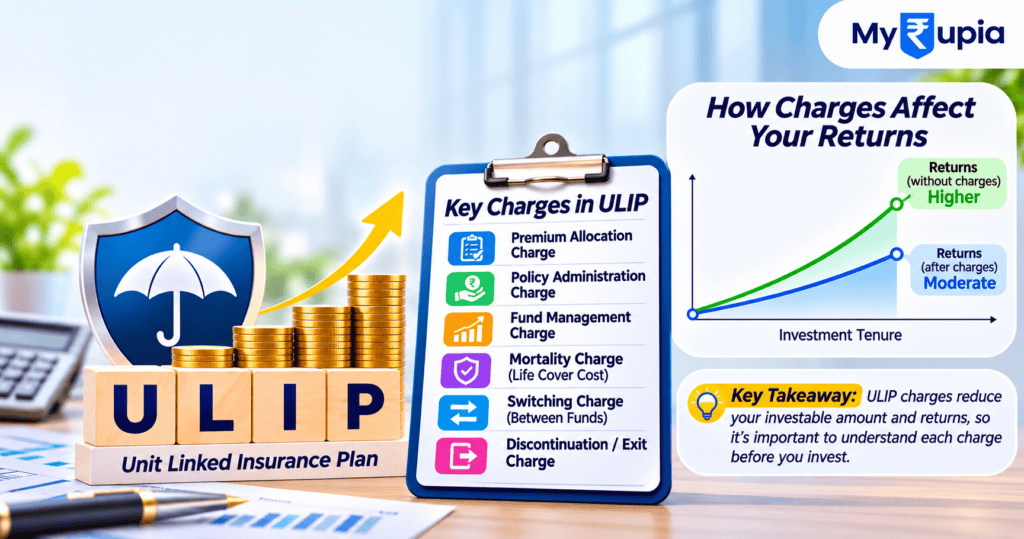
Before understanding all types of charges in ULIP and how they affect your investment returns, it is important to understand what ULIP is. A Unit Linked Insurance Product (ULIP) is an investment option and a financial product. It serves two purposes: it combines life insurance protection with market-linked investments. There are several reasons why unit-linked insurance plans are widely discussed for long-term financial planning. Some of them include:
- Dual Structure
- Regulatory Framework
- Potential for wealth accumulation over extended periods.
Importance of Understanding ULIP Charges
An individual needs to understand the charges in ULIPs. It is because, as mentioned above, it directly influences your investment performance. These charges are not merely administrative deductions. They significantly affect the compounding potential of investments. Hence, understanding all types of charges in ULIP and How They affect your investment Returns is essential for:- For comparing ULIPs across insurers or insurance providers
- For estimating realistic long-term returns
- For aligning ULIPs with financial goals
- For avoiding unpleasant surprises at maturity
ULIP charges
ULIP charges are associated with ULIP plans. In some cases, these are not clearly communicated to the policyholders. It is important to know about these ULIP charges, which you will pay for the entire term. This helps you to take an informed decision and buy the best unit-linked insurance plan as per your needs, goals and budget. These charges vary among insurance companies and plans. One must have a proper understanding of All Types of Charges in ULIP and How They Affect Your Investment Returns. Some of the common charges in ULIP include:Premium Allocation Charge
- This premium allocation charge is deducted from the premium before it is invested.
- It covers the initial expenses such as distribution costs and administrative charges.
- If the premium allocation charges are high, it reduces the initial investment amount. This lowers the compounding base.
- While many modern ULIPs eliminated this charge after the first few years, the early impact can be significant.
- For example, if the premium allocation charge is 5% and the premium is 1 lakh, then only 95k is invested in the funds that are chosen.
Policy Administration Charge
- This charge covers the insurer’s ongoing administrative expenses.
- It includes record-keeping, customer servicing and policy maintenance.
- Policy administration charges might be deducted monthly or annually, either as a fixed amount or a percentage of the premium of the fund value.
- Recurring policy administrative charges lead to a reduced fund value, especially if the policy tenure is short or premiums are modest.
Mortality Charge
- This mortality charge is for the life insurance component of a ULIP.
- They are based on the insured’s age, gender, health condition and the sum assured.
- The charge is deducted monthly by cancelling units from the fund.
- These charges increase with an increase in age.
- Higher mortality costs reduce the number of units held, thus reducing the overall fund value.
Fund Management Charge
- This fund management charge is compensation for the fund manager for managing the investments.
- It is similar to the expense ratio in mutual funds.
- IRDAI caps the FMC for ULIPs at 1.35% per annum of the fund value.
- Even though these are capped, they are deducted daily.
- Over a long period, even a 1% difference can lead to a noticeable change in the returns.
Switching Charge
- This switching charge is for switching between the funds.
- ULIPs allow the policyholders to switch between the funds based on market conditions or risk levels.
- Most insurers offer a limited number of free switches, and after that, switching charges are applied.
- Frequent switching can erode the returns.
- However, if done strategically, switching can help to manage the risk without a significant impact on the performance.
Partial Withdrawal Charge
- This partial withdrawal charge is charged on a partial withdrawal.
- Partial withdrawals allow policyholders to withdraw funds after the lock-in period.
- Some insurers charge a fee for each partial withdrawal if it exceeds free withdrawal limits.
- Withdrawals can reduce the invested corpus.
- This affects the future growth and further reduces the withdrawn amount.
Discontinuance Charge
- This discontinuance charge is also known as a surrender charge.
- It is applied if the policy is discontinued before the completion of the lock-in period
- IRDAI has capped surrender charges and mandates that discontinued funds be moved to a discontinued policy fund earning a minimum guaranteed return.
- Early surrender can significantly reduce the returns due to the chargers and loss of market exposure.
Rider Charges
- Riders are optional add-ons such as critical illness cover, accidental benefit, or waiver of premium.
- Rider charges are deducted periodically from the fund value.
- Even though riders ensure protection, they increase overall costs and reduce the investment options
Premium Redirection Charge
- Premium redirection allows future premiums to be invested in a different fund mix without switching existing investments.
- If charged, this can slightly increase costs but offers flexibility in aligning investments with changing goals.
- There are also other miscellaneous charges that might be charges based on the insurer.
How ULIP Charges Affect Long-Term Investment Returns
The cumulative effect of ULIP charges can be substantial over time. Charges reduce the number of units allocated, lower NAV growth, and limit compounding benefits. Investors focusing solely on gross returns may overlook the real impact of costs. Charges directly lower the amount of capital available for investment, meaning fewer units are purchased. For example, if a fund generates 8% returns, but the FMC is 1.35%, the net return is reduced significantly (e.g., 6.65%). Some of the effects include: Lower Initial Capital High upfront allocation charges and all other miscellaneous charges reduce the initial capital. This indirectly reduces the investment corpus, thus affecting the returns. Impact of GST An 18% GST is applicable on charges like FMC and policy administration, further reducing net returns. Long-Term Impact While charges often decrease over time, they directly impact the compounding of your investment. Suitability of ULIPs for Indian Investors ULIPs may be suitable for individuals who:- Have a long-term investment horizon
- Are comfortable with market-linked returns
- Require life insurance coverage
- Are willing to stay invested despite market volatility
Regulatory Safeguards and Transparency
IRDAI regulations mandate clear disclosure of ULIP charges, fund performance, and policy conditions. Insurers are required to provide benefit illustrations that show both low and high return scenarios, helping policyholders understand potential outcomes. These safeguards aim to protect consumers while ensuring informed decision-making.How to Minimize the Impact of ULIP Charges
There are certain steps or ways to minimise the impact of charges on ULIPs. Some of them include:- One must make sure that they choose ULIPs with low allocation and administration charges
- Another method to minimise the protection is to stay invested for the long term
- Avoid premature surrender. This is because it reduces the market exposure, and also, heavy charges are imposed on premature surrender.
- Limit unnecessary fund switching. Fund switching should be done strategically for better performance. If there are frequent switchings done, then some insurers might impose switching charges as well.
- Select riders only if essential. These riders increase premiums and also reduce the returns. So, one needs to choose riders very carefully to minimise the impact of ULIP charges.
Conclusion
ULIPs are insurance-linked investment products in India that require careful research before purchase due to their long-term nature and significant financial commitment. Investors are advised to compare plans using online tools, check ratings and reviews, and study policy brochures directly from insurers rather than relying on agents, as mis-selling can occur. Online ULIP plans are often more cost-effective than offline options. ULIPs involve multiple charges paid by policyholders, including premium allocation, fund management, policy administration, mortality, switching, surrender or discontinuance, rider, and miscellaneous charges. These costs vary across insurers and plans and are not always clearly communicated. Understanding all ULIP charges, their limits set by regulators, and their purpose is essential to choosing an affordable and suitable plan.Frequently Asked Questions
Q1. Are ULIP charges regulated in India?
Yes, ULIP charges are regulated by IRDAI, which caps fund management charges and limits surrender costs to protect policyholders.
Q2. Do ULIP charges reduce over time?
In most ULIPs, certain charges like premium allocation charges decrease after the initial years, improving long-term efficiency.
Q3. Is the fund management charge deducted separately?
No, the fund management charge is adjusted in the NAV and deducted daily, making it less visible but impactful.
Q4. Can ULIP charges be avoided completely?
No, ULIPs involve mandatory insurance and administrative costs. However, choosing low-cost ULIPs can minimise the impact.
Q5. How important is understanding ULIP charges before investing?
It is extremely important, as charges directly affect investment returns and long-term wealth accumulation.