

What is Group Health Insurance?
Group health insurance refers to the policy that offers medical coverage to a group of people. In most cases, it is purchased for the employees of a company. This way, the organisation gets to put all its employees under one single master policy. In this plan, employees have to pay the premium either partially or fully. Ultimately, it turns out to be a very cost-effective solution, as compared to health insurance plans bought individually. Also, a group insurance policy has fewer restrictions than an individual plan. In addition, it has a simpler enrolment process and offers a far broader coverage. All these advantages make the group plan an attractive solution for employees and employers.Key Group Health Insurance Benefits for Employees
There are many benefits of group health insurance, such as:1. Financial Protection Against Medical Expenses
The most important benefit of the group plan is the financial security it provides. Medical emergencies can arise anytime and might incur huge expenses. But with group health insurance, employees can dodge big hospital bills and get the medical care they need. This lets employees recover with peace of mind, without worrying about hospital charges.2. Coverage for Pre-Existing Diseases
This is yet again one of the standout group health insurance benefits. Individual policies come with a waiting period for pre-existing conditions. But group plans either completely waive or significantly reduce these waiting periods. This lets employees enjoy affordable coverage without long waiting periods.3. Cashless Hospitalisation
Most group health insurance plans are connected with hospitals that don’t require upfront payment. It’s the insurer that has to pay the hospital. This allows employees to avail a cashless treatment. This is especially beneficial in emergency situations when funds may not be immediately available.4. Coverage for Family Members
Many employers extend the coverage to the employee’s family members as well. This includes their spouses and children. Sometimes, their parents are also covered. This makes group health plans extra attractive as employees can operate stress-free, knowing their family is also financially protected.5. Lower Premium Costs
Group health insurance is also more affordable than individual policies. This is because in the group plan, the risk is spread across a large number of people. With this, employees can enjoy comprehensive coverage at little to no cost.6. Maternity and Newborn Benefits
Many group policies also come with maternity coverage. This is often not included in an individual plan, and if it is, it has long waiting periods. With the group plan, this is all taken care of. In addition, expenses related to childbirth and newborn care are also covered.7. Preventive Healthcare and Wellness Programmes
Many employers go one step ahead and also include preventive healthcare treatments, such as health check-ups and vaccinations. Many plans also include mental health support and fitness programmes. Overall, group health insurance benefits like these ensure a healthier workforce.8. No Medical Check-Ups
In most cases, employees can join group plans without having to undergo extensive medical examinations. This helps in quick onboarding and hassle-free enrolment.9. Easy Claim Process
Most group insurance policies have very streamlined claim procedures. This considerably reduces lengthy paperwork and long processing time.Key Group Health Insurance Benefits for Employers
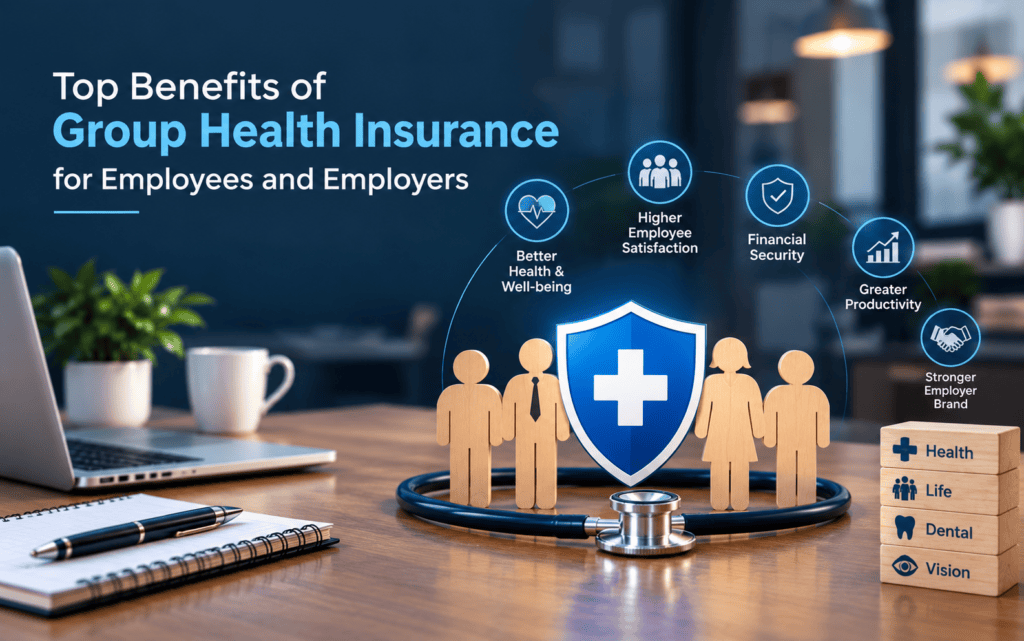
Organisations also benefit from providing group health insurance to their employees. There are various advantages, such as:1. Employee Retention and Satisfaction
Health insurance acts as a strong incentive for employees. It encourages them to stay with the company due to the added perks. Moreover, the policy also makes employees feel like the company cares about them, which further solidifies their bond with the organisation. Overall, group health insurance benefits employees in the long term and positively affects their satisfaction levels. This helps in increasing employee retention rates.2. Enhanced Productivity
Healthy employees are more focused and therefore more productive. Also, timely medical care ensures quicker recovery and less absenteeism. All this helps to create an environment where employees give their best without health-related interruptions.3. Tax Benefits for Employers
Employers also get to enjoy tax deductions on group health insurance premiums. Therefore, this turns out to be a cost-effective business decision, which employers should consider investing in.4. Advantage in Talent Acquisition
The job market is quite competitive. It takes more than just an attractive salary to entice a candidate. Offering group health insurance benefits makes a company stand out in the job market and improves its chances of securing top-tier talent.5. Customisable Coverage Options
Employers can customise insurance plans to suit their employees’ needs. They can include add-ons such as dental or mental health coverage. They can also choose coverage limits. This flexibility helps them allocate their health budget as required.6. Builds a Positive Employer Brand
Organisations that take employee well-being seriously are viewed positively by both employees and the general public. Offering group health insurance benefits helps build the reputation of the company multifold. In the long run, they are viewed as a responsible and caring employer.7. Simplified Administration
Group policies are also easier to handle, as compared to multiple individual plans. Appointed insurers normally offer onboarding support and also help in claims processing. This administrative ease is among the top advantages of group health insurance benefits.Challenges to Consider
While group health insurance has its benefits, there are also some limitations.1. Coverage Ends with Employment
This is the biggest limitation of group health insurance. The policy and, therefore, the benefits are tied to your job. They end when your tenure with the organisation completes. In case you resign or get laid off, your coverage ends immediately. Employees, in those situations, would suddenly become uninsured and have to buy an individual plan.2. Less Awareness Among Employees
Employees are generally not fully aware of what their group insurance plan covers. They usually do not take the time to understand the full coverage details and claim process. This leads to them underutilising the group health insurance benefits.3. Dependency on Employer Decisions
It’s the employer and not the employee who decides on the policy. Employees have no control over including additional coverage, say for a particular illness or more maternity benefits. Employers can also modify the policy as they deem fit, which might not always benefit the employees.How to Choose the Right Group Health Insurance Plan
To get the most out of the group health insurance benefits, employers should consider factors like:- The size of the workforce
- Network hospitals with a good geographical spread
- Inclusion of dependents
- Claim settlement ratio of the insurer
- Add-ons like OPD and mental health coverage
Conclusion
Group health insurance is no longer just something that is seen as a “nice-to-have” perk. It has slowly become an important part of employee benefits. And it is advantageous not just for employees, but also for employers. For employees, it provides financial security and promotes well-being. With quality healthcare, employees can carry on working with peace of mind. In the long run, it strengthens the bond between employer and employee. For employers, they get to enjoy better productivity from the workforce. This also affects the employee retention rate in a positive way. Overall, it helps with enhancing the brand reputation. Ultimately, group health insurance benefits both parties and is a real win-win situation for both employees and employers.Frequently Asked Questions
Q1. What are the main group health insurance benefits?
The main benefits of group health insurance are affordable medical care as well as financial protection. Employees also enjoy cashless hospitalisation and coverage for pre-existing diseases.
Q2. Is group health insurance mandatory for companies?
No, group health insurance is not mandatory for companies. However, many organisations offer it as a part of employee benefits. It ultimately benefits the company, as it is viewed positively and can improve employee retention.
Q3. Can employees continue group health insurance after leaving a job?
No, in most cases, the coverage ends along with employment. However, some insurers might offer conversion to an individual policy at the time of leaving.
Q4. Do group health insurance plans cover family members?
Yes, many plans are not just limited to employees, but also cover their families, that is spouse and children. This increases the overall protection.
Q5. Are there tax benefits associated with group health insurance?
Yes, there are also tax benefits with group health insurance. Employers can enjoy tax deductions on paid premiums. This makes buying group insurance for the workforce a financially beneficial option.