

On June 8, 2026, the National Health Authority of India signed an MoU with the Department of Health & Family Welfare, Government of West Bengal, extending Ayushman Bharat (PM-JAY) health assurance benefits to about 15 million families, including low-income families, elderly persons, and frontline workers in the state. Rolled out from August 16, 2026, it brings West Bengal, the final state to join PM-JAY, under the Central government’s flagship programme.
The PM-JAY scheme primarily aims to strengthen the state’s healthcare ecosystem. Individuals or families that do not meet the Centre’s eligibility criteria for the PM-JAY scheme would be covered by the State government’s newly launched Mukhyamantri Swasthya Bima Yojana (MMSBY).
Swasthya Sathi vs PM-JAY: Overview
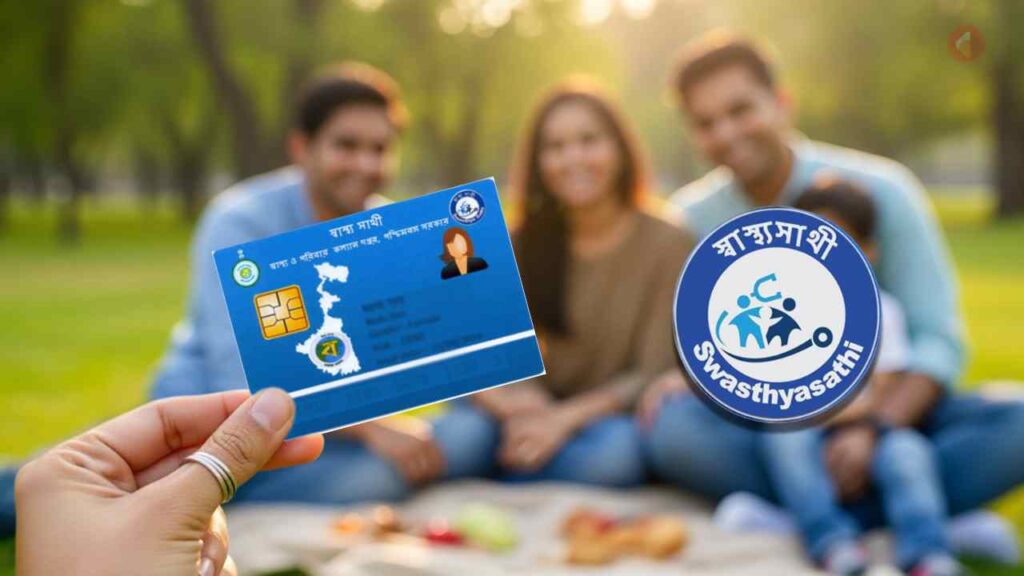
The move has sought to reverse a nine-year-old Swasthya Sathi scheme rolled out by the Trinamool Congress government in February 2017. Under the old scheme,
- Around 2.45 crore families can avail near-universal health coverage
- Beneficiaries and their families can avail a total cashless cover of ₹5 Lakh per year
- Pre-existing diseases are covered from the first day onward
- Smart cards are auto-renewed and issued in the name of the female Head of the family
- An empanelment committee approves and empanels hospitals through a transparent gradation system. Currently, 1500 hospitals within the state are listed under the scheme.
- SMS triggers notify beneficiaries of medical history or card-related updates
- The Swasthya Sathi app enables beneficiaries to raise queries or file grievances
According to Sharadwat Mukherjee, the Minister for Health and Family Welfare of West Bengal, the Ayushman Bharat scheme and MMSBY scheme will run alongside the Swasthya Sathi scheme for three months before being withdrawn in a phased manner. Under the national policy,
- Beneficiaries can avail up to ₹5 Lakh annual health coverage for secondary and tertiary hospitalisation
- No upper limit on the number of family members applies
- Pre-existing diseases will be covered from the first day on
- Pre-hospitalisation treatment (incl. diagnostic tests, cost of medicines, etc.) will be covered from three days before hospitalisation and up to 15 days after discharge
- Beneficiaries will be able to avail benefits in 1,930 hospitals within the state and 40,000 empanelled hospitals across the country
All senior citizens above the age of 70 and frontline workers (ASHA, AWW, and AWH) are automatically included as beneficiaries.
Parallel Run for All Three Schemes
To ensure a smooth transition and access to health benefits, the Health Department has provided empanelled hospitals with a Standard Operating Procedure (SOP).
Beneficiaries listed in the Ayushman Bharat databases or verified as PM-JAY cardholders through the Swasthya Sathi Transaction Management System will be treated under the WB PM-JAY scheme itself. Patients with an existing Ayushman Bharat card will therefore be directly transferred to the new scheme.
If e-KYC is missing, hospital staff will initiate verification through the NHA portal. Patients missing from the National Food Security Act (NFSA) records will be redirected to MMSBY. In both situations, treatment will continue under the Swasthya Sathi scheme. Patients with pending PM-JAY card approvals will also continue to receive treatment under the Swasthya Sathi scheme.
How to Apply & Get Your WB PM-JAY Card
Before the transition period ends and the Swasthya Sathi scheme is formally withdrawn, eligible families in West Bengal can apply for the Ayushman Bharat health card.
- Applicants need to check their eligibility under the PM-JAY
- If eligible, log in to the national portal through the correct Aadhaar-linked mobile number
- Select the right sub-scheme and district
- Provide the right details asked by the portal
- Complete the authentication process by verifying e-KYC and submit the application
- Once approved, the applicant can download their digital Ayushman Bharat card
Patients or individuals exploring health insurance for the first time can seek detailed guidance on MyRupia. Understand what adequate coverage entails and which type of health insurance serves you and your family best through independent expert guidance.
Disclaimer: This MyRupia article is for informational purposes only and is based on publicly available government, regulatory and industry sources. It should not be treated as investment, financial, tax, insurance, or legal advice. Information, examples, market data, and expert views mentioned in the article may change over time and should not be considered a recommendation to buy, sell, invest in, or surrender any financial product. Readers should evaluate their individual circumstances and consult a qualified financial professional before making decisions.