

A base health policy may not be enough to cover hospital bills from a serious illness or surgery if they exceed the sum insured. Top-up and super top-up plans are designed for this gap, and both belong to the wider category of health insurance coverage & add-ons. The two look alike, yet the way each applies its deductible can change a policyholder’s out-of-pocket costs.
This guide explains how each plan works, how they differ, which IRDAI rules and tax provisions apply and what to check before buying.
What Are Top-Up and Super Top-Up Health Insurance Plans?
Top-up and super top-up plans are health insurance policies that start paying once eligible medical expenses exceed a chosen deductible. They provide higher hospitalisation cover at a lower premium than a larger base policy, which is why health insurance coverage & add-ons of this type are widely discussed in India.
A deductible is the amount covered up to which the insurer does not pay under a top-up or super top-up facility, subject to how that particular policy defines the deductible. Both plan types are regulated by IRDAI, and terms differ across insurers.
Key terms used in these plans:
- Deductible: The amount that must be met before the add-on pays.
- Sum Insured: The maximum amount the add-on pays in a policy year.
- Base Policy: The primary policy, whether individual, family floater or employer-provided.
Note: A top-up or super top-up is generally issued as a separate policy with its own premium, terms and waiting periods.
How Does a Regular Top-Up Plan Work?
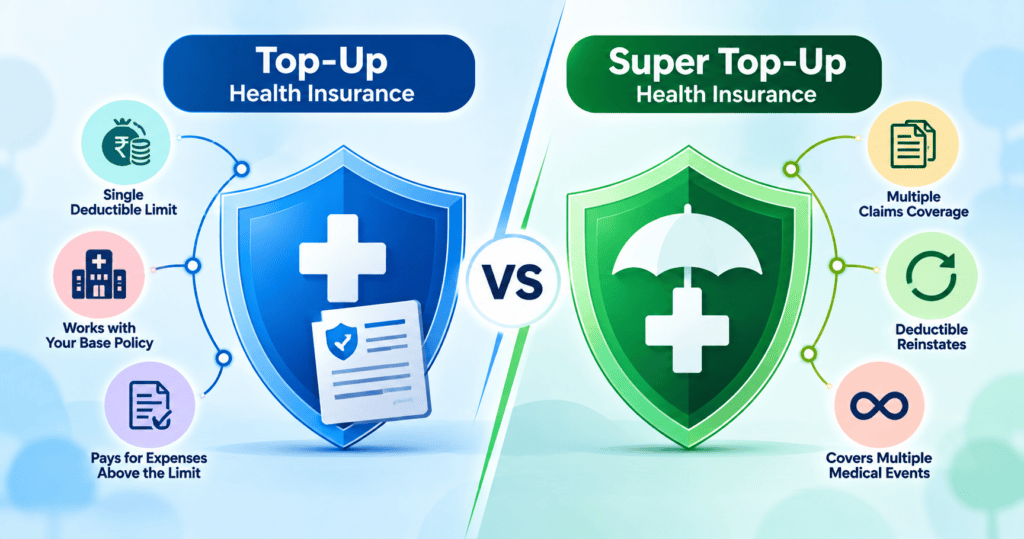
A regular top-up plan is a health insurance add-on that applies its deductible separately for each hospitalisation. The insurer pays only when a single claim exceeds the deductible, covering the excess up to the top-up sum insured. Bills below the threshold are not added together.
Consider a ₹5 lakh deductible with a ₹20 lakh top-up sum insured:
- One ₹8 Lakh Hospitalisation: The top-up pays ₹3 lakh.
- Two Hospitalisations of ₹3 Lakh and ₹4 Lakh in One Year: The top-up pays nothing, as neither bill exceeds ₹5 lakh.
This per-claim structure is the main limitation of a regular top-up. Those with repeated admissions may find that health insurance coverage & add-ons based on a per-claim deductible provide less coverage than expected.
How Does a Super Top-Up Plan Work?
A super top-up plan is a health insurance add-on that applies an aggregate deductible across all claims in a policy year. Once the total eligible medical expenses exceed the ₹5 lakh deductible, the super top-up plan’s payment begins. It covers eligible expenses above the deductible, up to the ₹20 lakh sum insured.
For example, suppose you have three claims in one year:
- ₹3 lakh
- ₹4 lakh
- ₹6 lakh
If all ₹13 lakh is eligible under the policy, the amount above the ₹5 lakh aggregate deductible would be ₹8 lakh, subject to the policy terms and sum insured.
Note: These examples assume that all expenses are eligible, there are no sub-limit reductions, and the deductible is met through the base policy or your own spending. Actual settlements follow policy wording.
This aggregate structure can be useful when a policyholder has multiple hospitalisations in a policy year.
What Are the Key Differences Between Top-Up and Super Top-Up Plans?
The main difference is how the deductible is measured. A regular top-up checks each claim individually, while a super top-up totals all claims in a policy year. Premiums and availability may also differ between these health insurance coverage & add-ons, as the table below shows.
The table compares both plan types on key parameters:
| Basis | Regular Top-Up | Super Top-Up |
| Deductible measured | Per hospitalisation | Aggregate for the policy year |
| Multiple claims in a year | Each claim assessed alone | Claims are combined |
| Payout trigger | Single bill above deductible | Total eligible expenses above deductible |
| Premium | Generally lower | Generally somewhat higher; varies by insurer, age and deductible |
| Availability | Varies by insurer | Varies by insurer |
Verdict: A super top-up may be more suitable for those seeking coverage across multiple admissions in a year, while a regular top-up may be more suitable for those primarily concerned about a single high-cost hospitalisation.
What Do These Health Insurance Coverage & Add-ons Usually Cover and Exclude?
Top-up and super top-up plans usually cover hospitalisation expenses above the deductible, including:
- Room rent
- Surgery
- Doctor fees
- Diagnostic tests
- Medicines
Note: Each product’s policy wording should be reviewed carefully, as exclusions, waiting periods and sub-limits may apply.
Features commonly seen across these plans:
- Pre- and Post-Hospitalisation Expenses: Many plans cover these for a defined number of days.
- Day-Care Procedures: Covered when listed in the policy.
- Maternity: Many plans do not include it.
- Exclusions: Cosmetic treatment and other standard exclusions listed by the insurer.
- Waiting Periods: Specific illnesses and pre-existing diseases may have waiting periods.
Which IRDAI Rules Apply to Top-Up and Super Top-Up Plans?
The IRDAI Master Circular on Health Insurance Business, dated 29 May 2024, sets requirements for health insurance policies. Important provisions include a 30-day free-look period for these health insurance plans, a 60-month moratorium period and a maximum 36-month waiting period for pre-existing conditions.
Top-up and super top-up policies are subject to the applicable IRDAI health-insurance framework. Some general provisions relevant to add-on buyers:
- Pre-Existing Disease Waiting Period: The waiting period can be up to 36 months under the 2024 framework. The period was reduced from 48 months.
- Moratorium: After 60 continuous months, claims generally cannot be challenged for non-disclosure or misrepresentation. This rule does not apply in cases of proven fraud.
- Free-Look Period: 30 days.
- Entry Age: There is no maximum entry age prescribed by IRDAI for health insurance.
Note: A new add-on policy generally starts its waiting periods unless it is a continuation or portability case. Policy documents and the IRDAI website should be checked for exact terms.
Are Top-Up Premiums Eligible for Tax Benefits?
Premiums paid for top-up and super top-up plans may qualify for a deduction under Section 80D of the Income Tax Act, 1961. This deduction, when eligible, is now covered under Section 126 of the Income Tax Act, 2025, for the tax year 2026-27. The deduction is available only under the old tax regime and is subject to certain limits.
Limits generally applicable are:
- Self, Spouse and Dependent Children: Up to ₹25,000 (₹50,000 if the insured person is a senior citizen).
- Parents: An additional ₹25,000 (₹50,000 if a parent is a senior citizen).
- Overall Ceiling: Up to ₹1 lakh where both the taxpayer and parents are senior citizens.
- Preventive Health Check-Up: Up to ₹5,000, included within these limits.
- Payment Mode: Cash payments of the premium are not eligible.
The limit applies to combined premiums, so a base plan and these policies together share the same cap.
Individual and family floater health insurance premiums have also been exempt from GST since 22 September 2025, following the 56th GST Council meeting. Group health insurance policies continue to attract 18% GST.
Note: Tax rules can change. A chartered accountant can confirm the position for a specific situation.
Who May Find Each Plan Better Suited?
Suitability depends on the base cover, budget, family profile and health history. The choice should also take into account how the deductible works, the expected number of claims and the policy’s terms.
Situations where each option is often considered:
- Base Cover of ₹5-1and which documents the base 0 Lakh in a Metro City: A deductible matched to the base sum insured is commonly used, so the add-on starts where the base policy ends.
- Reliance on Employer Cover: The deductible can be aligned with a personal base policy, since employer cover can end on a job change.
- Family with Older Members: Repeated admissions are more likely, so an aggregate deductible may be worth comparing.
An extremely high deductible can increase out-of-pocket costs. Therefore, these plans should not be considered a replacement for a base health insurance policy.
What Should Be Checked Before Buying?
Before buying a top-up or super top-up, you should carefully review the deductible, sum insured, waiting periods, exclusions, renewal terms and claim process. A fair comparison of health insurance coverage & add-ons can be made across insurers using the same deductible.
A useful checklist:
- Deductible Level: Confirm whether it is per claim or aggregate, and whether it is met through the base policy or personally.
- Sum Insured: Compare it with medical costs in the city and at the hospitals typically used.
- Waiting Periods: Check the waiting periods for pre-existing diseases and specific illnesses.
- Sub-Limits: Look for room-rent caps, disease-wise limits and co-payments.
- Claim Documents: Understand which documents the base insurer must provide for the add-on claim.
- Renewal Terms: Check premium changes with age and renewal conditions.
Reading the policy wording and using the 30-day free-look period can help avoid surprises.
Conclusion
Top-up and super top-up plans are types of health insurance coverage & add-ons that mainly differ in how they apply the deductible. A regular top-up applies the deductible to each hospitalisation, while a super top-up considers the total eligible expenses for the policy year.
The more suitable option depends on your existing cover, budget, family needs and policy terms. Before buying, compare the coverage, waiting periods, exclusions and other policy conditions to choose a plan that suits your needs.
Frequently Asked Questions
Q1. Can a super top-up be bought without a base policy?
Some insurers allow such purchases as separate policies. In that case, the deductible is borne personally before the plan pays. Terms differ across insurers, and smaller claims would fall entirely on the policyholder, so a base policy is often kept alongside.
Q2. Is a super top-up always better than a regular top-up?
Not necessarily. A super top-up’s aggregate deductible can respond to multiple claims in the same policy year, but premiums, availability and terms differ. A comparison of quotes at the same deductible and sum insured helps show which structure may be better suited.
Q3. Do top-up plans have their own waiting periods?
Yes, these plans typically have their own waiting periods. Pre-existing diseases may have waiting periods of up to 36 months under IRDAI rules, while specific illnesses may have shorter periods. Exact durations vary by insurer and policy.
Q4. Can the base policy and the add-on be from different insurers?
Generally, yes. The base policy and add-on can be with different insurers, subject to the applicable policy terms. The add-on insurer usually asks for hospital bills and settlement details from the base insurer. Buying both from one insurer may simplify paperwork, although the choice depends on terms and premiums.
Q5. What happens to an add-on if employer cover ends?
A plan with a deductible set against employer cover may have a gap if that cover ends. The deductible would then be borne personally until a new base policy is in place. Setting the deductible against a personal policy can reduce this risk.