

What Is a Medical Insurance Appeal?
A medical insurance appeal is an official effort to get an insurer to reconsider a rejected or partially approved claim. It gives the insured a chance to bring forward new documents or rectify mistakes that the insurance company may have believed were the reasons for denying the coverage. In India, all insurance companies operate under the supervision and direction of the Insurance Regulatory and Development Authority of India (IRDAI) – a government body in charge of the entire insurance sector. Among other things, it also defines the complaint handling process to be followed by the insurers so that the insured gets a fair chance to dispute the claim decisions. Appeals could be getting a review within the company or, if that doesn’t solve the problem, then taking it to the independent authority for resolution.Common Reasons for Claim Denial
It is paramount that you have a handle on why claims get denied before you try to appeal a medical insurance denial. That is because the reason will determine how you go about the appeal. Typical causes include:- The treatment was not medically necessary – This could mean that the insurer may not view the provided treatment as one that was crucial
- Policy exclusions – These are specific situations where the insurance does not cover the risk
- Pre-existing condition waiting period – The health insurance policy has this clause, whereby claims cannot be made in respect of a pre-existing condition for the waiting period only
- Incomplete documentation – Sometimes the claimant may forget to submit a full set of invoices, medical reports, discharge certificates, etc.
- Incorrect coding or billing errors – These refer to hospital or medical documentation errors
- No prior authorisation – This means that the necessary approvals were not obtained before carrying out the treatment
Key Documents Required Before Filing an Appeal
A well-documented appeal strengthens your case. You should gather all relevant records before initiating the process. Important documents include:- Policy document and schedule
- Claim form and rejection letter
- Hospital bills and payment receipts
- Discharge summary and prescriptions
- Diagnostic reports and medical records
- Doctor’s letter explaining medical necessity
- Communication records with the insurer
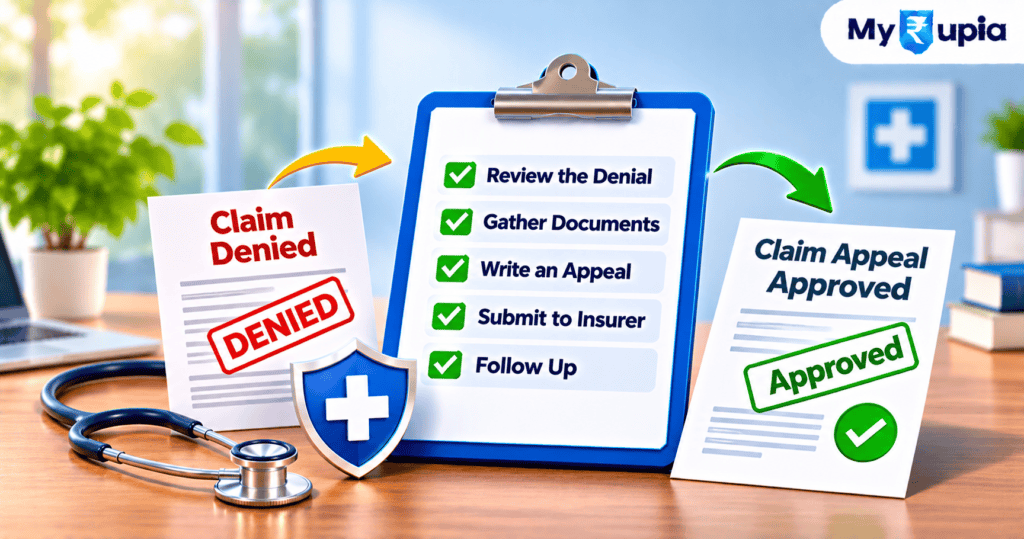
Step-by-Step Guide to Appealing a Medical Insurance Denial
Appealing an insurance denial step by step means you have to start from the basics and make each step count to ensure the best outcome for your goalStep 1: Review the Denial Notice Carefully
The first step is to carefully read the rejection letter from your insurance company or the Explanation of Benefits (EOB). The reason for denial is normally written on these letters. One of the main exercises will be to identify whether the issue is related to your eligibility, documentation, or policy terms. You will need this information in order to direct your appeal properly.Step 2: Check Your Policy Terms Thoroughly
You will find it useful to pull out your policy documents and read them while comparing them with the conditions stated in the rejection letter. Here are a few things you should highlight:- What kinds of coverage are included and excluded?
- Are there any waiting periods?
- Any sub-limits and caps;
- How a “medical necessity” is defined.
Step 3: Consult Your Doctor or Hospital
Doctors and hospital staff can be very helpful in solidifying your claim. Here are some things you could ask for:- A complete explanation of why the treatment was medically necessary;
- More detailed information about your treatment.
- Rectification of any possible errors on the billing (if it is the case).
Step 4: Draft a Clear Appeal Letter
Writing an appeal letter is more of a job, doing an exercise with facts and structuring your arguments in order to convince the reader. Things that make a good letter:- Your policy number, along with the claim details
- The date when you received the treatment
- The reason why your claim was denied
- Your explanation of why your claim should be approved
- Documents being attached
Step 5: Submit an Internal Appeal
You will be expected to submit your appeal to the insurer’s grievance redressal unit. Most insurance companies accept appeals submitted by mail, online portals, or physical forms. Regulatory standards normally state that appeals should be filed within a reasonable period after the denial (usually 15-30 days, depending upon the insurer’s policy). Make sure to keep one (or more) copies of your appeal and all related documents in case you need to refer to them later.Step 6: Track and Follow Up Regularly
After submission, monitor the progress of your appeal. Maintain a record of:- Dates of communication
- Reference numbers
- Names of representatives
Internal Appeal Process Explained
The internal review is the first stage of resolving your claim dispute. The insurer reassesses your case using additional documents and explanations provided. According to IRDAI guidelines, insurers are required to resolve grievances within 15 days of receiving a complaint. If further investigation is needed, they must inform you of the delay and expected resolution timeline. The outcome may result in:- Approval of the claim
- Partial settlement
- Rejection with explanation
External Escalation Options In India
In case your appeal inside doesn’t get you anywhere with the issue, you can contact some of the independent authorities. This is a crucial step in the whole process of how to appeal a medical insurance denial.1. Insurance Ombudsman
The Insurance Ombudsman is the one who takes care of disputes relating to the settlement of claims up to a certain monetary limit. Additionally, it is a no-cost and very accessible option for policyholders. You can lodge your complaint at the Ombudsman, but not later than one year after the insurer’s last reply is received by you.2. IRDAI Grievance Redressal (IGMS)
With the Integrated Grievance Management System (IGMS), policyholders have an opportunity to register their complaints with the regulator directly. This service also serves to keep a track of the complaints made and ensures that insurance companies are held accountable.3. Consumer Court
When disputes remain unsettled even after the above methods, one can approach the consumer courts, which have been set up under the Consumer Protection Act for handling cases. This mode of redressal can be comparatively slow, but it results in a legal remedy.Timelines and Deadlines You Should Know
In the scenario of appealing a medical insurance denial, acknowledging time-bound actions is a must. If you miss deadlines, you might lose the strength of your appeal. Points requiring your attention are:- The appeal should normally be lodged within 15 to 30 days post denial
- The insurer is expected to respond within 15 days (as per the guidelines of IRDAI)
- In case of a complaint to the Ombudsman, it should be made within 1 year, counting from the time of the final insurer response
Tips to Improve Your Appeal Success Rate
A plan that is well thought out can get you faster approval. Some handy tips are:- Be precise in your denial reason rebuttal and avoid generalities
- Quote policy language as much as possible and point out relevant clauses and definitions
- Double-check if the set of documents you are submitting is complete, since missing ones may not just delay but potentially deny the decision
- Consistency is the key: make sure that all records are the same
- Regularly follow up to keep communication going
Risks and Limitations of the Appeal Process
While appeals offer a structured remedy, they are not always successful. It is important to consider potential limitations.- Time-consuming process: Reviews and escalations may take weeks or months
- Documentation dependency: Lack of evidence can weaken your case
- Policy constraints: Some exclusions cannot be overridden
- Emotional stress: Ongoing disputes may be challenging
Conclusion
Understanding how to appeal a medical insurance denial enables you to respond effectively rather than accepting a rejection without review. A structured process, supported by accurate documentation and policy alignment, can improve your chances of a favourable outcome. Timely action, consistent follow-ups, and proper escalation play a critical role in resolving disputes. If needed, external authorities such as the Ombudsman or regulatory bodies provide additional support mechanisms.Frequently Asked Questions
Q1. How long does it take to appeal a medical insurance denial in India?
The internal appeal process usually takes up to 15 days as per IRDAI guidelines. However, complex cases may require additional time. External escalations, such as Ombudsman complaints, may take several weeks to months.
Q2. Can a denied claim be approved after appeal?
Yes, claims can be approved after review if sufficient evidence is provided. Approval depends on policy terms, medical justification, and completeness of documentation submitted during the appeal.
Q3. Is there a fee for filing an insurance appeal?
Internal appeals with insurers are generally free of cost. Filing a complaint with the Insurance Ombudsman is also free. However, legal proceedings in consumer courts may involve certain expenses.
Q4. What happens if my appeal is rejected again?
If your internal appeal is rejected, you can escalate the matter to the Insurance Ombudsman or IRDAI. You may also consider approaching consumer courts for further resolution.
Q5. What is the most common reason for claim denial?
Common reasons include incomplete documentation, policy exclusions, and lack of medical necessity. Identifying the exact reason is essential for preparing a strong and relevant appeal.