

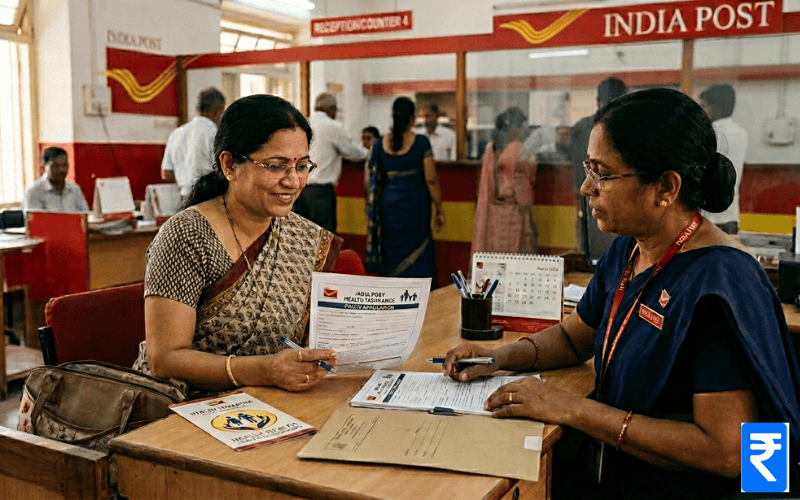
Health is the most important asset for an individual. In India, healthcare has become both a priority and a challenge. However, the costs of medical care are increasing significantly. It is making medical treatment unaffordable for many. In the same way, financial protection against critical illnesses is also becoming difficult to access. This is where post office health insurance comes in. It has emerged as an accessible route for individuals and many families. This has become a major option for individuals who are seeking basic or supplemental health cover through a familiar and widespread public sector channel.
This article provides a detailed and factual explanation of post office insurance, its plans and benefits, limitations and also the process of enrollment. It will help you make informed decisions about the plans and what to choose based on your financial needs and goals. Before going into the plans and their benefits, let us deep dive into post office health insurance.
Table of Contents
- What is Post Office Health Insurance
- Why Post Office Health Insurance Matters
- Importance of Post Office Health Insurance
- Accessibility
- Trust
- Assistance with Paperwork
- Coverage of Pre- and Post-Hospitalisation Expenses
- Types of Post Office Health Insurance Plans
- Group Accident and Hospital Cash Plans
- Express Health Plans
- Super Top-up Insurance
- Comprehensive Private Insurer Products
- Features of Post Office Health Insurance Plans
- Eligibility for Post Office Health Insurance
- How to Buy Post Office Health Insurance
- Offline via Post Office
- Online Process
- Benefits of the Post Office Health Insurance Plan
- Limitations
- Conclusion
- Frequently Asked Questions (FAQs)
What is Post Office Health Insurance
Post office health insurance is a health insurance plan that is offered through post offices in India. You can get this through the India Post Payments Bank (IPPB), owned by the Department of Posts. It is under the Government of India. It is not simply a standalone insurance product.
- The postal network acts as an agent to help the customers buy health insurance from private insurance companies.
- All the insurance cover, terms, and payouts are managed by the insurance company itself.
- The Post Office’s role is to help distribute these insurance products and, in some cases, facilitate the premium collection.
Thus, this health insurance acts as a distribution body for private insurance products. It leverages the reach of postal access points across India. This makes it easier for rural and urban Indians to access insurance solutions.
Why Post Office Health Insurance Matters
As healthcare expenses are growing, it is important for individuals and families to plan for potential medical costs.
Here are some reasons why this health insurance matters:
- Healthcare Costs Are Rising: Routine treatments and hospital stays can add expenses
- Financial Safety Net: A health insurance policy helps you to manage unexpected medical bills and avoid using your savings
- Tax Benefits: Premiums paid for health insurance may qualify for tax deductions under Section 80D of the Income Tax Act.
Importance of Post Office Health Insurance
There are several reasons for Indians to choose post-office health insurance. Some of them include:
Accessibility
The Indian postal network is one of the largest networks in the country. It is present in most towns and villages. This makes it easy for people in remote areas to know about the insurance policy. They can also buy an insurance plan at a physical post office branch. This reduces the barriers for those who are not digitally savvy.
Trust
Many trust the post office as it is backed by the government. They have a very long history of service. It also helps the private insurers. For individuals who find private insurance companies confusing, the post office channel often feels more approachable.
Assistance with Paperwork
The staff in the post office, including the postmen, often help the customers fill out forms and understand policy terms and conditions. This is more suitable in areas where agent services may be limited. This way, it is useful and important for private insurers as well.
Coverage of pre- and post-hospitalisation expenses:
Not only mainstream medical costs, but also the cost of OPD (out-patient department) expenses, and diagnostic tests have also risen significantly. This has made it even more important for individuals to buy a health insurance policy.
Types of Post Office Health Insurance Plans
There are several types of plans. Each plan is designed for different purposes and has different premiums. It depends on the insurer partner. Some types of plans include:
- Group Accident and Hospital Cash Plans
These provide coverage primarily for accidents, disability and death caused by accidents.
- These plans cover accidental death and permanent disability up to Rs. 10 lakh
- These plans have premiums of 299/399.
- Some versions of these plans include education assistance, daily hospital cash and other allowances.
- Higher-tier plans also include educational allowances.
- Express Health Plans
These are simple health plans that cover hospitalisation costs and, in some cases, accidental benefits too.
- These are issued via a partnership between IPPB and private health insurers.
- There is an annual premium of 755. The coverage can be up to 15 lakh.
- They generally operate as top-up plans.
- Super Top-up Insurance
- IPPB also facilitates super top-up health plans.
- They offer higher sums at relatively lower premiums.
- However, they require an underlying base plan or health insurance.
- Comprehensive Private Insurer Products
Through the post office health insurance, customers can also buy standard, privately underwritten health insurance plans. Some of them include:
- TATA AIG Health Plans: Offer hospitalisation cover
- Bajaj General HealthCare Plans: Cover inpatient expenses and ambulance charges
Features of Post Office Health Insurance Plans
Although the plans are offered by different private insurers, they all have certain common characteristics. Some features of these insurance plans include:
Cashless Hospitalisation
Customers can use cashless services at network hospitals that are offered by partner insurers with established hospital networks.
Renewability
Similar to standard health insurance policies, these policies typically offer annual renewal. For some products, a lifetime renewal is also available.
Waiting Periods
Most plans have waiting periods for pre-existing conditions and certain diseases. It is similar to other health insurance policies.
Standard Coverage Components
Common benefits include hospitalisation, surgery, day care procedures and in some cases OPD expenses as per policy terms.
Eligibility for Post Office Health Insurance
The eligibility criteria depend on the insurer and policy. However, the general features of post office health insurance include:
- Indian Citizens aged approximately 18 to 65 years.
- Some accident plans allow the inclusion of dependents like children.
- A valid IPPB account or postal banking relationship may be required.
You must always read the policy terms and conditions before purchasing. You can find the clear eligibility criteria in the policy documents.
How to Buy Post Office Health Insurance
You can enrol in this health insurance either offline or online:
Offline via Post Office
The offline process of purchasing a post office health insurance includes:
- Visit the nearest post office
- Ask for details on the health insurance plans
- Fill out the form with accurate details
- Submit the necessary documents and identity proofs
- Pay the premium amount as directed
- Receive your insurance documents immediately or by post
Online Process
The online process of purchasing a post office health insurance includes:
- Request quotes through the insurer’s portal
- Complete the E-KYC
- Select the coverage options
- Pay the premium online
- Download the policy documents
Not all plans support full online enrollment through the postal channel. You need to ask the branch staff if you are unsure.
Benefits of the Post Office Health Insurance Plan
Some benefits of the health insurance plan include:
- Wide Accessibility: The post office can be accessible to every individual living in rural areas of India. The sheer size of India’s postal network ensures that insurance products are accessible to remote areas as well.
- In-Person Assistance: At post offices, many customers get help with forms, explanations and enrollment procedures for the plans.
- Transparent Pricing: The insurance company decides the premium amount. The plan is submitted to IRDAI as per the rules. This helps make sure the pricing follows proper regulations.
- Additional Benefits: Some plans allow family members to be included in the coverage. In this way, there are many additional benefits provided to the insured individual.
Limitations
Some limitations of this health insurance include:
- No Underwriting by Post Office: The Post Office is the distributor of the policy. It does not handle any claim disputes. Claim disputes should be dealt with by the insurer or TPA only.
- Limited Choices: The choices with partners of post offices are limited. There are better options available with direct insurers, insurance brokers and agents.
- Product Limits: Certain plans might also have sub-limits and waiting periods. So, one should read the product terms carefully.
Conclusion
A post office health insurance plan is a great option for individuals living in remote areas. They get access to health insurance where sales channels are difficult to reach. The Post Office helps people get health insurance more easily.
They offer different benefits to the insured individuals. But the Post Office only sells the policy. It does not manage claims. If there is any problem with a claim, you have to contact the insurance company, not the Post Office.
So, it is very important to read and understand all the terms and conditions before you buy a policy.
Frequently Asked Questions (FAQs)
1. Is post office health insurance a government-run insurance policy?
No. Post office health insurance policies are issued and underwritten by private insurers. The post office or India Post Payments Bank simply acts as a corporate agent to distribute these products.
2. Does post office health insurance cover pre-existing diseases?
Coverage for pre-existing diseases depends on the specific plan and insurer terms. Most comprehensive plans have a waiting period before covering pre-existing conditions, similar to standard health insurance.
3. Can I get cashless hospitalization with post office health insurance?
Cashless treatment is available only if the underlying insurer offers a network hospital facility for that policy. Not all plans include cashless services, so check before enrollment.
4. Do I need an IPPB account to buy post office health insurance?
For some plans, you may need a linked India Post Payments Bank (IPPB) account, especially those tied to premium savings accounts or bundled offers. Other plans may be available directly through post office channels without an account.
5. Can children be covered under post office health insurance plans?
Yes. Some plans allow adding family members, including spouse and children, subject to age and policy terms defined by the issuing insurer.