

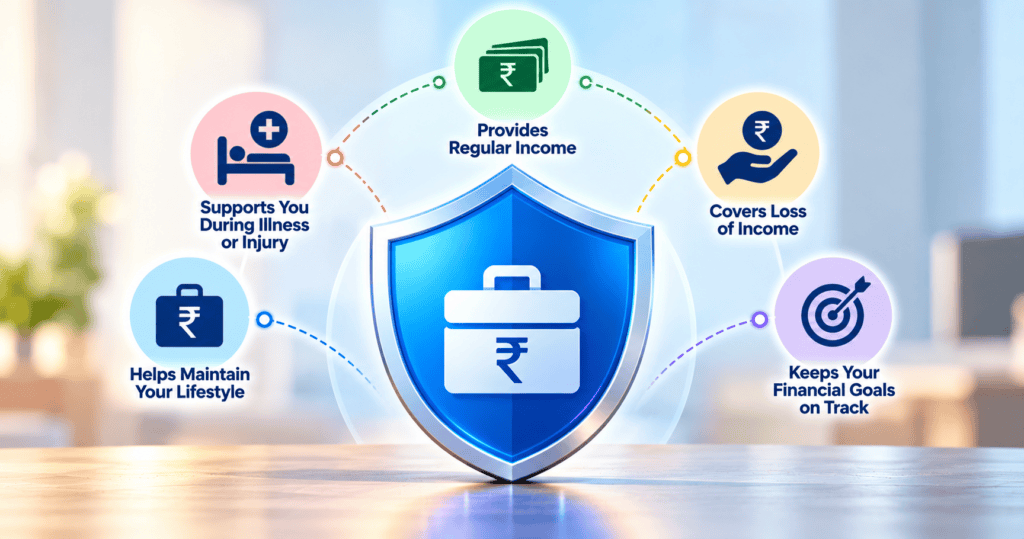
What Are Income Protection Plans?
Income protection plans are insurance or benefit arrangements that may provide financial support when a specified event affects an individual’s ability to earn or the financial security of their dependants. The term does not refer to one standard insurance policy in India. Insurance providers might be offering several income benefits to customers besides the standard life and disability insurance. These can include regular income, lump sum payment, or other forms of financial assistance if they qualify. The key difference between life insurance and disability benefits is that the former provides the benefit in case of death, whereas the latter covers financial loss due to a disabled state. Therefore, the policy wording matters more than the product name. It provides important clarification on:- What the policyholder is covered against
- What constitutes a disability and how it is defined
- What percentage of lost income the policy can cover
- How long the payments run; what the exceptions are, if any
- Under what circumstances the claim can be made.
Income Protection vs Health Insurance
Health insurance and income protection address different aspects of financial risk. IRDAI explains that health insurance products can cover medical expenses or provide defined benefits, depending on the type of policy. Insurers can also offer add-ons and riders to provide additional coverage. A hospitalisation policy, for instance, may help with eligible treatment costs. It does not automatically compensate for the salary a person may lose because illness prevents them from working.| Financial risk | Possible form of protection | Main purpose |
| Hospitalisation | Health insurance | Helps meet eligible medical expenses |
| Death of an earning member | Life insurance | Provides financial support to nominees |
| Qualifying disability | Disability cover or rider | Provides a defined benefit to the insured |
| Specified critical illness | Critical illness cover | Pays a predetermined benefit when the policy’s conditions are met |
| Employment-related sickness or disablement | ESIC benefits, where eligible | Provides statutory benefits under applicable conditions |
How Do Income Protection Plans Work?
Income protection is a type of insurance that replaces part of a person’s income if they suffer a serious illness or disability that prevents them from working. If it is a private cover, the payment comes into play when a condition is satisfied, for example, a person being completely disabled, not temporarily. The same logic applies to the diagnosis of a serious illness according to the terms and conditions of the policy. In the event of an illness or disability as covered under the policy, the person who purchased the policy or the person who is listed on it as the nominee makes a claim backed by documentary evidence. Then the insurance company analyzes the claim in light of the clauses of the policy, and the level of the benefit payable is decided. A benefit can be either paid as a one-off payment or as regular payments over a certain time. For example, HDFC Life states that its Income Benefit on Accidental Disability Rider can pay 1% of the rider sum assured monthly for 10 years after qualifying total permanent disability due to an accident. This is a product-specific feature, not a universal standard.Types of Income Protection Available in India
Several insurance products and statutory benefits can help address an income-related financial gap in India. However, each works differently, so the benefit should be assessed according to the risk it is designed to cover.Life Insurance With Income Benefits
Some life insurance products allow the death benefit to be paid as regular income to the nominee instead of entirely as a lump sum. The payment period and amount depend on the policy. This structure may help dependants manage ongoing expenses after the policyholder’s death, but it does not generally provide salary replacement if the policyholder becomes unable to work.Disability Benefits
Disability insurance or riders may provide a benefit after a qualifying disability. Policy definitions vary, with some covers focusing on total permanent disability and others addressing partial disability or specific impairments. A person’s inability to continue working does not automatically qualify for payment, making the policy’s disability definition and claim conditions important.Critical Illness Benefits
Critical illness policies generally provide a predetermined benefit after diagnosis of a specified illness, subject to the policy conditions. The payment may help manage financial pressures during serious illness, but it should not automatically be treated as salary replacement. Covered illnesses and eligibility requirements vary between products.Statutory Income-Related Benefits
Eligible employees covered under the Employees’ State Insurance scheme may receive sickness and disablement benefits subject to applicable requirements. The ESI Act provides for sickness payments and benefits arising from employment injury, including temporary and permanent disablement. ESIC states that Temporary Disablement Benefit is a periodic payment during certified absence caused by an employment injury. Therefore, existing statutory and employer benefits should be reviewed before considering additional private protection.Income Protection and Health Insurance Coverage & Add-ons
Health Insurance Coverage & Add-ons can be included in a broader risk management plan but do not substitute for loss of income. Health insurers can introduce products, add-ons, and riders, enabling the insured persons to make varied choices. The regulator also mandates a Customer Information Sheet, which is a summary of health insurance policies comprising such key elements as coverage, restrictions, sub-limits, deductibles, and waiting periods. Such a distinction plays a major role in evaluating life insurance assets. A health add-on might protect one from certain medical costs/events but does not necessarily mean one is compensated for lost earnings unless it is provided expressly by the insurance carrier.| Feature | Health Insurance | Health Add-on/Rider | Income or Disability Benefit |
| Primary purpose | Medical expense or defined health benefit | Adds specified protection | Addresses a defined financial or income-related risk |
| Trigger | Covered medical treatment or event | Event specified in add-on | Covered death, disability or other specified event |
| Payment | Depends on policy structure | Depends on add-on | Lump sum or periodic payment |
| Salary replacement | Not normally the primary purpose | Depends on product | May be provided for the covered event |
| Key documents | Policy wording and CIS | Add-on terms and CIS | Policy/rider wording |
Who May Consider Income Protection?
Income-related protection can be relevant when a household depends heavily on one person’s earnings. A prolonged interruption to that income may affect regular expenses even when medical costs receive separate coverage. People with significant financial commitments may also assess this risk. A home loan, children’s education, dependent parents or other recurring obligations can continue even when an earning member cannot work. Self-employed professionals and business owners may have a different protection gap from salaried employees. Their income may not include the same employer-provided benefits or paid leave arrangements. However, the need for additional insurance depends on existing resources. Employer benefits, savings, life insurance, health insurance, statutory benefits, and other assets can all affect the amount of additional protection required.What to Check Before Choosing a Plan
The premium should not be the only factor considered when assessing an income-related insurance benefit. The more important question is whether the policy responds to the financial risk that needs to be covered.Check the Covered Event
Start by identifying exactly what activates the benefit. Is it death, accidental disability, permanent disability, critical illness or another specified event? A policy that covers accidental permanent disability may not cover an inability to work caused by an illness. Similarly, a critical illness policy may only respond to conditions specifically listed and defined in the contract.Understand the Disability Definition
Disability terminology can have a major impact on a claim. Read whether the policy refers to total permanent disability, partial disability or another defined condition. Also check how the insurer determines whether the definition has been satisfied. The medical evidence and assessment requirements can differ between products.Check the Benefit Amount and Duration
A periodic benefit does not necessarily continue until retirement. It may operate for a fixed period. For example, the HDFC Life rider cited earlier specifies a 10-year payment period for its defined accidental total permanent disability benefit. Other products can have different payout structures.Read Exclusions and Waiting Conditions
Exclusions identify circumstances in which a benefit will not be payable. Waiting or qualifying periods can also affect when coverage begins or when a claim becomes admissible. For health insurance, IRDAI specifically highlights exclusions, sub-limits, deductibles and waiting periods as important information that should appear in the Customer Information Sheet.Compare It With Existing Protection
Before adding another policy, list the protection already available through an employer, statutory scheme or existing insurance. This can reveal both gaps and overlapping benefits. It also helps prevent the assumption that several policies necessarily provide the same type of financial protection.| Area to check | What to find out |
| Covered event | Which event triggers payment? |
| Disability definition | What level or type of disability qualifies? |
| Benefit amount | How much will be payable? |
| Payout period | For how long will payments continue? |
| Waiting period | Does any qualifying period apply? |
| Exclusions | Which situations are not covered? |
| Existing protection | What benefits already exist? |
| Claim requirements | Which documents and evidence are needed? |
How to Build a Financial Protection Strategy
Here is how to build a Financial Protection Strategy:- Assess your essential spending: Add up housing, food, utilities, education, loan repayments, and healthcare costs that will stay constant in an income interruption.
- Understand your financial risks: Think about how death, disability, temporary illness, and critical illness can interfere with your income and family finances.
- Check existing protection: Before getting another policy, get to know which benefits your employer is giving you through ESIC, existing health insurance, life insurance, disability, and emergency savings you have.
- Figure out the gap: After identifying what you already have and the money you have to pay, you will find it easier to identify the areas where more protection is needed.
- Get a regular update: Update your cover after major changes like marriage, children, new loans, employment, or a major change in income.
Limitations to Keep in Mind
Below are the limitations to keep in mind:- Conditions apply: Benefits are payable only when the event meets the policy or scheme’s definitions, exclusions and claim requirements.
- Coverage may be insufficient: A fixed benefit may not fully cover future expenses if household costs or financial commitments increase.
- Different risks need different covers: A disability rider may cover only defined disabilities, while health insurance generally covers eligible medical expenses rather than lost income.
- Policy terms matter: The payout amount, duration and exclusions should be reviewed alongside existing insurance and actual financial requirements.
- Regular review is important: Changes in income, expenses, family responsibilities or employment may require adjustments to the overall protection plan.
Conclusion
Income protection plans can help manage financial consequences arising from death, disability or certain serious illnesses. In India, however, income protection takes different forms. Life insurance, disability benefits, health insurance and statutory schemes such as ESIC address different financial risks and provide benefits under specific conditions. Before choosing cover, compare the covered event, disability definition, benefit amount, payout period, exclusions and existing protection. Health Insurance Coverage & Add-ons may address eligible healthcare expenses, while other benefits may support income-related needs. Reviewing these details can help identify genuine financial gaps and avoid unnecessary overlapping cover.Frequently Asked Questions
Q1. Is income protection a separate insurance category in India?
Not necessarily. Income protection is a broad term covering different insurance benefits, including life insurance income benefits and disability-related covers.
Q2. Does health insurance cover loss of salary during illness?
Health insurance generally covers eligible medical expenses, not lost salary. Income replacement depends on specific policy features or separate benefits.
Q3. What is a disability income benefit?
A disability income benefit provides periodic financial support when an insured person meets the policy’s defined disability conditions and eligibility requirements.
Q4. Can employees receive income-related benefits without private insurance?
Yes, eligible employees may receive statutory sickness and disablement benefits through the Employees’ State Insurance scheme, subject to applicable conditions.
Q5. What should be checked before buying income protection cover?
Check covered events, disability definitions, benefit amounts, payout duration, exclusions, qualifying conditions, claims requirements and existing employer or insurance protection.