

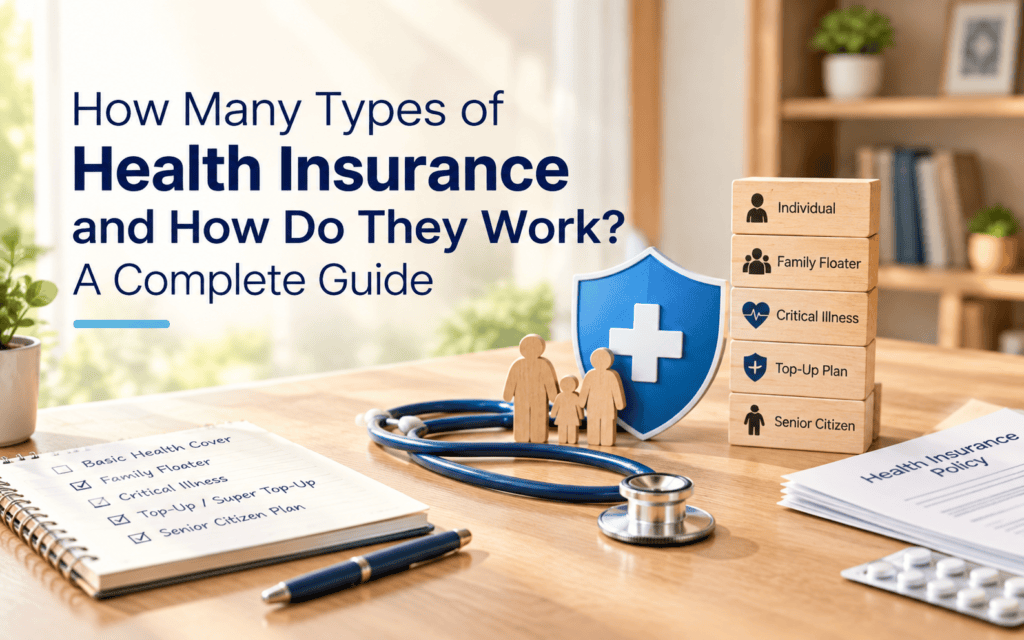
With healthcare costs in India rising steadily each year, knowing how many types of health insurance are available and which one suits your situation can make a real difference to how well-prepared you are when medical expenses arise. In India, there are nine main types of health insurance, each designed for a different need, age group, or health situation.
This guide walks through each one. Get to know about each plan type in detail: what it covers, who it suits, and what to check before buying.
What is Health Insurance
Health insurance is a contract between you and an insurance company. In exchange for a regular premium payment, the insurer agrees to cover specified medical expenses such as hospitalisation, surgery, critical illness, or a combination of these.
Who Regulates Health Insurance in India? All health insurance products sold in India are regulated by the Insurance Regulatory and Development Authority of India (IRDAI). IRDAI sets minimum standards for coverage, claim settlement timelines, and policyholder rights, ensuring that insurers operate within a defined framework of accountability. |
Some plans also cover smaller treatments that do not need long hospital stays, as well as expenses before and after hospitalisation. This helps you to reduce the financial burden when you have medical emergencies.
Why Health Insurance is Important
According to industry reports, medical inflation in India has been running at approximately 13% per year significantly higher than general inflation. A routine hospitalisation at a private facility in a metro city can cost anywhere from ₹50,000 to several lakhs, depending on the nature of the condition and the hospital. For many, this can be very hard to manage suddenly.
Health insurance helps you in the following ways:
- Protects savings: You do not need to use all your savings for your medical bills
- Gives financial support: It reduces the stress of arranging money during a health emergency
- Provides cashless treatment: Many hospitals accept direct payment from insurers
- Encourages early treatment: You are less likely to delay going to the doctor because of cost
- Tax benefit: Premiums paid for health insurance qualify for a deduction under Section 80D of the Income Tax Act
Section 80D Tax Benefit You can claim a deduction of up to ₹25,000 per year on health insurance premiums for yourself, your spouse, and dependent children. If you also pay premiums for your parents, an additional deduction of up to ₹25,000 is available or ₹50,000 if your parents are senior citizens. This makes health insurance both a protection tool and a tax-planning instrument. |
Understanding Different Types of Health Insurance in India
Health insurance plans in India are broadly grouped into nine types based on who they cover, what conditions they address, and how benefits are paid out. While individual insurer offerings may vary, these categories provide a reliable framework for comparison.
These include:
| Plan Type | Best For |
| 1. Individual | Single person |
| 2. Family floater | Families |
| 3. Senior citizen | Age 60+ |
| 4. Critical illness | High-risk individuals |
| 5. Group | Employed individuals |
| 6. Top-up / Super top-up | Those with existing cover |
| 7. Personal accident | High physical risk |
| 8. Disease-specific | Known health risks |
| 9. Maternity | Expecting families |
Each type is made for a different situation. Some plans help you pay for regular hospital bills like room charges and doctor fees. Others are made to give support during serious illnesses or specific conditions. So, choosing the right type depends on your age, health needs and family situation.
Let us look at these plans in more detail:
1. Individual Health Insurance
If you are looking for coverage that is entirely your own with a dedicated sum insured that no one else can dip into, an individual health insurance plan is the starting point. It covers only one person. You buy a policy with a fixed sum insured. This is the maximum amount the insurance company will pay. Individual health insurance plans in India are typically available with sum insured options ranging from ₹2 lakh to ₹1 crore or more. Premiums vary based on age, health profile, and the sum insured chosen a healthy 30-year-old may pay between ₹6,000 and ₹15,000 annually for a ₹5 lakh plan.
If you need any kind of treatment, the insurer pays your medical bills up to what is needed. If your expenses are higher than the sum insured, you have to pay the extra amount yourself.
Features:
- Covers only the insured person
- Premium depends on age and health
- The sum insured is not shared
Who should consider it:
- People who want personal coverage
- Individuals with specific health needs
2. Family Floater Health Insurance
For families looking to consolidate their health cover under a single policy rather than buying separate plans for each member, a family floater plan offers a practical and often more affordable alternative. This plan covers your whole family under one policy. In this plan, a single sum insured is shared by all family members. If one person uses some money for treatment, the remaining amount can still be used by others in the same year.
Features:
- Covers spouse, children and sometimes parents
- Lower premium than buying separate policies
- One shared cover for all members
Important consideration: Since all family members share a single sum insured, a large claim by one member can exhaust the cover for the entire family in that policy year. Families with older members or known health conditions may want to consider a higher sum insured or supplement with individual policies.
Consider this plan if:
- Families with young and healthy members. This is where the likelihood of multiple large claims in the same year is lower. Families with elderly parents or members with chronic conditions may find individual policies or a hybrid approach more suitable.
- People who want a simple and cost-effective plan
3. Senior Citizen Health Insurance
As healthcare needs intensify with age, standard health plans may not provide adequate cover for senior citizens. Plans designed specifically for older adults address this gap with features tailored to age-related medical requirements. This plan is made for people above 60 years old. As people grow older, their health needs usually increase and medical treatments can become more frequent and expensive. This type of insurance is made to support those needs and reduce the financial burden.
Features:
- Higher premium due to higher risk
- Covers age-related illnesses
- May include regular health check-ups
Co-payment requirement: Most senior citizen health insurance plans in India include a mandatory co-payment clause, typically 10% to 30% of each claim amount. This means the policyholder pays a portion of the hospital bill themselves. It is important to compare co-payment terms across plans, as they affect the actual out-of-pocket cost during hospitalisation.
This plan is for:
- Senior citizens
- Families planning coverage for parents
IRDAI Update In recent years, IRDAI has directed insurers to remove upper age limits on health insurance entry, making it possible for older individuals even those above 65 or 70, to purchase new health policies. However, premiums for older entry ages are significantly higher and co-payment requirements may apply. |
4. Critical Illness Insurance
Critical illness insurance works differently from a standard health plan. Rather than reimbursing your hospital bills, it pays you a fixed lump sum amount on diagnosis of a specified serious illness regardless of your actual treatment cost. You can use this money for treatment, recovery, or to cover income lost during the illness. This plan covers serious diseases. If you have any serious diseases, you get a lump sum amount. This amount can be used for your treatment or other expenses.
Critical illness plans in India typically cover between 10 and 36 specified conditions, depending on the insurer and plan. More comprehensive plans cover a wider list including organ failure, paralysis, major burns, and certain neurological conditions at a higher premium. Common illnesses covered:
- Cancer
- Heart attack
- Kidney failure
- Stroke
Features:
- One-time payment
- Not linked to hospital bills
- Fixed list of diseases
- Survival period: Most critical illness policies in India require the policyholder to survive for a specified period, typically 30 days, after diagnosis before the lump sum is paid.
Who should consider it:
- People with a family history of serious diseases
- Those wanting extra protection
5. Group Health Insurance
If your employer provides health insurance as part of your benefits package, you are covered under a group health insurance plan. It helps cover medical costs while you are working with the company. The company buys one policy for all its staff, so employees get health cover as part of their job. You usually stay covered as long as you are working there.
Features:
- Lower or no premium for employees
- Limited coverage
- Ends when you leave the organisation.
Note: IRDAI guidelines allow employees to port their group policy benefits to an individual plan without losing waiting period credits provided the transition is initiated before the group cover lapses. Employees should check portability terms with their HR team before resigning.
Who should consider it:
- Employees who get health benefits from their company
While group health plans are a valuable workplace benefit, the sum insured may not always be sufficient for all employees particularly those in larger cities or with dependant family members. It is worth reviewing your group plan’s coverage limits and considering a personal plan to fill any gaps.
6. Top-Up and Super Top-Up Plans
These plans help you extend your health insurance coverage beyond the limit of your existing base policy at a significantly lower premium than purchasing a higher base sum insured outright.
| Feature | Top-Up Plan | Super Top-Up Plan |
| How the deductible works | Activates only when a single claim exceeds the deductible | Activates when total claims in a policy year exceed the deductible |
| Best suited for | One large hospitalisation | Multiple hospitalisations in a year |
| Example | Base cover ₹5L; pays only if one claim crosses ₹5L | Base cover ₹5L; pays once total yearly claims cross ₹5L |
| Recommended for | Lower-risk individuals | Families or those with ongoing or chronic conditions |
7. Personal Accident Insurance
Personal accident insurance provides financial protection specifically in the event of accidental death, disability, or injury. This type of cover is triggered only by an accident, making it a complementary rather than a standalone solution.
It gives you compensation for:
- Death due to an accident
- Disability (policies differ between permanent total disability (e.g., loss of both limbs or eyesight) which typically pays 100% of the sum insured and permanent partial disability (e.g., loss of one limb or eye) which pays a defined percentage. Temporary total disability may also be covered, providing weekly compensation during recovery.
- Loss of income
Features:
- Focuses only on accidents
- Offers fixed payouts
- May include hospital expenses
This plan is for:
- People with high travel or physical risk
Note: Many comprehensive health insurance and motor insurance policies include a basic personal accident cover for the owner or policyholder as a standard feature. A standalone personal accident plan offers higher and more detailed cover particularly for disability and income loss and is worth considering separately if your profession involves significant physical risk.
8. Disease-Specific Insurance Plans
These plans cover only one illness or a small group of related illnesses. This means they are not for all of your health problems, but only for specific conditions.
Examples:
- Cancer insurance
- Diabetes cover
You buy this plan to protect yourself against a particular disease. If you are diagnosed with that illness, the plan helps pay for treatment costs related to it.
Features:
- Focused coverage
- Lower premium
- Limited scope
Choose this plan:
- If you are someone with a high risk of certain diseases
Disease-specific plans cover only the named condition any other hospitalisation falls outside their scope. They are best used as a supplement to a comprehensive base plan, particularly if you have a confirmed elevated risk for a specific condition.
9. Maternity Health Insurance
Maternity health insurance covers medical expenses related to pregnancy and childbirth including hospitalisation for normal or Caesarean delivery, pre-natal check-ups, and basic newborn care. It is typically available as an add-on to a comprehensive health plan rather than a standalone policy.
Features:
- Covers normal and C-section delivery
- Includes pre and postnatal care
- Maternity benefits typically come with a waiting period of 9 months to 4 years, depending on the insurer. This means the policy must have been active for that duration before a maternity claim can be made. Buying a plan with maternity cover well in advance of family planning is strongly advisable.
- Most maternity add-ons in India come with a defined sub-limit a capped amount the insurer will pay for delivery expenses. This cap is separate from the overall sum insured and can range from ₹25,000 to ₹1 lakh or more depending on the plan. Always check the sub-limit, as actual delivery costs at private hospitals often exceed these figures.
This plan is for:
- Couples planning a family
Important Features of Health Insurance Plans
Before choosing a plan, it is important for you to understand what it offers and how it works. Knowing these basic features will help you choose the right plan for your needs.
- Sum insured: The maximum amount the insurer will pay you for your medical expenses in a year
- Premium: This is the amount you pay every year to keep your insurance active
- Waiting period: The time you need to wait before you can claim for certain illnesses or treatments
- Cashless facility: This means the insurance company pays the hospital directly, so you do not have to pay first
- Network hospitals: List of hospitals that have tie-ups with your insurer, where you can use the cashless facility
- Renewability: This means you can continue your policy every year without losing your coverage
- Claim settlement ratio (CSR): The percentage of claims an insurer settles out of all claims received. A CSR above 95% is generally considered reliable IRDAI publishes this annually for all insurers
What Health Insurance Usually Covers
A standard comprehensive health insurance plan in India typically covers the following medical expenses though the exact inclusions and limits will vary by insurer and plan. This usually includes:
- Hospitalisation costs
- Surgery expenses
- Doctor fees
- Medicines and tests
- Pre and post-hospital expenses
- Daycare procedures
- AYUSH treatments
What Health Insurance Usually Does Not Cover
Every health insurance policy includes a defined list of exclusions expenses the insurer will not cover under any circumstances. Reviewing these before purchasing a plan helps you avoid claim surprises.
Some common exclusions include:
- Cosmetic treatments
- Self-inflicted injuries
- Non-medical expenses
- Certain pre-existing diseases during the waiting period
- Alternative treatments
- Injuries due to alcohol or drug use
- Treatment taken outside India
Because of this, it is very important for you to read the policy documents. It will help you know whether this policy is best for you or not. This way, you can have a final decision.
Factors to Consider Before Buying
Choosing the right plan involves weighing several practical factors against your personal situation. A few simple things can help you choose better:
| Factor | What to Check | Practical Guidance |
| Coverage amount | Is the sum insured enough for your city and hospital costs? | In metro cities, aim for at least ₹10 lakh per person; higher if you want buffer for rising medical costs |
| Age and health | How do your age and medical history impact eligibility and premium? | Buy early. Premiums are lower and exclusions are fewer when you’re young and healthy |
| Waiting periods | How long before pre-existing conditions and specific treatments are covered? | Choose plans with shorter waiting periods; compare this closely across insurers |
| Hospital network | Are quality hospitals near you part of the insurer’s network? | Check the insurer’s city-wise network list to ensure easy access to cashless treatment |
| Claim settlement ratio | How consistently does the insurer settle claims? | Look for a CSR of 95% or higher, based on annual data published by the Insurance Regulatory and Development Authority of India |
How to Choose the Right Health Insurance Plan
Choosing the right plan should be based on your needs and situation. What works for one person may not work for you.
Define who you’re buying for
Start with the use case. Individual, family floater, or senior citizen plans solve different needs.
- Self → individual plan
- Young family → floater plan
- Ageing parents → senior citizen plan
Fix the right sum insured
Anchor this to treatment costs in your city.
- Tier-2 cities → ₹5–10 lakh may work
- Metro cities → ₹10–20 lakh is more realistic
Always plan for one major hospitalisation, not routine care.
Shortlist and compare plans
Use insurer websites or licensed brokers to compare:
- Coverage inclusions and exclusions
- Waiting periods
- Network hospitals
- Claim settlement ratio (CSR)
Avoid choosing on premium alone.
Evaluate add-ons carefully
Add-ons improve protection, but only if relevant:
- Critical illness → useful for high-risk profiles
- Maternity → only if planning in near term
- Zero depreciation → more relevant for motor, not health
Pick selectively. Don’t overload the policy.
Review at every renewal
Your needs evolve with age, income, and dependents.
Reassess:
- Coverage adequacy
- New exclusions or changes
- Upgrade options
A policy that worked 3 years ago may be insufficient today.
| Do Not Delay: Premiums increase with age, and several conditions can lead to loading (higher premiums) or exclusions if you wait. Buying health insurance in your 20s or 30s — even if you feel healthy ensures lower premiums, longer waiting period completion windows, and fewer underwriting restrictions. |
Conclusion
Understanding how many types of health insurance there are helps you make better choices. Each plan is made for a different need. Some cover basic hospital costs and others help in serious illness or accidents. There is no one plan that suits everyone. Your choice depends on your age, family, health and budget. Always read the policy details carefully. Also, check your plan from time to time to see if it still fits your needs.
Taking sufficient time to choose the right plan can help you handle medical expenses without using up all your savings.