

Understanding Employer-Provided Medical Coverage
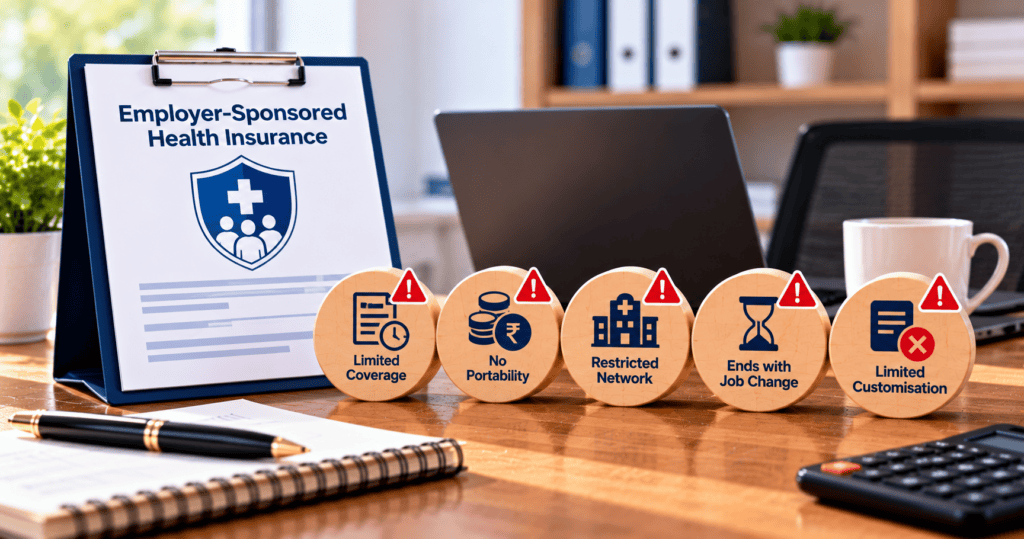
An employer-provided plan is a group medical policy that an organisation purchases for its staff members. The company generally pays the full premium – but how employer-provided health insurance actually works, including costs and enrolment, is worth understanding before you assess its gaps. These plans are popular because they offer a simple enrollment process without individual medical checkups. This means employees receive coverage even for existing health conditions from the first day. However, the organisation remains the legal owner of the policy. This lack of individual ownership is one of the main cons of employer sponsored health insurance plan setups, as it leaves you with no voice in choosing the benefits or the insurance provider.The Risks of Job-Dependent Protection
One of the most significant drawbacks of a group scheme is its temporary nature. Your medical protection remains active only as long as you are part of the organisation.- Employment Changes: If you resign to start a new business or move to a different firm, your coverage typically ends on your final working day. This leaves a gap where you have no medical safety net during your transition.
- Layoffs: In the event of a sudden job loss, your insurance disappears exactly when you might struggle to pay for private premiums.
- Waiting Period Restarts: If you buy a private plan after leaving a job, you may have to wait several years before it covers pre-existing illnesses. Maintaining a personal policy alongside your employer plan helps you complete these waiting periods while you are still healthy.
Control and Customisation Restrictions
When you use a company plan, the management decides the level of care you receive. This leads to a lack of flexibility that may not match your specific family needs.- Inflexible Funding: Standard group policies often provide a fixed amount for all staff at the same level. This funding might cover basic treatments. Major surgeries or chronic conditions often require much higher limits than what an employer-sponsored plan offers.
- Fixed Benefit Lists: You usually cannot add specific riders like maternity support, dental care, or vision benefits if the organisation has not already included them in the master policy.
- Limited Provider Access: Insurers often have a specific list of affiliated medical centres. You might find that your preferred family doctor or a nearby speciality facility is not on the approved network list.
Comparison of Employer Plans and Private Policies
It is helpful to see how these two types of coverage differ in practical terms to understand the cons of employer sponsored health insurance plan options.| Feature | Employer-Sponsored Plan | Individual Health Insurance |
| Policy Ownership | Held by the organisation | Held by the individual |
| Selection of Terms | Limited to company choices | Highly flexible for your needs |
| Duration of Cover | Lasts as long as your job | Stays active for your entire life |
| Waiting Periods | Minimal or none | Typically 2 to 4 years |
| Growth Benefits | Fixed coverage amount | Increases for claim-free years |
| Tax Reductions | None for the individual | Available under Section 80D |
Hidden Financial Limits and Costs
Even a plan with a high total limit can include clauses that result in personal expenses. Organizations often use these internal limits to manage their annual premium budgets.- Room Price Caps: Many group policies set a maximum daily rate for hospital rooms. If you prefer a private suite that costs more than this limit, you must pay the difference out of your own pocket.
- Specific Surgery Limits: Treatments like cataract surgery or kidney stone removal often have fixed payout caps regardless of the total hospital bill.
- Shared Payment Clauses: Certain schemes require the employee to pay a portion of every claim, usually between 10% and 20% of the bill.
Vulnerability for Dependents and Retirees
Employer-provided plans usually stop the moment you retire. Finding a fresh policy at age 60 is challenging because premiums are high and insurers often exclude older individuals with heart issues or diabetes. Additionally, many companies are reducing parental coverage to save on costs. If your employer decides to remove family members from the group plan, your parents could be left without any medical backup. A private plan stays with you throughout your life, regardless of where you work, ensuring your loved ones have consistent protection. Considering the cons of employer sponsored health insurance plan choices, it is clear that a secondary policy is a necessary investment. Are you unsure if your current company coverage is enough for your family? You can talk to an Expert today to find a personal health policy that fits your budget.Frequently Asked Questions
Q1. Why is a private policy necessary if my employer provides one?
A private policy offers a permanent safety net that remains active even if you change jobs or retire. It also provides tax benefits under Section 80D. Employer-paid plans do not offer these tax reductions for the individual employee.
Q2. Can my employer change my health benefits without asking?
Yes. The organisation owns the contract and can negotiate different terms every year. They can reduce the total coverage, add new cost-sharing clauses, or change the insurance company entirely to manage their corporate budget.
Q3. Does a new individual plan cover my current health issues?
Most individual health insurance plans have a waiting period for pre-existing conditions, usually between two and four years. This is why it is better to start a personal plan early while you are healthy, rather than waiting until you leave your current organisation.
Q4. How can I use both a company plan and a personal policy?
You can use both policies to manage a large medical bill. In most cases, you would use the employer-sponsored plan first to pay the initial portion. If the bill exceeds your company’s limit, your private policy can cover the remaining balance.
Q5. What happens to my coverage if I take a career break?
If you take a break from employment, your group coverage usually stops immediately. Without a personal health policy in place, you and your dependents will have no medical insurance during your time away from the professional workforce.