

What is Motor Insurance?
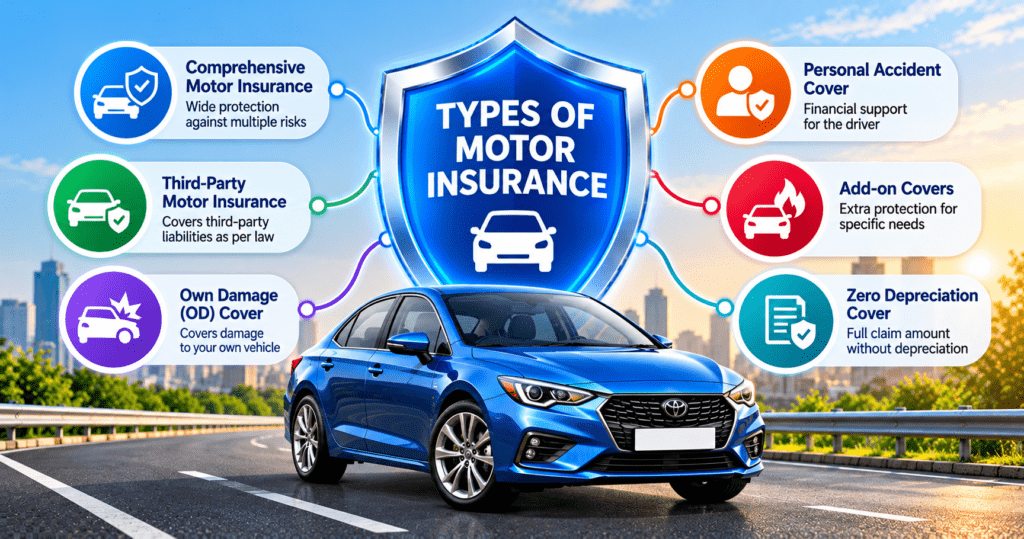
Motor insurance is a legally mandatory insurance between the vehicle owner and the insurance company. It protects the owner against damage to their own vehicle and covers third-party liability (depending on the chosen type of policy). The insurance also offers protection from accidents, theft and natural threats. Driving with motor insurance is a legal requirement under the Motor Vehicles Act, 1988. Motor insurance is also known by other names, like vehicle or auto insurance. It includes protection for two, three and four wheelers.Types of Motor Insurance Policy
The types of motor insurance policy are categorised as per the coverage and the type of vehicle. Here are the insights into each category:Based on the Scope of Coverage
Liability Only Policy
To understand the legal requirements and protection offered to third parties, read our guide on how third-party car insurance works and why it’s mandatory.Standalone Damage Policy
The Standalone Own Damage (OD) insurance offers coverage against damage to one’s own vehicle. The covered issues include theft, repairs, accidents and other such scenarios. It is suitable for individuals already possessing a third-party liability policy.Package Policy
Also referred to as a comprehensive policy, it includes both a liability-only policy and damage to the owner’s vehicle (OD cover). It offers protection under all of the following scenarios:- Fire, explosion, lightning and self-ignition
- Riot and strike
- Burglary, theft and housebreaking
- Malicious act
- Flood, storm, earthquake, cyclone, hurricane, inundation, tempest, hailstorm, landslide, rockslide and frost
- Terrorism acts
- Accident external means
- Transit through inland waterways, rail/road, elevator or air, and lift
Based on Vehicle Category
Private Car Insurance
This insurance is specific to cars like hatchbacks, sedans, SUVs and others used for non-commercial purposes. Here, the protection is imparted against natural calamities, accidents, theft and third-party liabilities. Private car insurance helps individual owners reduce their out-of-pocket expenses in case of damage and during legal procedures. Before choosing a policy, compare the available car insurance options and understand which coverage best suits your vehicle.Two-wheeler Insurance
The two-wheeler insurance is offered by the insurance company for vehicles like mopeds, motorcycles and scooters. Here also, the cover is against theft, accident, fire, natural disasters and third-party liabilities. Depending on the type of policy or add-on, the coverage may also extend to the owner-rider and pillion passenger.Commercial Vehicle Insurance
This insurance serves the owners whose vehicles are used for business or income-generating activities. It is applicable for vehicles like taxis, ambulances, auto-rickshaws, trucks, buses, and other transport or service vehicles. Commercial vehicle insurance is designed by the companies to address risks associated with higher usage, which includes operational exposure and frequent travel. The financial cover acts against operational risks, accidental damage and liabilities occurring during the business activities.Exclusions Under Motor Insurance Policy
The following are the situations where a motor insurance policy does not offer any benefit to the policyholder:- Non-possession of a driving license
- Electrical or mechanical breakdowns
- Using a vehicle for unlawful purposes
- Driving under the influence of drugs or alcohol
- Accident outside the geographical limits
Add-On Covers in Motor Insurance Policies
Regular motor insurance policies have a limited scope of coverage. More benefits can be obtained through add-ons. Among the different available options, individuals can choose the ones that suit their interests and lifestyle. However, note that add-ons will increase the premiums. Here are various types of add-on covers:Zero Depreciation Cover
Also known as nil depreciation cover and bump-to-bumper depreciation cover, this add-on reduces the impact of depreciation on certain parts of the vehicle during a settlement claim. As a result, it offers a higher claim amount to the insured despite depreciation in the value of the car’s parts. The cover can generally be incorporated in the policy within five years (variable as per the insurer) of the vehicle purchase. Also, insurers may or may not impose a limit on the number of claims that can be made under this add-on during the policy period.Engine Protection Cover
An engine protection add-on is a beneficial option for individuals possessing high-value and branded cars. The cover offers protection from the high costs associated with engine repairs. Issues that can be claimed include electrical or mechanical breakdown of the engine, water ingress, oil spill and others. It is not applicable to accidents, damage due to negligence and regular wear and tear of the engine. Also, the eligibility to opt for this add-on is limited depending on the car age and insurer.Roadside Assistance Cover
If the vehicle breaks down on the road, having a roadside assistance cover would offer ease. As per this add-on, you would be eligible for round-the-clock support, which covers minor repairs, towing, flat tyre replacement, fuel delivery, battery jumpstarts and assistance from a mechanic. All of this would be available on a single call to the insurer. Roadside assistance cover offers convenience and ensures smooth and safe travel. It is best suited for those who travel a lot.No Claim Bonus (NCB) Protection Cover
No Claim Bonus (NCB) refers to the discount earned by the insured when they do not raise a claim during the policy period. It allows a reduction in the premium in subsequent renewals. However, even if the insured raises a claim during the policy period, NCB protection helps retain the accumulated NCB. The NCB add-on applies only to the own-damage premium. Also, it may not be available in case of multiple claims or total loss. Further, it is usually offered for vehicles within a specified age limit and varies as per the insurer.Daily Allowance Cover
Opting for this add-on allows the insured to obtain daily travel expenses from the insurance company when the insured vehicle is under repair or unavailable due to theft. It requires the vehicle to be at an authorised network garage and may not be applicable for short repair durations. This cover offers a claim amount to be spent on a cab or alternate public transport during the period. While it depends on the policy term and limits, the compensation amount is generally disbursed on a per-day basis.Return to Invoice Cover
Choosing Return to Invoice (RTI) cover makes the policyholder eligible to receive the original invoice value of the vehicle. It is applicable in case of total loss or theft of the vehicle. The cover is beneficial as standard claims offer lower settlements as per the depreciated market value. The claim amount from RTI cover includes the ex-showroom price, registration charges and road tax as per the policy terms. Again, the RTI cover can be bought for new vehicles, generally within 3 to 5 years of age, with the limit varying as per the insurer.Key Replacement Cover
This cover handles the expenses related to the car’s lock. Hence, if the car keys are lost, damaged, or stolen or if the lock system requires replacement or repair, the key replacement cover helps receive the settlement. In the case of theft, FIR is required to process the claim, depending on the policy terms.Consumables Cover
Consumables cover is an add-on that reimburses the cost of consumable items used during the repair after an accident. The items that can be claimed include engine oil, nuts and bolts, screws, washers, and other such components commonly excluded from standard policies. It is an effective option to proceed with if you want to lower the out-of-pocket expenses during repairs. However, the consumables cover is also applicable to relatively newer vehicles, and terms and conditions vary as per the insurer.Loss of Personal Belongings Cover
The add-on provides compensation to the insured if the personal items kept inside the insured vehicle are damaged or lost. The products that can be claimed under this cover include electronic devices, personal items, sports equipment, car accessories, and other valuables. The loss of personal belongings coverage helps reduce financial loss arising from theft or damage to personal belongings during an insured event. Note that the claim is subject to specified limits and conditions defined by the insurer.Benefits of Motor Insurance Policies
The motor insurance policies support the policyholder in situations like the requirement of repairs, accidents, liabilities and others. Here is how they are helpful:- Monetary Coverage: The occurrence of unfortunate events creates both mental and financial pressure. Similarly, car repair expenditures are high. Regular premiums paid in the policy offer coverage for both unexpected and scheduled financial expenses.
- Liability Coverage: Situations involving damage to the person, property and legal matters involve hefty payments to the third party. The motor insurance policy offers financial ease in such situations, too.
- Legal Compliance: Buying a motor insurance policy is mandatory as per the law. Driving without a policy is illegal and can attract fines or lead to suspension of the license. Hence, it helps fulfil legal requirements as well.
- Mental Peace: Having something to cover you from financial issues that can arise anytime out of nowhere allows you to remain stress-free. It helps plan the finances accordingly without unnecessary financial burden.
Conclusion
Motor insurance policies are designed to provide financial protection, legal compliance and support during unexpected events. The presence of at least a liability-only policy is mandated by law to help meet the financial expenses to be paid to third parties in case of any type of damage. Further, the types of motor insurance policy available can be paired with add-on covers to offer additional protection in events that are specific to the insured’s daily routine. For instance, daily allowance cover, roadside assistance cover and many more. Understanding the available options helps make well-informed decisions for financial and legal protection in real-life situations.Frequently Asked Questions
Q1. How should I choose the right motor insurance policy?
The choice will mostly depend on your needs and finances. Factors to consider to ensure protection along with long-term value include vehicle type, usage, type of coverage, add-ons, insurer’s claim settlement record and premium affordability.
Q2. Can I transfer my motor insurance policy when selling my vehicle?
The motor insurance policy can be transferred to the new owner. It requires filing the request within 14 days of ownership transfer, along with required documents and endorsement by the insurer.
Q3. What happens if I miss renewing my motor insurance policy on time?
If policy renewal is missed, the policy lapses and coverage stops. Reinstating the policy would require inspection and be subject to the insurer’s terms and conditions.
Q4. Can I change my insurer at the time of renewal?
Yes, changing the insurer at the time of renewal is possible. You can switch to the one offering better premiums, higher claim amounts and superior customer service. You can also transfer No Claim Bonus (NCB) at this time.
Q5. Does motor insurance remain constant throughout multiple years?
The premiums to be paid on motor insurance depend on factors like vehicle age, claim history, add-ons, NCB and regulatory updates.