

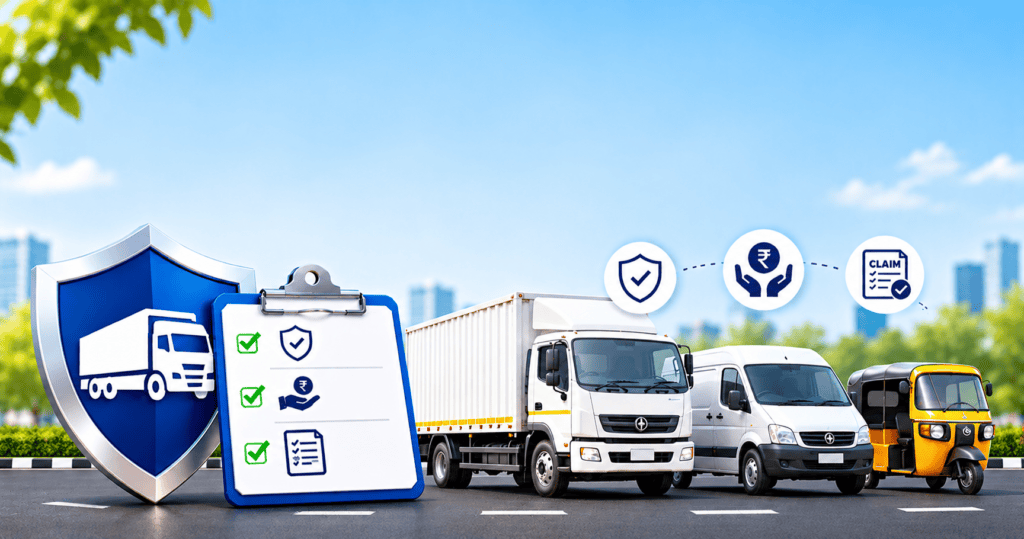
What Commercial Motor Insurance Means
Commercial motor insurance is built for vehicles used for business activity rather than private driving. A standard commercial vehicle package policy gives cover for loss or damage to the insured vehicle and also covers liability to third parties, subject to the terms in the policy schedule. The insured declared value, or IDV, sits at the centre of the policy value for total loss and constructive total loss claims. That structure matters because a commercial vehicle carries more than transport value. It carries earning value. A truck, taxi, or passenger vehicle can affect income the moment it stops running, so the policy has to support both repair costs and legal liability. The owner-driver personal accident cover is included in the motor policy structure for all classes of vehicles under the rules that apply.Types of Commercial Motor Insurance in India
There are mainly two types of commercial motor insurance policies in India:| Type of Commercial Vehicle Insurance Policy | Coverage Offered |
| Third Party (TP) Liability Commercial Vehicle Insurance Policy | Covers damages caused to third-party property or persons. It also provides financial protection against third-party injuries, death, and property damage caused by the insured commercial vehicle. |
| Comprehensive Commercial Vehicle Insurance Policy | Covers both third-party liabilities and damages to the insured commercial vehicle due to accidents, fire, theft, flood, earthquake, and other unforeseen events. |
What Commercial Motor Insurance Usually Covers
The cover is usually split into two main parts. One-part deals with damage to the insured vehicle. The other part deals with liability to people outside the vehicle.Own Damage Cover
The own damage section in the commercial vehicle policy covers loss or damage to the insured vehicle from fire, explosion, self-ignition, lightning, burglary, housebreaking, theft, riot, strike, malicious damage, terrorism, storm, flood and earthquake. It may also provide for the cost of protection and transfer to the nearest repairer when the vehicle is disabled by a covered loss, subject to limits in the policy. This part matters for owners who depend on the vehicle every day. A repair bill is one side of the loss, but downtime can hurt more. A policy that includes own damage helps manage that gap when the vehicle needs recovery or repair after a covered event.Third Party Liability Cover
The liability section protects the insured against legal liability arising from use of the vehicle. The insurer covers the insured for sums the insured becomes legally liable to pay for death or bodily injury to any person and damage to third-party property, subject to the schedule limits. This cover is important because accidents can create claims that go beyond the vehicle itself. Medical bills, property damage, and legal liability can follow one incident. In commercial motor insurance, third-party cover sits as the legal shield that keeps those claims inside the policy structure.Owner Driver Personal Accident Cover
Personal accident cover for the owner-driver under liability only and package policies for all classes of vehicles are also important. The cover applies when the insured person is driving, mounting into, dismounting from, or travelling in the insured vehicle in the manner described by the policy wording. That piece often gets overlooked. Yet for many business owners, the driver is also the operator, the coordinator, or the person who closes delivery schedules. The policy gives that person a separate layer of protection inside the motor cover structure.A Quick View of the Core Cover
| Cover Type | What it Usually Includes |
| Own damage | Fire, theft, riot, strike, malicious damage, terrorism, storm, flood, earthquake, and similar covered losses. |
| Third-party liability | Death, bodily injury, and property damage to others are subject to liability limits. |
| Personal accident | Protection for the owner-driver under the motor policy structure. |
Benefits of Commercial Motor Insurance
The following are the main benefits that make commercial motor insurance useful for business vehicles:Continuity of Business
When a vehicle stays off the road, bookings, deliveries, and route plans can all be affected. Commercial motor insurance helps reduce that disruption by covering repairable damage and third-party liability under one policy.Clearer Claim Value
The policy uses the IDV as the sum insured. In a total loss or constructive total loss claim, that value sets the upper limit from the start, which makes the claim amount easier to understand.Towing and Recovery Support
If the vehicle breaks down after a covered loss, the policy can pay for protection and removal to the nearest repairer, within the policy limits. For a taxi or goods vehicle, that support can ease pressure during a difficult claim.Add-Ons for Extra Protection
Some policies allow add-ons such as towing support, protection and removal cover, and loss of income cover in certain vehicle classes. These options can suit vehicles that stay on the road all day and face a higher downtime cost.What Affects the Premium
Commercial vehicle pricing depends on a few practical checks, and each one changes the premium in a different way.Declared Value of the Vehicle
The insurer usually sets the IDV at the start of the policy using the manufacturer’s listed selling price after depreciation. A newer vehicle usually carries a higher IDV, while an older one may have a lower insured value.Type of Vehicle
The premium changes with the vehicle category. A taxi, a goods carrier, and a specialized commercial vehicle do not fall into the same pricing group, so their risk level is treated differently.Age of the Vehicle
Older vehicles usually bring a lower IDV and a different premium structure. In some cases, the insurer and policyholder agree on the value when the vehicle is older.Add-ons Chosen by the Owner
Extra cover, such as towing support or loss of income cover, adds to the premium. The final price reflects both the base risk and the extra protection the owner selects.How the Claims Process Works
A claim works best when the insured informs the insurer quickly and keeps the papers ready. Every claim-related letter, writ, summons, or process should be forwarded to the company at once. That early notice helps the insurer start the claim file without delay.Step 1: Notify the Insurer
After an accident, theft, fire, or another covered event, the insured should tell the insurer as soon as possible. The policy terms ask for immediate notice and cooperation during the claim process. If a legal paper arrives, it also has to go to the insurer without delay.Step 2: Share the Required Documents
The insurer will ask for claim forms, vehicle details, repair estimates, and supporting papers tied to the loss. In a total loss or theft claim, additional documents may be needed before settlement moves forward. Claim processing can require documentary proof of registration charges and road tax in certain add-on claims.Step 3: Survey and Repair
Once the claim is reported, the insurer may arrange for a surveyor to inspect the vehicle and assess the extent of the damage. Repair work usually begins after the inspection report and repair estimate are approved. If the vehicle cannot be driven after the incident, the policy may also cover towing or removal charges to the nearest repair facility, subject to the policy limit.Step 4: Settlement
For total loss or constructive total loss, the claim value follows the IDV framework in the policy. A vehicle can be treated as a total loss when the aggregate cost of retrieval and or repair exceeds 75% of the IDV, subject to the policy terms. That makes the IDV one of the most important figures in the claim outcome.How to Choose the Right Policy
Follow the three checks below to choose the right policy:Check the Vehicle Usage
The first check should be the vehicle’s use. A goods carrier, passenger vehicle, taxi, or fleet vehicle faces a different pattern of exposure, so the cover should match the actual work the vehicle does. A policy that fits a private car may leave gaps for a business vehicle that stays on the road longer and carries more risk.Review the IDV
A high IDV can raise premium cost, but it also changes the ceiling that matters in a total loss or theft claim. The right balance depends on the age of the vehicle, the daily use, and the loss the owner can absorb without stress.Choose Add-ons Based on Business Needs
Towing, removal, loss of income, and other extra covers may suit a vehicle that earns daily revenue, but every add-on should answer a real business need. That approach keeps commercial motor insurance tied to use rather than extras.Conclusion
The right commercial motor insurance policy does three jobs at once. It covers damage to the insured vehicle, protects against third-party liability, and gives the owner-driver a separate personal accident layer under the rules that apply. For a business vehicle, that combination helps reduce repair shocks and keeps legal exposure inside one policy. The strongest policy choice usually comes from matching cover to use. A commercial vehicle that runs every day needs a policy that fits its working life, its claim risk, and its downtime cost. That is where commercial motor insurance proves its value.Frequently Asked Questions
Q1. What does commercial motor insurance usually cover?
It usually covers own damage and third-party liability. The own-damage side includes fire, theft, riot, strike, malicious damage, terrorism, flood, and similar risks. It can also include personal accident cover for the owner-driver.
Q2. Is towing or removal covered after an accident?
The commercial vehicle package wording supports reasonable protection and removal to the nearest repairer after a covered loss. The policy places limits on that amount based on the vehicle class. Add-ons can also extend towing support in some products.
Q3. How does the insurer decide the claim amount in a total loss?
The claim value depends on the IDV, which the policy fixes at the start of the policy period. A vehicle can be treated as a total loss if repair and retrieval costs cross 75% of the IDV. The final settlement then follows the policy terms.
Q4. What should I do right after an accident?
Tell the insurer in writing as soon as possible. Keep every claim paper, legal notice, and repair document ready for the file.
Q5. Which vehicles need commercial motor insurance?
Commercial vehicles used for business activity usually need this type of cover. That includes goods carriers, passenger vehicles, taxis, and other working vehicles covered under commercial policy classes. The exact policy depends on the vehicle type and use.