

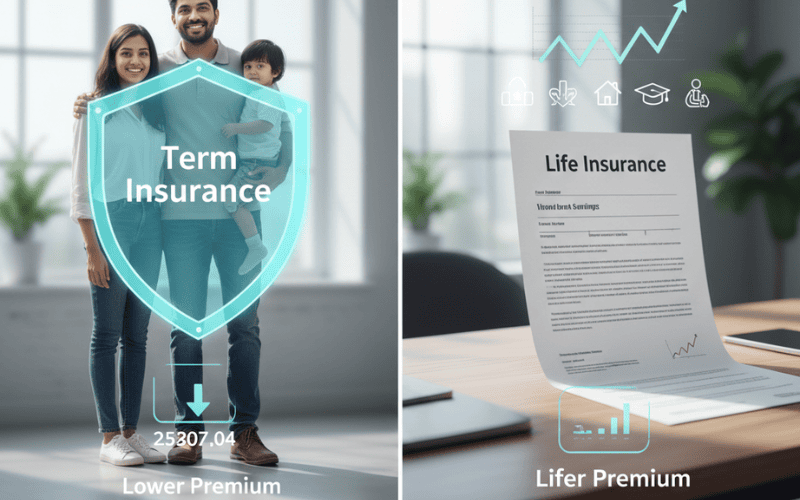
Life insurance decisions rarely happen with clarity. In most households, people make them under pressure rather than through careful analysis: a persistent agent, a looming tax deadline, or the vague fear of being “uninsured”. What follows is usually a quick purchase, not a considered one. In the end, people end up with policies that do not align with their needs, or in terms of what those policies actually do for them.
This confusion is most visible when individuals try to choose between term insurance and life insurance. Some people unknowingly treat them as interchangeable options when, in reality, they are built for different purposes altogether. Any serious discussion on comparing protection, cost, and benefits between term insurance and life insurance must start with this reality. If the structure is wrong, the outcome will be wrong, regardless of how attractive the brochure looks.
Table of Contents
- Basic Overview: Term Insurance vs Life Insurance
- Understanding the Scope of Traditional Life Insurance Policies
- Term Insurance as a Pure Risk Protection Instrument
- A Comparative Analysis: Term Insurance vs Life Insurance
- Factor: Coverage Adequacy
- Factor: Cost Structure and Premium Efficiency
- Factor: Policy Benefits and Realised Outcomes
- Factor: Long-Term Policy Performance and Policyholder Experience
- Factor: Assessment of Savings Discipline Claims
- Factor: Impact of Inflation
- Factor: Policy Complexity and Claims Process Transparency
- Suitability Criteria for Traditional Life Insurance Plans
- Conclusion
- FAQs
Basic Overview: Term Insurance vs Life Insurance
Let’s begin with the basics so you can make a decision with firm foundations.
Life Insurance
A cushion for your family members to fall back on in the event of your demise, life insurance acts as a financial backup for desperate times. The insured pays a premium over a stipulated period of time for life-long financial coverage of his family or dependents in his absence. When families are swept off by despair and grief, a life insurance plan emerges as the silver lining in a rather gloomy cloud.
Term Insurance
You can understand term insurance as life insurance, but with a deadline. While the policyholder has to pay premiums in the same way as they might for life insurance (the rates are lower for term plans), the coverage stands for a fixed term. If the policyholder passes away during the term, their dependents/beneficiaries receive a payout. In case the term has passed, no benefits can be obtained.
Understanding the Scope of Traditional Life Insurance Policies
Some people use the phrase “life insurance” loosely, which is part of the problem. In practical terms, it refers to traditional policies and includes endowment plans, money-back plans, and whole-life policies. These products attempt to combine life cover with savings.
The pitch is familiar. Protection in case of death, and a payout if the policyholder survives. Premiums paid into such policies are divided across several competing objectives:
- Insurance cover
- Savings accumulation
- Administrative costs
- Distribution commissions
They support long-term but basic monetary protection and come with tax advantages.
Term Insurance as a Pure Risk Protection Instrument
Term insurance does not pretend to be versatile. It has one purpose: to provide financial protection for a defined period. The structure is straightforward and cuts to the chase. Choose the sum assured, choose the term, and pay the premium.
If the insured dies during the policy term, the nominee receives the death benefit. If not, the policy ends. There are no bonuses to interpret and no projections to revisit every few years.
People often misunderstand this simplicity as a limitation. In reality, it allows term insurance to deliver meaningful protection without unnecessary cost.
A Comparative Analysis: Term Insurance vs Life Insurance
A detailed comparative analysis of term insurance vs life insurance is incomplete without a discussion on their coverage, cost structure, policy benefits, and time-sensitive performance:
Factor: Coverage Adequacy
Protection does not have to be worthwhile only when you continuously hold ownership of a policy. The central concern should be whether a payout can realistically replace lost income, clear liabilities, and keep dependents financially stable.
- Term insurance offers substantially higher coverage for the same premium when compared with traditional life insurance. The difference lies in the structure. Because insurers use term insurance premiums solely to price mortality risk, they can offer higher coverage levels.
- Life insurance policies divert large portions of the premium away from pure protection. Instead, they distribute protection along multiple pillars. It permits borrowings against the cash value accumulated through such distribution of premiums but provides lower coverage.
Factor: Cost Structure and Premium Efficiency
Life insurance costs more because it does more, not necessarily because it always does everything better. Insurers build administrative overheads, guaranteed features, and distribution expenses into the pricing.
Term insurance avoids most of this. Naturally, premiums are capped at lower rates. Additionally, the pricing is transparent, particularly in direct or online plans. You pay for coverage, and that is what you get.
Over long periods, this cost difference might compound, especially if you need to budget the investment. Paying high premiums for lifelong coverage might not be conservative planning if you’re looking for short-term coverage. In such a case, the policyholder practices inefficient risk management while presenting it as safety.
Factor: Policy Benefits and Realised Outcomes
Traditional life insurance is often sold on maturity benefits. These come with long timelines and stable features. In many cases, maturity amounts don’t just look respectable but also come through when multiple people are dependent on your paycheck.
While stability is a reliable dimension, the payouts might underperform after inflation. It might not be able to meet demands when adjusted for rising living costs. In such a scenario, disappointment won’t just arrive as a hollow in the chest of your loved one who has to keep going in your absence, but also impair them in monetary terms.
Term insurance, under this condition, does not offer maturity benefits and does not attempt to justify itself on that basis. Its value lies in short-term certainty. If the insured dies during the term, the family receives a significant financial buffer. That is the entire proposition. As a result, criticising term insurance simply for not matching up to life insurance misses the point there.
Factor: Long-Term Policy Performance and Policyholder Experience
Most people feel relieved once they complete an insurance purchase. However, that relief fades with time if they choose the wrong policy for their needs.
- Term insurance works in a straightforward way. You pay the premiums, the coverage continues, and you do not need to track anything. Either you still need the cover, or you do not.
- Life insurance ages differently. Statements arrive. Bonus figures change, and projected values move around. You could even get a bonus from the insurer on completion of premium payments for a specific period of time.
To be brief, policyholder experience can involve complexities when it comes to life insurance. Active engagement with an insurer is necessary to avoid misinformation or gaps in financial planning. In comparison, term insurance requires limited involvement of the holder. Therefore, depending on the cover period, a term insurance can deliver as competitive a performance as a life insurance policy.
Factor: Assessment of Savings Discipline Claims
People often view life insurance as a tool that encourages saving. That, for the most part, is a fair evaluation. However, it’s all right if your priorities require a term insurance once the trade-offs of the former become visible.
- Endowments & whole life insurance plans allow policyholders to get a lump sum payout when the policy matures. They serve as an alternate savings fund and differ based on timelines. While endowment plans have shorter terms, whole life insurance plans generally mature by the time a holder is 95 years of age.
- Term insurance, in contrast, stays out of the way but doesn’t come with payouts for the living policyholder. Beyond the premium, it does not interfere with cash flow decisions. It assumes nothing about future income stability or behaviour. If the insured passes away during the term, their beneficiary receives the payout, and that is that.
You should note that committing to long-term savings can sometimes limit your choices. Many life insurance policies lock funds into rigid, time-bound structures. However, rigidity does not always create discipline and therefore do not treat it as the norm.
Factor: Impact of Inflation
Inflation can erode fixed benefits without warning. This matters more than many buyers realize.
- Traditional life insurance policies usually lock coverage at levels that appear adequate at purchase. Years later, those figures lose relevance. Increasing coverage through similar policies is expensive, which is why many remain underinsured.
- Term insurance does not eliminate inflation risk, but it can allow for realistic planning in the short-term. Higher coverage is affordable, and adjustments are possible. The only downside to this is the lack of returns for the policyholder in their lifetime.
Factor: Policy Complexity and Claims Process Transparency
Insurance should function during periods of financial stress. That is precisely when complex policies can create problems.
- Term insurance claims are generally straightforward. The policy clearly defines the conditions and outcomes.
- Life insurance claims, particularly those involving surrender or maturity, include more variables. This does not imply misconduct; the product design simply requires these elements.
For most people, financial literacy isn’t a quick study or within reach. Therefore, products should simplify outcomes, not complicate them at critical moments. Transparent guidance and patient clarification can aid people in making good judgments.
Suitability Criteria for Traditional Life Insurance Plans
There are scenarios where traditional life insurance fits the checklist and then those where term insurance does more than enough.
Individuals who already have sufficient term cover and prefer conservative, hands-off savings may consider life insurance policies. These plans can rescue families from financial despair during desperate times and come with a money-back option on maturity. The coverage, however, is lower when compared to term insurance buffers.
Conclusion
When stripped of marketing language, comparing protection, cost, and benefits between term insurance and life insurance leads to a straightforward conclusion.
Term insurance delivers superior protection over the short term, but it has one downside: the policy does not return any money to the policyholder if they outlive the term.
Life insurance offers convenience and predictability, often at the expense of adequate coverage. A high-premium, low-coverage life insurance policy is not sufficient simply because it pays something back at maturity. You need term insurance to prevent financial collapse, because comfort without real protection cannot act as security.
FAQs
Q1. Are term insurance and life insurance designed to be interchangeable products?
They are often sold that way, but they are not designed that way. Term insurance exists for protection during earning years. Life insurance policies are structured to combine protection with a savings outcome. Once that distinction is ignored, comparisons become misleading, and coverage decisions suffer.
Q2. Why do life insurance premiums appear high even when the coverage amount is limited?
This happens because the premium is not paying only for protection. A large part of it is committed elsewhere from the start. Coverage is just one component, not the priority. This is why premium size and protection level rarely move in the same direction in traditional life insurance.
Q3. Should maturity payouts be treated as a key advantage of life insurance policies?
Only within limits. Maturity payouts provide predictability, not financial strength. Over long periods, inflation reduces their usefulness. They may close a policy neatly, but they rarely solve long-term financial needs on their own.
Q4. Does inflation meaningfully change how insurance coverage should be evaluated?
It does, whether it is acknowledged or not. Fixed sums lose relevance over time. Most policies are bought with present-day assumptions and left untouched. Term insurance makes higher coverage easier to commit to early, which reduces the need for later correction.
Q5. Is it practical to rely on one insurance policy for protection as well as savings?
It is practical only in the sense that it reduces decision-making. Financially, it introduces compromises. Protection and savings respond to different risks and timelines. Treating them as one objective simplifies ownership, not outcomes.