

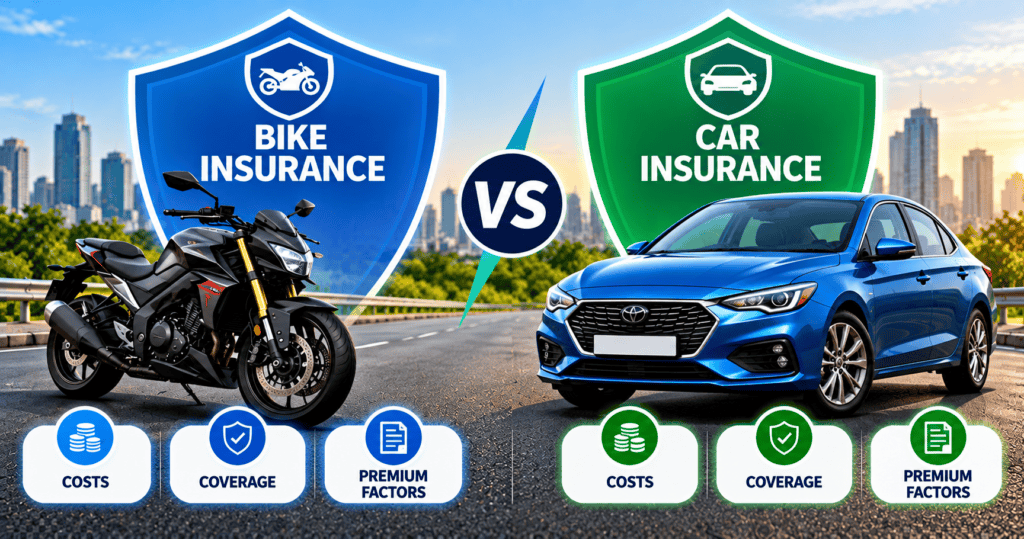
When people compare motor insurance, they often look at the premium first and stop there. That misses the bigger picture. The final cost of bike and car policies changes with vehicle value, cover choice, deductibles, and claim history. Is bike insurance cheaper than car? The direct answer to the question depends on certain factors. It is usually yes, but only when you compare similar cover types and similar risk profiles.
This article covers how bike insurance and car insurance differ in cost, coverage, and the factors that determine the final premium.
What Does Bike Insurance and Car Insurance Cover
IRDAI groups motor insurance into two broad forms, liability-only cover and package policy, and both bike insurance and car insurance follow the same basic structure.
Liability-Only Cover
Covers injury or damage caused to other people. This is the mandatory legal requirement and does not include damage to your own vehicle.
Package Policy
Combines third-party cover with protection for your own vehicle. It brings multiple types of risks under one policy instead of separate covers.
Damage to Insured Vehicle
Covers repair or replacement costs if your own bike or car gets damaged due to an accident.
Theft Cover
Covers loss if the insured vehicle is stolen, based on the policy terms.
Fire Damage
Covers damage caused by fire, explosion, or self-ignition.
Natural Disasters
Covers damage caused by events like floods, cyclones, earthquakes, or storms.
Man-Made Events
Covers damage caused by events such as public disturbances or intentional damage by others.
| Cover | Bike Insurance | Car Insurance |
| Liability-Only Cover | Covered | Covered |
| Package policy | Available | Available |
| Damage to Insured Vehicle | Covered (under package policy) | Covered (under package policy) |
| Theft cover | Covered | Covered |
| Fire damage | Covered | Covered |
| Natural disasters | Covered | Covered |
| Man-made events | Covered | Covered |
Why Bike Insurance is Usually Cheaper Than Car Insurance
The insured value of a bike is generally lower than that of a car. IRDAI says the premium depends on factors such as the class of vehicle, cubic capacity, seating capacity, age of vehicle, discounts, loadings, past claims experience, and IDV. Those factors often work in favour of two-wheelers because the exposure is smaller and the vehicle value is usually lower.
IRDAI’s policy wording defines IDV as the insured declared value, and it reflects the market value after depreciation adjustments. Since cars usually carry a higher market value than bikes, the own damage premium for a car often starts from a higher base.
The Main Factors That Change the Premium
The following are the main factors that affect the premium:
The Vehicle Itself
IRDAI notes that insurers consider vehicle class, age, capacity, IDV, discounts, loadings, and previous claims while setting the premium. A newer or more expensive vehicle usually attracts a higher premium, and that applies to both bikes and cars.
Cover Choice
Liability-only cover costs less because it protects only against third-party liability. Package cover costs more because it also protects the owner’s vehicle against its own damage.
Claims History
IRDAI says no claim bonus can reduce the own damage premium, and it can reach 50% after successive claim-free years. That reward matters for both bikes and cars, and it can narrow the premium gap between two policies if one owner has a cleaner record.
Policy Continuity
IRDAI says motor policies usually run for one year and do not come with a grace period for premium payment. If a comprehensive policy breaks for more than 90 days, the No Claim Bonus is lost, and the vehicle may need inspection before the policy restarts.
How Coverage Needs Differ for Bike and Car Owners
A bike and a car may follow the same insurance rules, but the kind of cover each owner needs is not the same.
- A bike owner often wants to keep the premium under control while still covering theft, own damage, and third-party liability.
- A car owner often needs wider protection because repair bills may rise faster after an accident.
- For a bike, the policy value stays closer to the vehicle’s price and depreciation.
- For a car, the higher base value usually pushes the premium up more when own damage cover is included.
- A cheaper premium does not always mean better value.
- IRDAI advises buyers to compare deductibles, coverage, and IDV before choosing a policy.
Add-Ons That Can Push The Price Up
Add-ons can raise the premium, so each option should be chosen with a clear purpose.
- Add-ons extend the basic policy by covering extra risks, which improves protection but increases the total premium.
- Each add-on adds to the final price, so the premium moves higher as more options are selected.
- Car policies often include more add-ons because repair costs and vehicle value are higher, while bike policies usually remain simpler.
- Choosing only the add-ons that match actual needs helps avoid paying for features that may not be used.
The aim is to keep the policy practical by selecting only what adds real value instead of increasing the premium without a clear benefit.
A Simple Premium Comparison Table
The table below gives you a broad understanding that a small, older car can sometimes cost less to insure than a powerful new bike with expensive add-ons.
| Comparison point | Bike insurance | Car insurance |
| Usual premium level | Lower | Higher |
| Main reason | Lower IDV and repair exposure | Higher IDV and repair exposure |
| Liability-only option | Available | Available |
| Package cover | Available | Available |
| Add-on impact | Usually moderate | Often stronger |
| NCB effect | Reduces premium | Reduces premium |
Which Policy May Suit Which Owner?
The choice here depends on the type of cover you select, not the vehicle itself.
| Policy type | Who it may suit | Why it may fit |
| Liability-only cover | Owners who want to meet the legal requirement and keep the premium lower | Covers third-party damage only and does not include damage to the insured vehicle |
| Package policy | Owners who want protection for their own vehicle, along with third-party cover | Includes own-damage cover and usually covers theft, fire, and certain other losses |
| Lower IDV option | Owners of older or lower-value vehicles | Keeps the premium lower as the insured value of the vehicle is lower |
| Higher IDV option | Owners of newer or higher-value vehicles | Provides stronger protection where the repair or replacement cost is higher |
The better approach is to match the cover level with the vehicle’s value and the level of protection required.
What to Check Before Buying
A few key checks can help you choose the right policy without overpaying or missing important cover.
- Policy Type: Start with the type of policy. Liability-only cover keeps the premium lower but offers limited protection. A package policy costs more and also covers damage to your own vehicle.
- IDV, Deductible, and NCB: Check the insured declared value, deductible, and no claim bonus carefully. These directly affect both the premium, and the claim amount you receive.
- Add-Ons: Review add-ons one by one before selecting them. Choose only those that match your needs, instead of adding features that may not be useful later.
Conclusion
Bike insurance is usually cheaper than car insurance because bikes generally carry lower IDV, lower repair exposure, and lower replacement cost. That broad pattern explains why the answer to “Is bike insurance cheaper than car?” is usually yes. Still, the final premium depends on more than vehicle type alone.
A careful buyer should compare the policy type, IDV, deductible, NCB, and add-ons before deciding. That approach gives a better picture than the premium number alone. It also helps the buyer choose the policy that fits the vehicle, the budget, and the level of protection needed.
Frequently Asked Questions
Q1. Is bike insurance cheaper than car insurance in India?
In most cases, yes, bike insurance is cheaper than car insurance. Bikes usually have a lower IDV and smaller repair exposure than cars. The final premium still depends on the vehicle, cover type, and claim history.
Q2. Why do premiums differ even when the cover looks similar?
IRDAI says insurers look at vehicle class, age, cubic capacity, seating capacity, IDV, and past claims. Even two similar policies can cost differently if the vehicle values are not the same. Add-ons and deductibles can also change the quote.
Q3. Does the package cost more than liability-only cover?
Yes, package cover usually costs more because it includes its own damage protection along with third-party liability. Liability-only cover protects less, so the premium stays lower. That pattern applies to both bikes and cars.
Q4. How does the No Claim Bonus affect the premium?
No Claim Bonus reduces the own damage premium after claim-free years. IRDAI says it can go up to 50% in successive claim-free years. If the policy breaks for too long, that benefit can be lost.
Q5. What should I check before choosing motor insurance?
Compare the premium, IDV, deductible, coverage, and add-ons together. IRDAI advises buyers to look at all these parts before deciding. That gives a clearer view of value than premium alone.