

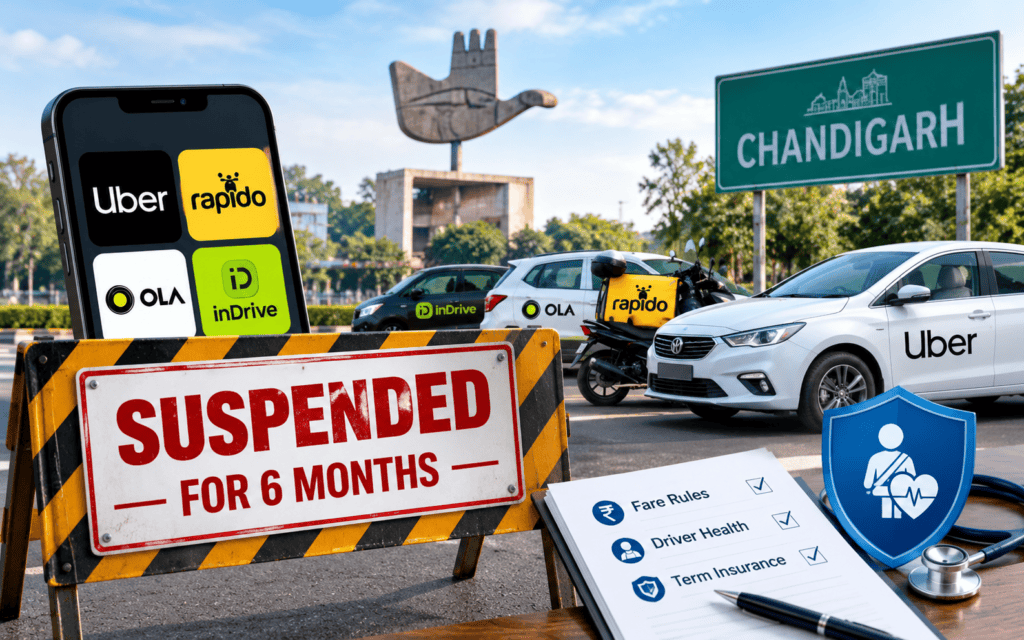
| The latest suspensions leave Chandigarh commuters with only Sahkari Taxi Cooperative Limited’s Bharat Taxi, while drivers continue to flag concerns over fares, insurance and working conditions. |
Chandigarh has suspended the aggregator licences of Uber and Rapido for six months, citing continued violations of the Chandigarh Administration Motor Vehicles Aggregators Rules, 2025. The suspension took effect on September 8 and will remain in force till March 2027.
With Ola and in Drive already suspended for six months in June and August, respectively, all four major cab aggregators operating across the Tricity, Chandigarh, Mohali and Panchkula, now stand suspended.
Fare Violations, Driver Insurance Among Key Concerns
The orders were issued by State Transport Authority (STA) Secretary Nitish Singla under Rule 17 of the 2025 Rules. The action followed repeated notices and opportunities to demonstrate compliance.
Uber was first asked to submit a compliance report on July 8, 2025, and received a show-cause notice on October 10 after its response was found unsatisfactory. The STA said Uber failed to implement the fare rates notified by the administration and was found to be overcharging commuters in violation of Rule 14(iii).
The authority also cited complaints about a subscription or recharge model for drivers and the attachment of non-commercial vehicles to the platform. Uber’s Sector 47-C office was found closed or locked during three inspections in May 2026.
Rapido faced similar action. Its insurance cover for bike-taxi captains was found to be limited to accidental death and injury, which the STA said fell short of the coverage mandated under the 2025 Rules. Its Sector 32-D office was also found locked during three inspections.
Driver unions had additionally alleged that aggregators were charging commissions of about 30%, above the 20% limit set by the Chandigarh Administration.
What Drivers Should Check on Insurance
The Motor Vehicle Aggregator Guidelines, 2020 require aggregators to ensure health insurance of at least ₹5 lakh for each integrated driver, with a 5% annual increase from the 2020-21 base year. They also require term insurance of at least ₹10 lakh per driver, subject to the same annual increase.
For drivers, this means checking whether the insurance cover is actually in place, the applicable coverage amount and whether it is being provided or ensured by the aggregator.
The guidelines place these obligations on the aggregator rather than requiring drivers to arrange this cover independently.
Passenger Cover is a Separate Issue
Driver insurance should not be confused with passenger protection. The 2020 guidelines require vehicles integrated with aggregators to have valid third-party insurance and refer to commercial insurance covering third-party risks.
The information available for this report does not establish a separate, standalone passenger insurance policy operated by the aggregator. The vehicle’s third-party insurance is therefore distinct from the health and term insurance requirements applicable to drivers.
Gig Workers Have Wider Social-Security Provisions
The Code on Social Security, 2020 formally recognises gig and platform workers and provides for government-notified social-security benefits, including life and disability cover, health and maternity benefits and accident insurance.
The Code also provides for aggregators to contribute 1-2% of annual turnover to a Social Security Fund, subject to a cap of 5% of payments made or payable to gig and platform workers. Workers can register through e-Shram and receive a unique Aadhaar-linked ID intended to make benefits portable across platforms.
For Chandigarh’s drivers, however, the immediate issue is compliance with the city’s aggregator rules on fares, insurance, training and vehicle eligibility.
Commuters Left with Limited Options
The suspensions could reduce the number of app-based transport options available to Chandigarh residents, while drivers attached to the affected platforms may need to consider other authorised platforms during the suspension period.
The drivers’ protest, including a 16-day hunger strike, ended on Tuesday after the latest licence suspensions.
The Chandigarh action is separate from the Supreme Court’s nationwide investigation into fraudulent motor accident compensation claims. While that case involves alleged manipulation of insurance compensation claims, the Chandigarh proceedings concern aggregator licensing and compliance with transport rules.
| Learn how driver health and term insurance differ from vehicle third-party cover, and what these forms of insurance mean for gig and platform workers. With MyRupia |
Disclaimer: Insurance requirements and social-security provisions may be subject to applicable rules and subsequent regulatory changes. Readers should verify the latest requirements with the relevant authorities before relying on them.