

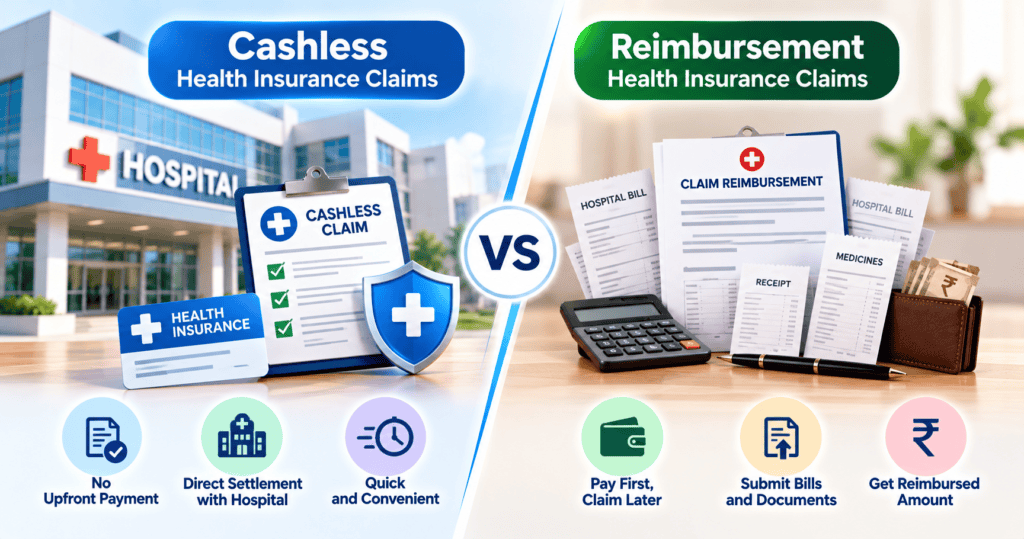
What Is Cashless Health Insurance?
Cashless health insurance is a hospitalisation facility in which the insurer settles approved medical bills directly with a network hospital, so the patient does not pay most costs upfront. The patient typically covers non-payable items or amounts beyond the sum insured, while the insurer clears the rest with the hospital. Cashless treatment is generally available at the insurer’s network hospitals, and the patient shows a policy card at the hospital’s insurance desk. In the cashless vs reimbursement comparison, this route can reduce the policyholder’s upfront payment burden and requires insurer authorisation before or during treatment.What Is a Reimbursement Claim?
A reimbursement claim is a health insurance claim where the policyholder pays the full hospital bill first and later submits documents for repayment. This route may apply when the treating hospital is outside the insurer’s network or when cashless treatment is declined or not used. The policyholder submits original bills, a discharge summary and a claim form. The insurer then verifies and pays the eligible amount into the bank account. In the cashless vs reimbursement comparison, reimbursement places the initial financial burden on the policyholder, with the insurer settling the eligible amount later.How Do Cashless vs. Reimbursement Processes Differ?
The cashless vs reimbursement process differs mainly in timing and who pays first: the cashless option involves pre-authorisation, with the insurer paying the hospital directly, while reimbursement involves paying first and recovering the eligible amount afterwards. For cashless treatment, the hospital desk submits a pre-authorisation form at least 48 hours before planned admission or within 24 to 48 hours of emergency admission. The insurer or TPA reviews and either approves, queries or rejects the request. For reimbursement, the insurer assesses the claim after the required documents and medical records are submitted, generally following treatment and discharge.What Documents Does Each Claim Type Need?
Cashless claims need identity and policy proof plus a pre-authorisation form completed by the treating doctor, while reimbursement claims need the complete set of original bills and medical records submitted after discharge. The cashless claim needs fewer documents upfront, while reimbursement requires more documents after treatment. For cashless treatment:- Health insurance policy or e-health card
- Government-issued photo ID
- Pre-authorisation form (doctor-completed)
- KYC documents
- Claim form (Parts A and B, IRDAI format)
- Original bills and payment receipts
- Original discharge summary
- Investigation reports and prescriptions
- Police FIR, if accident-related
What Are the IRDAI Timelines for Each Claim Type?
IRDAI’s Master Circular on Health Insurance Business, effective 31 July 2024, sets a one-hour deadline for cashless pre-authorisation and a three-hour deadline for discharge authorisation, while reimbursement claims must be decided within 30 days of receiving the last document. If discharge authorisation exceeds three hours, the insurer must pay any extra hospital charges from its shareholders’ funds, not the patient. For reimbursement, a delay beyond 30 days attracts penal interest at 2% above the bank rate. IRDAI’s 2023-24 annual report recorded that health insurers settled only 86.27% of reimbursement claims within this target, showing a gap between rule and practice.What Are the Advantages and Limits of Cashless Claims?
Cashless claims can reduce financial strain during hospitalisation, but they can still involve out-of-pocket costs. Understanding both sides is important when assessing the cashless vs reimbursement options available to a policyholder. Advantages:- No large upfront payment for most of the bill
- Discharge authorisation under the 3-hour IRDAI timeline
- Less paperwork during treatment
- Restricted to network hospitals (unless using Cashless Everywhere)
- Sub-limits and co-payments still apply.
- A hospital’s cashless tie-up can be suspended without much notice. For example, Niva Bupa withdrew cashless access at Max Hospitals from 16 August 2025, so patients had to use the reimbursement route.
What Are the Advantages and Limits of Reimbursement Claims?
Reimbursement claims offer more flexibility when choosing a hospital, since network status doesn’t matter, but they require arranging funds upfront and waiting for repayment. This difference is an important consideration in the cashless vs reimbursement decision. Advantages:- Non-network hospitals may be used, subject to policy terms and claim conditions.
- Useful when cashless is denied or unavailable
- Requires arranging the full bill amount immediately
- Settlement can take up to 30 days even if all requirements are met.
Cashless vs Reimbursement: Full Comparison
The table below sets out the cashless vs reimbursement comparison, covering payment flow, timelines and typical use cases.| Basis | Cashless Claim | Reimbursement Claim |
| Who pays first? | The insurer pays the hospital directly. | The policyholder pays, then claims back. |
| Hospital requirement | Network hospital | Non-network hospital, subject to policy terms |
| IRDAI timeline | 1 hour pre-auth; 3 hours discharge | 30 days from the last document |
| Documentation stage | Before/during treatment | After discharge |
| Delay penalty on insurer | Pays the extra hospital charges | Pays 2% above bank rate interest |
| Best suited for | Network hospital care | Non-network or denied cashless |
When Does a Cashless Claim Turn Into a Reimbursement Claim?
A cashless claim may need to be claimed through reimbursement when the insurer cannot authorise direct settlement, such as when treatment is outside the policy terms or when the information is incomplete. However, a cashless request being rejected does not automatically mean the underlying treatment claim is payable through reimbursement. If a cashless request is declined, the policyholder may pay for treatment and later submit the claim for reimbursement, subject to the policy terms. Insurers may also provide partial cashless cover and leave the remaining amount for reimbursement after review. This is a common but often overlooked part of the claims journey, as the two routes are not always mutually exclusive during a single hospitalisation.What Is “Cashless Everywhere” and How Does It Change Things?
Cashless Everywhere is an industry initiative, launched by the General Insurance Council on 24 January 2024, that extends cashless treatment to hospitals outside an insurer’s formal network, subject to conditions. It narrows the gap between the two routes in the cashless vs reimbursement process by making cashless available at more hospitals, although it is not available everywhere. Under this initiative, the non-network hospital must have at least 15 beds, be registered under the Clinical Establishments framework and agree to the insurer’s tariff. Policyholders must still inform the insurer 48 hours before planned admission, or within 48 hours of emergency admission, and the claim must be admissible. The scheme does not force every hospital to participate, so reimbursement may be needed where a hospital declines.How Should a Policyholder Choose Between the Two?
The choice between cashless vs reimbursement depends on the hospital, policy terms and circumstances. Cashless may be available at a network hospital, while reimbursement may be used when cashless treatment is unavailable. Practical pointers:- Verify network status just before admission, since hospital agreements can change.
- Keep emergency funds ready even for cashless treatment in case of a deposit request.
- Retain every original document for reimbursement, since incomplete paperwork can cause delays.
Conclusion
The cashless vs reimbursement choice depends on the circumstances of the hospitalisation and the applicable policy terms. Cashless treatment can reduce the policyholder’s upfront payment burden, while reimbursement remains an option when cashless treatment is unavailable or not used. Keeping documents ready and confirming network status in advance can help a policyholder navigate the cashless vs reimbursement choice with fewer surprises.Frequently Asked Questions
Q1. Is cashless always faster than reimbursement?
Cashless claims have specific IRDAI timelines for pre-authorisation and discharge authorisation, while reimbursement claims must be decided within the applicable timeline after receipt of the last necessary document. These timelines apply to different stages of the claim process, so they should not be treated as a direct comparison of overall claim settlement speed.
Q2. Can I switch from cashless to reimbursement mid-treatment?
Yes, if a cashless request is denied or only partially approved, the remaining or full amount can be claimed through reimbursement with the required documents. This can form part of the cashless vs reimbursement process and does not necessarily mean that the treatment itself has been rejected.
Q3. Does the hospital network affect the cashless vs reimbursement decision?
Yes, hospital network status can affect the available claim route. Cashless treatment may be available at network hospitals or under Cashless Everywhere, subject to the applicable conditions. If cashless treatment is unavailable, the policyholder may need to use the reimbursement route.
Q4. What happens if my insurer delays a claim beyond the IRDAI deadline?
If cashless discharge authorisation exceeds three hours, the insurer bears the applicable additional charges, while delayed reimbursement attracts interest at 2% above the bank rate, which is paid to the policyholder. Persistent delays can be escalated to the insurer’s grievance officer or the Insurance Ombudsman.
Q5. Do I need different insurance policies for cashless and reimbursement?
No, both claim types are usually available under the same health insurance policy. The cashless vs reimbursement choice depends on the hospital, policy terms and circumstances, not on having separate plans.