

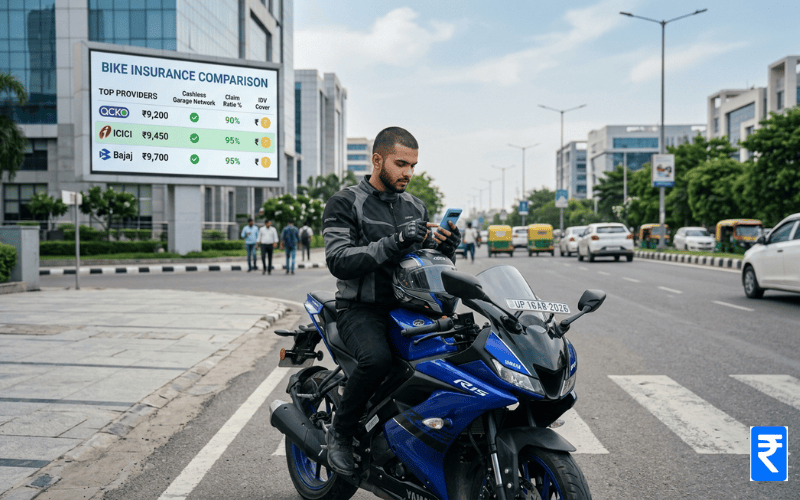
Motorbike insurance pricing depends on several factors, including machine capacity, location, insurer, type of policy, and rider profile. With updates in third-party premiums rates by the Insurance Regulatory and Development Authority of India (IRDAI), inflationary adaptations, and changing threat patterns, policyholders must have up-to-date information.
This article explains the average motorbike insurance cost in 2026, key factors impacting the cost, and cost-saving strategies.
Understanding the Average Motorbike Insurance Cost in 2026
The average motorbike insurance cost in India in 2026 depends on the type of policy you buy.
-
Third-Party Insurance premiums (IRDAI- Approved Rates)
Third-party motor insurance rates in India are regulated by the Insurance Regulatory and Development Authority of India (IRDAI). The premium depends on machine capacity (cc).
As per IRDAI’s notified premium structure for two-wheelers (2024 – 25, latest applicable slab structure as of publication):
| Engine Capacity | Premium (Approx.) | |
| 1 Year-Plans | 5-Year Plans | |
| Less than 100cc | ₹538 | ₹2,901 |
| 75–150 cc | ₹714 | ₹3,851 |
| 150–350 cc | ₹1,366 | ₹7,365 |
| Above 350 cc | ₹2,804 | ₹15,117 |
Since third-party premiums are regulator-approved, they remain largely uniform across insurers. Therefore, the base average motorbike insurance cost for third-party coverage typically ranges from ₹538 to ₹2,804 annually, depending on engine size.
-
Stand Alone Damage
Standalone own-damage (OD) insurance protects your motorbike against various incidents. However, third-party liabilities are excluded from this coverage. Premiums depend on the Insured Declared Value (IDV), age, model, and add-ons. This coverage protects your vehicles against:
- Accidents
- Theft
- Fire
- Natural calamities
- Vandalism
Average costs start from ₹107 to ₹640 annually, varying widely by bike specifics without fixed slabs.
-
Comprehensive Motorbike Insurance Cost in 2026
Comprehensive motorbike insurance combines mandatory third-party liability coverage with own-damage protection for your bike. In other words, this plan provides dual protection to the policyholder.
Comprehensive insurance includes:
- Third-party liability
- Own-damage protection
- Fire, theft and natural disasters
- Man-made events (scream, vandalism)
The average motorbike insurance cost for comprehensive coverage in 2026 generally starts from ₹714 to ₹885 annually. Premiums are calculated based on the IDV of the bike, engine capacity and age of the vehicle. The rider’s age and location are also factored in.
Key Factors That Influence the Average Motorbike Insurance Cost
Understanding pricing variables helps explain why the average motorbike insurance cost differs between riders.
-
Machine Capacity (CC)
Machine capacity refers to the engine displacement, which indicates the bike’s power output and size. It is measured in cubic centimeters. Higher engine capacity (CC) raises premiums due to increased power, speed, accident risk, and repair costs.
-
Bike’s Age
The bike’s age refers to the manufacturing or model year of the motorcycle. Older bikes face higher depreciation. This lowers the IDV and reduces premiums. On the other hand, newer models have higher rates due to increasing replacement costs.
-
Ensured Declared Value (IDV)
IDV is the current request value of your bike after deprecation. An advanced IDV increases the average motorbike insurance cost, while a lower IDV reduces the coverage but may limit claim payout.
-
Location of Registration
Metro metropolises like Mumbai, Delhi, and Bengaluru generally have advanced premiums due to:
- Advanced business viscosity
- Increased theft rates
- Greater accident frequency
-
Rider’s Age & Claim History
Younger riders tend to have higher accident rates, which can lead to increased premiums. Similarly, a history of past claims may result in higher renewal costs.
-
No Claim (NCB) Perk
The No Claim Bonus or NCB is a discount on premiums offered by your insurance company for not raising any claims during the policy period. It is granted as a reward for driving safely. The NCB can be accumulated on consecutive claim-free years.
Let us take a look at how NCB affects your premium:
| Number of Claim-free Years | Percentage of Discount |
| For the first claim-free year | 20% |
| 2nd claim-free year (continuous) | 25% |
| 3rd claim-free year (continuous) | 35% |
| 4th claim-free year (continuous) | 45% |
| 5th claim-free year (continuous) | 50% |
Claim Settlement Ratio and Its Role in Insurance Cost
While assessing the average motorbike insurance cost, riders should also examine the insurer’s claim settlement rate (CSR). CSR indicates the chance of claims settled by the insurer during a fiscal year. An advanced CSR may reflect stronger claims operation practices, though it shouldn’t be the sole decision factor.
IRDAI publishes periodic reports detailing insurer performance criteria, including claim agreement statistics. Premiums may differ between insurers based on underwriting practices, functional costs, and threat assessment models.
Choosing a policy grounded solely on the smallest premium without reviewing claim processes may produce complications during the agreement.
Add-On Covers and Their Cost Impact
Add-on covers are optional extras that can enhance your base policy. Selecting multiple add-ons cumulatively increases the total premium based on their individual charges. The cost is also affected by your bike’s specifics. Add-ons can increase the average motorbike insurance cost by 5 – 30%, depending on selection. Let us take a look at the specific add-on covers available to policyholders:
- Zero Depreciation Cover: Zero Depreciation Cover waives the depreciation clause on parts during claims. This ensures that your insurance plan covers full repair costs.
- Machine Protection: This add-on safeguards the engine against any damage. This includes water ingress, oil leaks, or hydrostatic shocks.
- Roadside Assistance: With this add-on, you can receive 24/7 towing, fuel delivery, or on-spot repairs during breakdowns.
- Return to Invoice: It reimburses the full invoice value of the bike in case of total loss or theft, bypassing depreciation.
- Consumables Cover: This reimburses expenses for engine oil, nuts, bolts, and fasteners during repairs. These items are often excluded from standard base policies.
- NCB Protection Cover: NCB Protection Cover preserves your No Claim Bonus even after a claim. This prevents premium hikes at renewal.
- Key Replacement Cover: This add-on cover compensates for costs to replace lost or damaged bike keys and locks.
Depreciation Rules and Their Effect on Premium Calculations
Deprecation plays a crucial part in determining both claim payouts and the average motorbike insurance cost. IRDAI’s standard depreciation schedule reduces the value of the corridor similar to plastic, rubber, and fibre factors over time. For illustration, a plastic corridor may carry a depreciation of over 50% in claim computations.
Still, the insurer waives these premiums, adding the premium slightly but potentially reducing out-of-pocket charges during claims. If a policyholder opts for zero-deprecation add-on content.
Understanding depreciation methods helps riders estimate whether paying a slightly advanced deduction is financially practical.
| Age of the Bike | Rate of Depreciation in % |
| Less than 6 months old | 0% |
| Between 6 months – 1 year | 5% |
| Between 1 – 2 years | 10% |
| Between 2 – 3 years | 15% |
| Between 3 – 4 years | 25% |
| Between 4 – 5 years | 35% |
| Between 5 – 10 years | 40% |
| More than 10 years old | 50% |
How to Reduce the Average Motorbike Insurance Cost
Although premiums are risk-based, riders can take steps to manage the average motorbike insurance cost.
- Maintain No Claim Perk: Avoid small claims if the form cost is manageable. Conserving NCB help reduces future premiums.
- Choose Advanced Deductibles: Opting for voluntary deductibles lowers the deductible but increases the policyholder’s share of claim cost.
- Compare Online: Online aggregators allow comparison across insurers for better pricing transparency.
- Install Anti-Theft Device: An ARAI-approved anti-theft device may reduce the premium.
- Renew on Time: Avoid policy lapse to maintain benefits and NCB validity.
- Select Applicable IDV: Avoid under-assuring to reduce premiums excessively. Lower IDV may reduce claim payout.
Renewal Timing and Long-Term Cost Efficiency
Timely renewal plays an important part in managing the average motorbike insurance cost. However, riders may lose accumulated No Claim perk (NCB) benefits and may need a vehicle examination before renewal if a policy lapses. This can increase executive detainments and conceivably affect ultra-expensive pricing.
Long- term whisked programs for new two-wheelers can stabilize pricing over time and reduce exposure to periodic rate oscillations. Still, policyholders should review terms precisely before concluding for multi-year content.
City-Wise Variation in Motorbike Insurance Cost
Metro metropolises generally witness more advanced premiums than League 2 metropolises due to:
- Theft data
- Road traffic
- Accident frequency
For illustration:
- Mumbai & Delhi advanced premium classes
- Jaipur and Indore have fairly lower premiums
This geographic factor plays a direct part in determining the average motorbike insurance cost.
Market Trends Impacting 2026 Premiums
Several macro trends impact the average motorbike insurance cost.
- Rising spare part prices
- Growing electric two-wheeler relinquishment
- Advanced business visibility in civic India
Impact of Electric Two-Wheelers on the Average Motorbike Insurance Cost
The rise of electric two-wheelers ( EV bikes and scooters) is gradually impacting the average motorbike insurance cost in India. Electric bikes frequently have higher upfront purchase prices due to lithium-ion batteries, which increases the Insured Declared Value (IDV) and, in turn, insurance premiums. Battery relief costs are high, and insurers may price on-damage coverage accordingly.
Still, EVs generally have a smaller moving corridor compared to Internal Combustion Engine (ICE) bikes, which may reduce certain form pitfalls over time. As EV relinquishment increases and actuarial data improves, insurers may upgrade ultra-expensive pricing structures.
Is Comprehensive Insurance Necessary?
While assessing the average motorbike insurance cost, riders should weigh premiums versus implicit form cost.
Third-party insurance is legally required, but it only covers damage you cause to others. It does not pay for repairs to your own bike after an accident, theft, or natural disaster.
Comprehensive insurance costs more in premiums. However, it covers both third-party liability and own-damage. For mid-range or high-value bikes, the repair or replacement cost after a single major incident can far exceed the extra premium you pay annually.
Conclusion
The average motorbike insurance cost in India in 2026 depends on multiple variables, including machine capacity, IDV, rider profile, location, and type of coverage chosen. While third-party insurance is obligatory under law, comprehensive insurance offers broader fiscal protection.
Premiums are regulated in part by IRDAI for third-party cover, while own-damage pricing depends on personal requirements. Riders should estimate requirements precisely rather than focusing solely on minimising premiums.
Understanding how the average motorbike insurance cost is calculated enables informed opinions, better fiscal planning, and better long-term savings.
FAQs
1. What is the average motorbike insurance cost in India in 2026?
The average motorbike insurance cost ranges from ₹1,200 to ₹7,000 annually for most standard bikes under comprehensive coverage. Third-party-only insurance starts from ₹538, depending on engine capacity.
2. Does engine capacity affect insurance premiums?
Yes. IRDAI categorises premiums by engine capacity. Higher CC bikes attract higher third-party premiums and usually higher own-damage premiums due to increased repair and risk costs.
3. Can I reduce my insurance premium legally?
Yes. Maintaining a No Claim Bonus, choosing voluntary deductibles, installing anti-theft devices, and comparing policies online can reduce the average motorbike insurance cost.
4. Is third-party insurance enough?
Third-party insurance is legally required but does not cover damage to your own bike. Comprehensive insurance offers broader financial protection.
5. How often are motorbike insurance premiums revised?
Third-party premiums are periodically revised by IRDAI based on actuarial risk data and market conditions. Own-damage premiums vary by insurer and risk profile.