

Artificial intelligence could help Indian insurers reach underserved customers, streamline claims, improve underwriting and control operating costs as insurance penetration remains below global levels.
India’s insurance industry could use artificial intelligence (AI) to expand coverage, improve operational efficiency and deliver better customer experiences, according to a September 2026 report by McKinsey & Company. The report, India’s New Insurance Track: The Marathon Becomes an AI-Led Decathlon, identifies opportunities to apply AI across sales, distribution, underwriting, claims management and customer servicing.
Despite rapid growth in digital payments and financial services, India continues to face a significant insurance protection gap. The sector needs more productive distribution networks, lower operating costs and simpler customer journeys to reach more households, particularly in smaller cities and rural areas.
AI could improve insurance distribution and underwriting
AI-powered voice assistants and regional-language tools could help insurance advisors explain products, access sales guidance and serve customers through simpler digital interfaces. These tools could prove particularly useful in Tier 2 and Tier 3 cities, where language barriers and limited digital familiarity can restrict access to insurance.
Insurers could also use AI to monitor advisor performance, identify sales pipeline gaps and guide managers towards more effective coaching. Such improvements could help distributors serve more customers without proportionately increasing their operating costs.
In underwriting, AI could analyse applications, assess risk, support pricing decisions and generate quotations. Insurers could initially use AI to assist human underwriters before allowing systems to handle routine cases within defined limits. Human experts would retain oversight of complex cases, exceptions and broader portfolio risks.
AI could speed up claims processing
Claims management offers another opportunity to improve insurance services. AI systems could organise claim documents, assess coverage, flag potential fraud and direct claims to the appropriate teams. Automated workflows could reduce repetitive administrative work and help claims handlers prioritise complex cases.
AI copilots could also provide claims professionals with coverage assessments, liability recommendations and relevant supporting information. However, insurers would need appropriate human oversight, clear escalation procedures and safeguards against inaccurate decisions.
Low insurance penetration highlights the opportunity
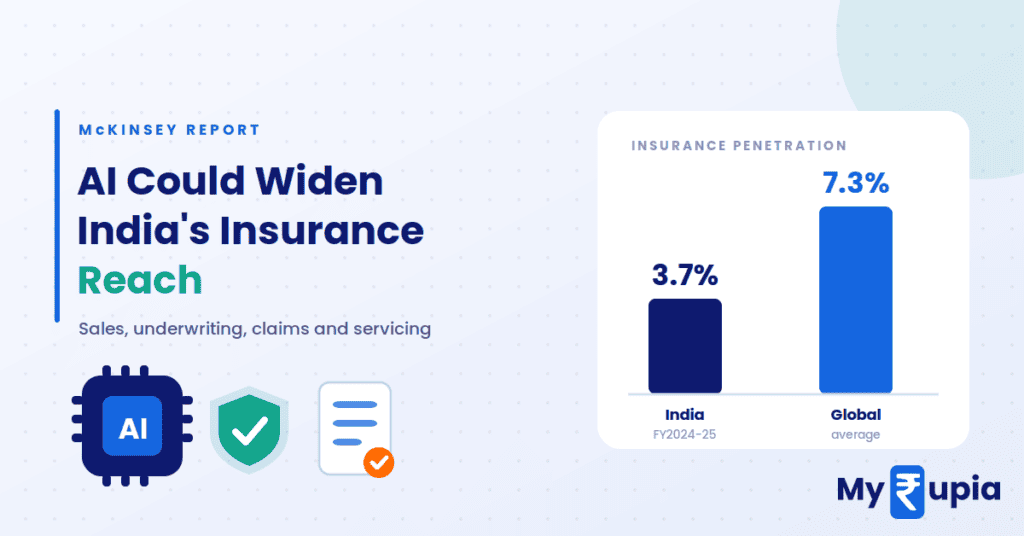
India’s insurance penetration stood at 3.7% of GDP in FY2024–25, comprising 2.7% for life insurance and 1% for non-life insurance, according to the government’s Press Information Bureau. McKinsey’s September 2026 report compares India’s penetration with a global average of approximately 7.3%.
The industry also faces mounting cost pressures. McKinsey estimates that individual new business premiums at private life insurers grew at around 14% annually between FY2022 and FY2025, while total operating expenses increased by approximately 20% annually.
These figures highlight the need for insurers to improve productivity while expanding their reach.
Personalised servicing could strengthen customer engagement
AI could help insurers offer personalised policy guidance, renewal reminders, claims updates and support across digital and voice channels. Customer service representatives could also use AI tools to retrieve policy information, summarise conversations and resolve routine requests more efficiently.
However, technology alone will not close India’s insurance protection gap. Insurers must combine AI adoption with affordable products, transparent communication, responsible data use and accessible customer support to build trust and encourage wider insurance adoption.
Life Insurance Overview: Understand the basics of life insurance and why adequate protection matters for individuals and families.
Also Read: Supreme Court Orders Travel Insurance for Offline Rail Tickets
Disclaimer: This MyRupia article provides information based on publicly available government, regulatory and industry sources. It does not constitute investment, financial, tax, insurance or legal advice. Information, examples, market data and expert views may change over time and do not represent a recommendation to buy, sell, invest in or surrender any financial product. Readers should consider their individual circumstances and consult a qualified financial professional before making financial decisions.