

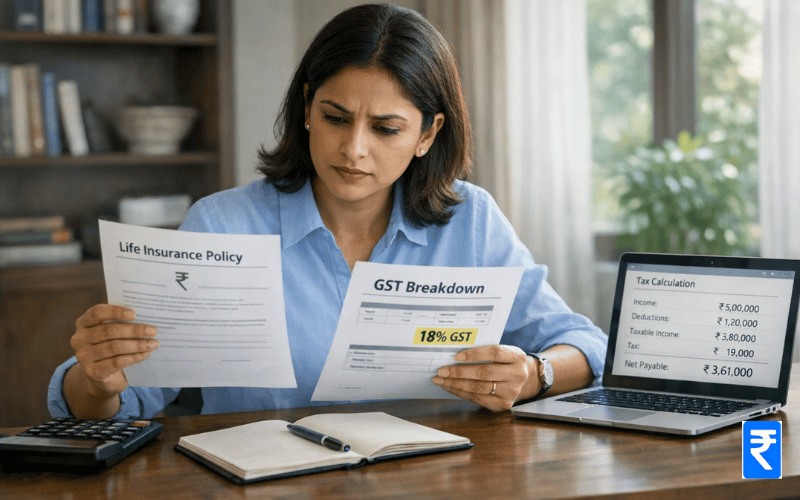
If you ask most people in India why they bought life insurance, their answers usually revolve around responsibility: family security, peace of mind, and tax savings. What rarely comes up in that conversation is GST, not because it isn’t important, but because insurers quietly add it to the premium and people accept it as part of the cost. Since GST came into effect in 2017, it initially made life insurance policies more expensive by adding an 18% tax. However, from September 22, 2025, the government reduced GST on life insurance premiums to 0%, significantly lowering costs for policyholders.
Still, the difference shows up slowly. You may pay a few hundred rupees extra each year, and over time that becomes a few thousand. Over a long policy term, it turns into real money. GST does not reduce your policy benefits, but it does change how much money leaves your bank account and how efficiently your money works for you.
This is why understanding GST on life insurance matters, especially for Indian policyholders who hold policies for 15, 20, or even 30 years.
Table of Contents
- Why is There Tax on Life Insurance?
- What Your Premium Pays For
- GST is Not the Same for All Policies
- Term Insurance and GST
- Savings-Oriented Policies and GST
- ULIPs: GST Treatment Explained
- Pension and Annuity Plans and GST
- Riders and GST
- Does GST Actually Reduce Returns?
- GST and Income Tax: Key Differences
- Managing GST Without Overthinking It
- Conclusion
- Frequently Asked Questions (FAQs)
Why is There Tax on Life Insurance?
The Indian tax law treats insurance as a service under it. GST replaced service tax in 2017, and initially life insurance premiums were taxed at 18% before being reduced to zero in 2025.
GST is not income-based. It does not matter whether you are salaried, self-employed, or retired. If you pay a premium, GST applies. The insurance company collects it and transfers it to the government. The amount does not stay with the insurer.
Every time you pay a premium, you have to pay the GST, too. So a policy with a long premium-paying term naturally attracts more GST over time.
What Your Premium Pays For
When you see your premium amount, it looks like a single number. In reality, it is a mix of several costs together.
There is the obvious part — the cost of life cover. Then there are administrative expenses. There are costs related to maintaining the policy, servicing it, and sometimes distributing it. In policies that include savings or investment, a portion of the premium goes towards building value over time.
GST is applied to service-related components such as risk cover and administrative charges (before 2025 reforms).
GST is Not the Same for All Policies
One of the most confusing aspects for policyholders is that two life insurance policies can attract very different GST amounts, even if the premiums look similar.
Here’s a broad snapshot that helps put things in perspective:
| Policy type | How GST is charged |
| Term Insurance | 0% GST on individual term insurance premiums (from Sept 22, 2025); earlier it was 18%. |
| Endowment/ Money back | 0% GST on individual endowment and traditional plans after Sept 2025; earlier GST was applied only on the risk portion (e.g., 4.5% first year, 2.25% thereafter). |
| ULIPs | 0% GST on ULIPs (post-2025 reform); earlier GST of 18% applied only on charges such as fund management and administration. |
| Pension/ Annuity | 0% GST on individual pension and annuity plans post-2025; earlier, lower effective GST rates applied on the risk portion. |
| Riders | 0% GST on riders attached to individual life insurance policies after Sept 2025; earlier taxed at 18%. |
This table simplifies things, but the experience differs depending on the type of plan.
Term Insurance and GST: No complexity, No relief
Term insurance is the easiest to understand and, tax-wise, the most straightforward, as there are:
- No investment elements
- No maturity benefit, but only life cover
Because of this, GST is charged on the entire premium at 18 percent.
So, earlier, a ₹10,000 premium attracted ₹1,800 GST (18%). After Sept 2025, GST is 0%, so the payable amount remains ₹10,000.
This does increase the cost, but it does not affect the policy payout. In the event of a claim, the nominee receives the full sum assured. Despite the higher GST, term insurance remains the most cost-effective form of protection available in India.
Savings-Oriented Policies and Why GST is Lower There
Endowment and money-back plans work differently. Insurers allocate a part of the premium to savings and use the remaining portion to provide life cover.
Insurers do not apply GST to the entire premium in these plans. Instead, they charge GST only on the risk portion. The tax rate is higher in the first year and drops from the second year onward.
Earlier, insurers charged GST only on the risk portion (4.5% in the first year and 2.25% thereafter). However, from September 2025, the government reduced GST on these policies to 0%.
For a policyholder who pays ₹40,000 annually, GST in the first year would come to ₹1,800. From the second year onward, the tax would fall to ₹900.
Over time, the lower rate reduces the tax burden, but the impact still remains. Higher premiums reduce overall efficiency, and that indirectly lowers the returns from such policies.
ULIPs: Where GST is Present But Not Obvious
ULIPs confuse many people when it comes to GST. The key thing to remember is that GST is not charged on the money that is invested in the market.
Instead, GST applies to the charges deducted by the insurer. These include mortality charges, administration fees, fund management charges, and similar costs.
Earlier, GST of 18% applied to ULIP charges (not investments). From Sept 2025, there is not GST on ULIPs for individual policies.
Because ULIP charges generally reduce over time, the GST impact also reduces as the policy matures. Over long durations, market performance matters far more than GST. Still, the tax does slightly reduce the net investment value, especially in the early years.
Pension and Annuity Plans Get a Softer Treatment
The government reduced GST on pension and annuity plans to 0% for individual policies from September 2025.
Policymakers introduced this lower rate to encourage retirement planning. For retirees or near-retirees, even small cost differences matter, and this reduced GST helps keep payouts more stable.
Riders: Small Additions, Full GST
Riders often feel inexpensive when you add them to a policy. Under the new 2025 reforms, the government has removed GST on riders for individual policies.
Common examples include:
- Accidental death riders
- Critical illness riders
- Disability riders
Insurers tax each rider separately. When policyholders add multiple riders, the cumulative GST can rise higher than expected.
This is why policyholders should choose riders carefully instead of adding them automatically.
Does GST Actually Reduce Returns?
GST does not reduce the sum assured or the maturity value directly. Before Sept 2025, GST increased premiums and indirectly reduced returns. After GST removal, policyholders retain full premium value, improving cost efficiency.
Higher premiums mean less money available for other investments. In savings-based policies, the effective yield becomes slightly lower. Over long durations, this difference compounds.
Shorter-term policies feel the impact more sharply. Long-term policies dilute it.
A simple comparison helps explain this:
| Policy category | Impact (Pre-2025) | Impact (Post-2025) |
| Term | High | None |
| Endowment | Moderate | None |
| ULIPs | Low–Moderate | None |
| Pension | Low | None |
GST and Income Tax are Not Connected
Many people assume they can adjust the GST they pay on premiums under income tax deductions. However, this assumption is incorrect.
Policyholders may claim a deduction on the premium under Section 80C. However, they cannot claim the GST portion separately. In practice, GST remains an expense that stays outside the income tax system.
Managing GST Without Overthinking It
GST is no longer applicable on individual life insurance policies after Sept 2025, so policyholders no longer need to factor it into cost management decisions.
Buying insurance early helps reduce risk-related charges. Avoiding unnecessary riders keeps premiums lower. Comparing policies based on total cost rather than just base premium gives a clearer picture.
Most importantly, understanding the structure of the policy before buying it prevents disappointment later.
Conclusion
GST was previously added to the cost of life insurance, but its removal in 2025 has significantly improved affordability and accessibility.
Remember, life insurance remains a long-term commitment. Knowing how GST fits into that commitment simply makes you a more informed policyholder.
FAQs
1. Is Goods and Services Tax applicable to all life insurance policies issued in India?
Yes, it is applicable, though not always in a way that looks obvious at first glance. Some policies clearly show GST on the entire premium, while others don’t seem to add much tax at all. That usually happens because GST is being charged only on certain components of the policy. So while every life insurance policy does carry GST, the way it shows up can differ quite a bit.
2. Does the payment of GST have any effect on the sum assured or the claim settlement process?
No, it really doesn’t. GST is settled at the time the premium is paid and doesn’t travel with the policy after that. Once the policy is in force, the tax part is no longer relevant. During a claim, the insurer looks only at coverage and policy terms. The GST you paid earlier doesn’t reduce or alter the payout in any way.
3. Why is the GST rate on term insurance policies higher compared to other life insurance products?
Term insurance is designed to be simple. There’s no savings element, no investment portion, and nothing that builds value over time. Because of that, the entire premium is treated as a charge for providing protection. GST is therefore calculated on the full amount. Other policies split the premium into different parts, which naturally lowers the portion on which GST is applied.
4. Can GST paid on life insurance premiums be claimed as a deduction under the Income Tax Act?
No, the GST amount cannot be claimed separately. This tends to confuse people because insurance premiums themselves are eligible for deductions under Section 80C. But GST doesn’t fall under that benefit. It is simply an additional cost added to the premium and does not provide any extra tax relief.
5. Does GST materially reduce the returns from life insurance policies over the long term?
Not in a direct sense. GST doesn’t cut into maturity values or guaranteed benefits. What it does is increase the premium you pay each year. Over time, especially in savings-based policies, this can slightly affect efficiency. In long-term policies, the impact usually evens out, but it’s still part of the overall cost picture.