

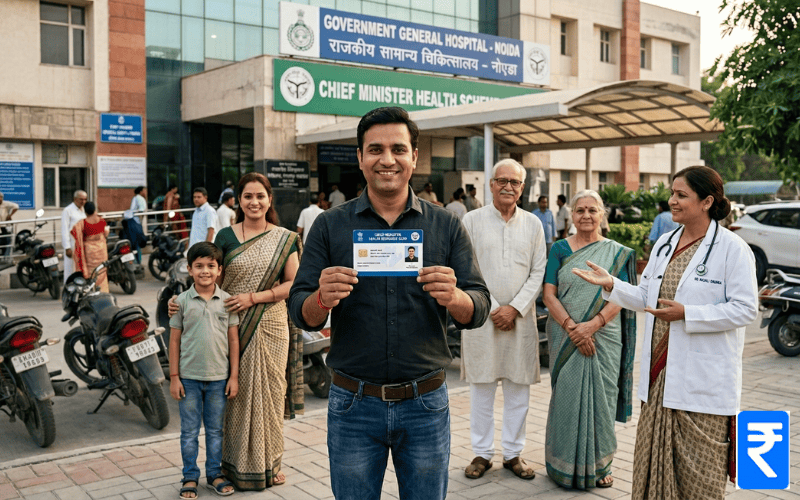
India’s healthcare inflation accounts for 48% of total health spending, creating severe financial pressure on low and middle-income households. To address this, state governments across India have launched CM health insurance schemes that grant eligible residents access to medical services without upfront payment at approved facilities.
This guide covers everything you need to know about the Chief Minister health insurance card — how it works, who qualifies, how to apply, and which hospitals accept it.
Table of Contents
- What Is a Chief Minister Health Insurance Card?
- Scheme Objectives
- How It Works
- CM Health Insurance Card Eligibility Criteria India
- Documents Required
- How to Apply for Chief Minister Health Card
- Coverage and Benefits
- What Is Not Covered
- Coverage Limits
- Chief Minister Health Card Hospitals List
- State Scheme vs Ayushman Bharat
- Advantages
- Limitations
- Common Claim Rejection Reasons
- Renewal and Validity
- Tips for Beneficiaries
- Future Developments
- Conclusion
- FAQs
What Is a Chief Minister Health Insurance Card?
A Chief Minister health insurance card is issued under health coverage schemes run by state governments across India. Backed primarily by state budgets — with occasional support from national programmes — the card allows beneficiaries to access cashless treatment at empanelled public and private hospitals.
The card serves as proof of enrolment, permitting care without upfront payment at affiliated facilities. While coverage details vary by state, the core objective of every CM health insurance scheme in India remains the same: reduce financial barriers to quality healthcare.
Common scheme names across states include:
- Chief Minister Comprehensive Health Insurance Scheme — Tamil Nadu
- Mukhyamantri Amrutum Yojana — Gujarat
- Chief Minister Jan Arogya Yojana — various states
Despite differences in names and benefit scope, how a Chief Minister health insurance card operates remains largely consistent across India.
Scheme Objectives
State government health insurance schemes are designed to:
- Lower out-of-pocket spending on medical care
- Improve access to hospitalisation and surgeries
- Protect low-income households from catastrophic medical expenses
- Strengthen public and private healthcare networks through empanelment
- Promote early diagnosis and treatment of serious illnesses
Unexpected hospitalisation often strains household budgets within days. The CM health insurance scheme India exists precisely to prevent that financial destabilisation.
How It Works
Once eligibility is verified against government databases — ration cards, socioeconomic surveys, or income records — beneficiaries receive either a physical or digital Chief Minister health insurance card. This card is presented during hospitalisation at any empanelled centre.
1. Enrolment and Identification
Families qualify based on income reports, ration documentation, or household assessments. After verification, they receive a physical card or digital credential.
2. Empanelled Hospitals
Both registered private clinics and public medical centres participate. Access is limited to officially empanelled facilities.
3. Cashless Treatment
At a network hospital, the card is verified, the treatment package is approved, and the insurer or state body settles the bill directly with the hospital. No upfront payment is required from the patient.
4. Package-Based Coverage
Most CM health insurance schemes operate on fixed treatment packages that include:
- Doctor fees
- Hospital stay
- Surgery costs
- Medicines during hospitalisation
- Diagnostic tests
5. Claim Settlement
Claims are processed by the hospital directly with the implementing agency or insurer. Patients are only required to submit personal claims if treatment is received outside the network.
CM Health Insurance Card Eligibility Criteria India
Government health insurance card eligibility varies by state, but the following conditions apply in most schemes:
Income Limits
Families earning below a specified annual threshold are eligible. The exact limit differs by state.
Residency
Permanent residency within the issuing state is mandatory.
Ration Card or Government ID
Most schemes require a ration card alongside Aadhaar or equivalent official identification.
Socioeconomic Status
Priority is typically given to:
- Economically weaker sections (EWS)
- Daily wage labourers
- Rural households
- Vulnerable and marginalised communities
Exclusions
Some schemes exclude:
- Income taxpayers above certain thresholds
- Government employees covered under separate medical programmes
Because CM health insurance card eligibility criteria in India differ by state, always verify on your state health department’s official website before applying.
Documents Required
Applicants generally need the following:
- Aadhaar card or any government-issued photo ID
- Address proof
- Income certificate
- Ration card or family card
- Passport-size photographs
Certain states accept online verification through official databases, reducing the paperwork required.
How to Apply for Chief Minister Health Card
Knowing how to apply for Chief Minister health card is straightforward once eligibility is confirmed. Follow these steps:
Step 1: Check Eligibility
Visit the official state health scheme website or your district health office to confirm whether your household qualifies under the government health insurance card eligibility criteria.
Step 2: Submit Application
Applications can be submitted:
- Online through the state government portal
- At enrolment camps organised by local authorities
- At designated government or district offices
Step 3: Verification
Authorities verify submitted documents and cross-check eligibility against official databases.
Step 4: Card Issuance
Once approved, you receive a physical or digital Chief Minister health insurance card — your entry point to cashless treatment at empanelled hospitals.
Coverage and Benefits
State government health insurance scheme benefits typically include:
Hospitalisation
Inpatient treatment costs are covered under most plans.
Surgeries
Approved surgical procedures fall within defined benefit packages.
Diagnostic Tests
Tests conducted during hospitalisation are generally included.
Pre- and Post-Hospitalisation
Some schemes cover costs incurred before admission and after discharge, subject to limits and prior authorisation.
Maternity Benefits
Select schemes include pregnancy and childbirth expenses, with specific caps and conditions.
Financial Coverage
Regardless of state, the Chief Minister health insurance card generally provides coverage ranging from ₹1 lakh to ₹5 lakhs per family per year. Many programmes cover over 1,000 pre-defined treatment packages, ensuring standardised cost control.
What Is Not Covered
Common exclusions under the CM health insurance scheme India include:
- Cosmetic and elective aesthetic procedures
- Experimental treatments
- Outpatient visits (under most plans)
- Non-medical expenses
- Treatments outside approved packages
- Alternative therapies unless specifically added
Understanding exclusions helps avoid unexpected out-of-pocket expenses.
Coverage Limits
Most schemes define annual per-family caps. Beneficiaries should always verify:
- Maximum annual coverage amount
- Procedure-specific sub-limits
- Number of family members covered under one card
Typical limits range from ₹1 lakh to ₹5 lakh or more, depending on the state and scheme design.
Chief Minister Health Card Hospitals List
A Chief Minister health insurance card is valid only at empanelled hospitals. Before admission, always:
- Confirm the hospital is on the Chief Minister health card hospitals list
- Verify whether your specific treatment is eligible
- Check pre-authorisation requirements
The official list of empanelled hospitals is available on your state’s health scheme website. Leading schemes typically include both government hospitals and a large network of private facilities across districts.
State Scheme vs Ayushman Bharat
Many beneficiaries confuse state-level schemes with the central government’s Ayushman Bharat programme. Key differences:
| Feature | CM Health Insurance Scheme | Ayushman Bharat (PMJAY) |
|---|---|---|
| Coverage Amount | ₹1–5 lakh (varies by state) | ₹5 lakh per family/year |
| Portability | Valid within issuing state only | Valid across India |
| Database | Regional data systems | Centralised national database |
| Eligibility | State-specific criteria | SECC national data |
| Administration | State health department | National Health Authority |
Beneficiaries may hold both cards where both schemes operate — always verify with local authorities on how the two programmes align in your state.
Advantages
Key benefits of the Chief Minister health insurance card include:
- Cashless treatment at empanelled hospitals
- No upfront payment for approved procedures
- Coverage for major surgeries and diagnostics
- Access to both public and private hospital networks
- Financial protection against large, unexpected medical bills
- State government health insurance scheme benefits that extend to dependents
Limitations
The Chief Minister health insurance card does not eliminate all medical expenses. Limitations to be aware of:
- Package caps may not cover the full cost of complex treatments
- Limited or no outpatient coverage
- Waiting periods in some schemes
- Geographic restrictions — valid only within the issuing state
- Documentation requirements at the time of hospitalisation
Always review your specific scheme’s guidelines carefully.
Common Claim Rejection Reasons
Claims are frequently denied due to:
- Treatment not listed under approved packages
- Incorrect or incomplete documentation
- Treatment taken at a non-empanelled hospital
- Absence of required pre-authorisation
- Lapsed or unrenewed card
Understanding these rules significantly reduces the likelihood of rejection.
Renewal and Validity
Some schemes require periodic renewal or re-verification. To avoid gaps in coverage:
- Update income or family records if circumstances change
- Ensure Aadhaar or ID details remain current
- Check your card’s validity date regularly
Failure to renew can interrupt access to cashless treatment at empanelled facilities.
Tips for Beneficiaries
To get the most from your Chief Minister health insurance card:
- Keep all documents accessible at all times
- Always verify hospital empanelment before admission
- Understand your scheme’s package limits before treatment
- Ask the hospital about pre-authorisation steps upfront
- Maintain discharge summaries and medical records for future reference
Future Developments
State government health insurance schemes are increasingly integrating with national digital health initiatives. Digital Health IDs under Ayushman Bharat are expected to synchronise verification, patient records, and claim settlements across platforms.
In the near future, the Chief Minister health insurance card may be linked to these digital systems — enabling faster verification, reduced administrative burden, shorter waiting times, and a smoother overall experience for beneficiaries.
Conclusion
The Chief Minister health insurance card plays a vital role in expanding hospital access and reducing financial burden for eligible households across India. However, the value it delivers depends closely on understanding your CM health insurance card eligibility criteria, the scheme’s benefit limits, the Chief Minister health card hospitals list in your area, and the steps required to use it correctly.
Taking time to understand what is covered, what is excluded, and how to apply for Chief Minister health card in your state helps avoid surprise costs and ensures you get the full benefit of the scheme when you need it most.
Frequently Asked Questions
1. Is the Chief Minister health insurance card valid in all hospitals?
No. The card is valid only at empanelled hospitals listed under your state’s scheme. Always confirm a hospital’s empanelment status before admission to avoid out-of-pocket expenses.
2. What is the CM health insurance card eligibility criteria in India?
Eligibility is primarily based on income, state residency, and socioeconomic status. Most schemes target economically weaker sections, rural households, and daily wage earners. Criteria vary by state — check your state health department’s website for exact requirements.
3. How do I apply for the Chief Minister health card?
Visit the official state health scheme portal or nearest district health office, submit the required documents, complete verification, and receive your card upon approval. Many states also offer enrolment at community camps.
4. Does the Chief Minister health insurance card cover all diseases?
No. Coverage applies to pre-defined treatment packages. Cosmetic procedures, outpatient visits, and experimental treatments are typically excluded.
5. Can I hold both Ayushman Bharat and a state CM health card?
In many states, yes. Both programmes can co-exist, though benefits and eligibility criteria differ. Check with your state health authority for specific rules.
6. Where can I find the Chief Minister health card hospitals list?
The official list of empanelled hospitals is published on your state government’s health scheme website. Most schemes include both government hospitals and a wide network of private facilities across districts.