

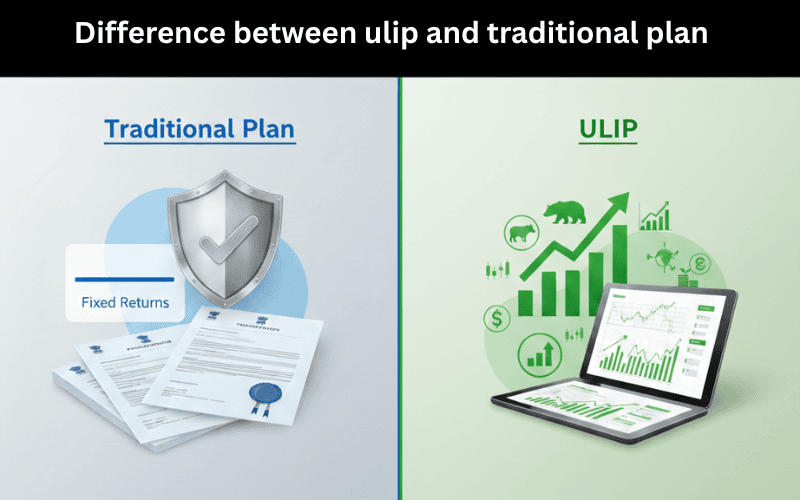
Once you have a secured job and income, you start to think about the next step in your life – a step paving the way to a secure, stable, and promised future for your loved ones. Life insurance plans are a great starting point for your progressive financial planning for the future. With numerous insurance plans available on the market, selecting the right plan requires thorough research and alignment with individual goals. This is where the choice between traditional life insurance plans and ULIPs comes into focus. While both have specific benefits and risks, there is a significant difference between ULIP and traditional plan working mechanisms.
This article explores traditional insurance plans and ULIPs, their differences, key benefits, and aims to guide you in finding the right plan that best suits your financial goals and future aspirations.
Table of Contents
- What is ULIP?
- What is a Traditional Life Insurance Plan?
- Types of Traditional Life Insurance Plans
- Benefits of Traditional Life Insurance Plans
- Benefits of ULIPs
- Key Differences Between ULIP and Traditional Life Insurance Plans
- Risk level (market-linked vs low risk)
- Return potential (variable vs stable)
- Transparency levels
- Lock-in period differences
- Premium allocation structure
- ULIP vs Traditional Plan: Comparison Table
- Which Plan to Choose?
- A traditional life insurance plan
- ULIPs are a better option
- Conclusion
- FAQs
What is ULIP?
ULIP stands for Unit Linked Insurance Plan. In simple terms, it is an insurance product that combines life insurance protection with market-linked investment options in a single plan. Therefore, it helps policyholders build long-term wealth while also providing life cover.
In this plan, the premium you pay is divided between life insurance protection and investments in market-linked funds such as equity, debt, or hybrid funds. As a result, you receive dual benefits, insurance coverage and investment growth. Additionally, the investment component depends entirely on the investor’s choice and risk appetite, with the flexibility to switch funds based on market conditions.
Finally, at maturity, the insurer pays the fund value accumulated through these investments to the policyholder. However, the final return depends on market performance.
What is a Traditional Life Insurance Plan?
They are the classic insurance plans that focus on providing long-term financial security and savings benefits. The plans promise assured benefits to the policyholder on maturity. Risk is covered by the insurance provider, and the policyholder is credited with tax benefits. Depending on the policy terms, the plan can be extended, and in case of death, the death benefit will be paid to the nominees.
Types of Traditional Life Insurance Plans
Below are the common types of traditional plans available in India:
- Endowment Plan: This plan is a pure life insurance product that provides financial protection for a fixed term. It pays a death benefit if the policyholder passes away during the policy period, with no maturity payout.
- Whole Life Insurance Plan: This plan is a savings-oriented life insurance plan that combines life cover with assured maturity benefits. It offers predictable payouts through an assured sum and possible bonuses, without exposure to market fluctuations.
- Money-Back Plan: This is a traditional insurance plan that offers periodic payouts during the policy term, along with life cover. In case of death, the nominee receives the full assured benefit regardless of payouts made.
Benefits of a Traditional Life Insurance Plan
Traditional plans prioritize stability, certainty, and long-term financial security over market-linked returns. The key benefits include:
- Capital Safety: The premium paid is safe from market fluctuations as the companies invest in low-risk instruments that provide stable returns.
- Guaranteed Returns: The sum assured at the purchase of the policy is returned to the policyholders with declared bonuses depending on the insurer’s performance.
- Predictable Payouts: The payout at maturity is predictable as they are exempt from market risks.
- Tax Efficiency: Premiums are deductible under Section 80C, and maturity is generally tax-free under Section 10(10D).
- Stable Life Cover: Traditional life insurance offers consistent life insurance coverage throughout the policy term.
- Loan Facility: You can borrow money against the policy’s surrender value at competitive interest rates.
- No Fund Management Required: Policyholders are free of the stress of managing funds as the investors do the work on their behalf.
Benefits of ULIPs
ULIPs typically offer better flexibility and growth potential. Here are the major benefits policyholders have:
- Market-Linked Growth: The premium paid is invested in funds of your choice, such as equity or debts allowing you to earn higher returns.
- Fund Switching Flexibility: Though ULIPs have higher risk when compared to traditional life insurance plans, the policyholders have the flexibility to switch between equity, debts or balanced funds, taking advantage of market changes.
- Better Transparency: ULIPs offer high transparency through regular disclosure of NAV, fund value, and applicable charges.
- Dual Benefit Structure: ULIPs combine life insurance coverage with market-linked investment potential in a single plan.
- Partial Withdrawals: After the mandatory lock-in period of 5 years, partial funds can be withdrawn in case of emergencies without cancelling the entire policy.
- Tax Treatment: Premiums may qualify under Section 80C, and maturity proceeds are exempt under Section 10(10D), subject to applicable conditions and premium limits.
Key Differences Between ULIP and Traditional Life Insurance Plans
Life cover is the common feature of ULIPs and traditional life insurance plans. That said, it is important to explore the difference between ulip and traditional plan.
Risk Level
Traditional Insurance plans have a low risk factor as the payment is protected from market fluctuations, and the risk is borne by the insurance provider. Ideal for risk-averse policyholders.
ULIPs have a higher risk factor compared to traditional life insurance plans, as they provide a dual-benefit option that includes market-linked investment. The funds invested are subject to market fluctuations and are considered better suited for those looking to save and invest at the same time, and who can tolerate a certain level of risk.
Returns
Traditional life insurance plans offer a predictable and assured return payment as the market fluctuations are not an affecting factor. Even if the market crashes, your returns will not be affected.
ULIPs return may vary depending on where you have chosen to invest your funds. The returns fluctuate based on the Net Asset Value of the market. Though market volatility can affect returns, policyholders have the option of switching funds to manage risks.
Transparency
Traditional insurance plans have limited transparency. The premium payments are invested by the insurance provider, and in return, the policyholders are protected from market fluctuations.
ULIPs have high transparency, given the option to choose where to fund your investment. However, the risk should be managed by the policyholder with the flexibility of switching funds.
Lock-in Period
The lock-in period is usually longer in traditional life insurance plans, which also indicates limited liquidity and long-term commitment. Note that some plans, such as a whole life insurance plan, may provide coverage for several decades. However, it is not to be confused with the lock-in period.
ULIPs have a mandatory lock-in period of 5 years, after which premature withdrawals are also allowed, giving flexibility to the policyholders.
Premium Allocation
The premiums paid in traditional life insurance plans are entirely handled by the insurance provider. The policyholders do not have control over where the premium is invested.
In ULIPs, the premium is split into two parts, where one portion goes towards life insurance coverage, and the remaining amount is invested in market-linked funds such as debts, equity, and balanced funds, depending on the choice of the policyholder.
Here is a quick look at the difference between ULIP and traditional plan:
| Factor | ULIP | Traditional Plan |
| Risk level | Market-linked risk | Low risk |
| Returns | Higher potential | Moderate but stable |
| Transparency | High | Limited |
| Lock-in period | 5 years | Longer commitment |
| Premium allocation | investment+insurance | Mostly insurance |
Which Plan to Choose
Once you know the difference between ulip and traditional plan, the right choice depends on your financial goals, risk appetite, and investment horizon. Here’s how to decide:
A traditional life insurance plan may be the suitable choice if you:
- Prefer certainty and capital protection over higher returns
- Have a low-risk appetite and want predictable outcomes
- Are you planning for non-negotiable goals like a child’s basic education or family security
- Value peace of mind from guaranteed or stable maturity benefits, regardless of market conditions
- Want assured benefits with minimal involvement
ULIPs can be a better choice when you:
- Want to beat inflation and build long-term wealth
- Have a long investment horizon of at least 10 to 15 years
- Are comfortable with short-term market fluctuations for higher return potential
- Prefer active involvement, including fund switching based on market conditions
- Are you planning goal-based wealth creation, such as retirement or higher education
- Want a transparent product with partial withdrawals after 5 years and growing life cover
Conclusion
Both ULIPs and Traditional Life Insurance plan serve different financial needs. While ULIPs generally better suit investors seeking market-linked growth, traditional life insurance plans offer stability and security. Understanding your goal and risk appetite is the key to making the right choice.
FAQs
Q1. What is the main difference between ULIPs and traditional life insurance plans?
The risks and returns make the key difference between the two options. ULIPs are market-linked with high risk, while traditional plans are more stable and predictable with lower risk.
Q2. Are ULIPs riskier than traditional insurance plans?
ULIPs can carry higher market risks since you invest a part of the premium in equity or debt funds. Traditional plans are not market-linked.
Q3. Do ULIPs and traditional insurance plans provide life insurance cover?
Yes. Both ULIPs and traditional plans provide life insurance cover along with maturity or investment benefits.
Q4. What is the lock-in period for ULIPs and traditional insurance plans?
ULIPs have a mandatory lock-in period of five years. The lock-in period for traditional plans is longer, depending on the type of plan.
Q5. Are ULIP returns guaranteed?
No. ULIP returns are market-linked and not guaranteed. Traditional plans can have guaranteed benefits and declared bonuses, depending on the type of plan.