

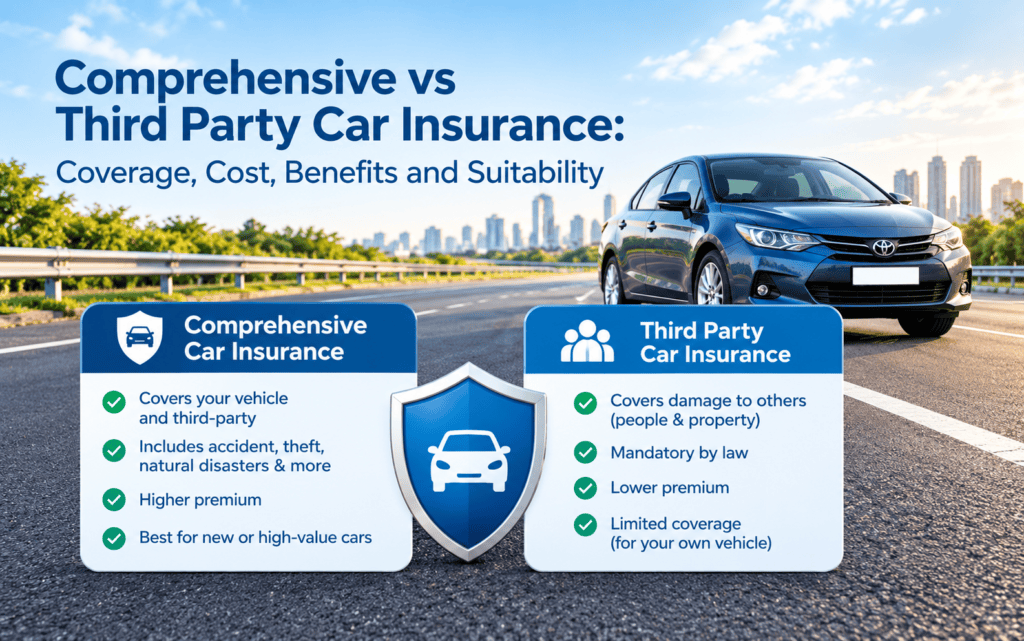
Every time you purchase car insurance in India, the decision often comes down to comprehensive vs third party car insurance. Each option offers a different level of protection, cost, and risk exposure. And this debate between the two is a common decision point among indian vehicle owners. As per the Motor Vehicles Act, 1988, all cars that are driven in public places must have motor vehicle insurance. Even if they choose the most basic insurance policies, policyholders must have at least “third-party liability” car insurance.
If the owner of the car or someone else driving the other vehicle causes an accident, the third-party coverage is very important. You should know that car insurance may or may not cover damage done by the owner.
So, between comprehensive vs third party car insurance, which one should you choose? In this guide, we will discuss coverage, cost, benefits, risks, and suitability to help you make an informed decision.
Understanding Car Insurance in India
Car Insurance in India is a policy that covers the car owner’s financial losses caused by damage or theft of the insured vehicle, as long as the terms and conditions are met. According to the law, all automobile owners in India must get car insurance for their vehicles that are on the road. Car insurance protects the owner of the vehicle against legal liability for injuries or damage to third-party property. You have to choose between Comprehensive and Third Party car insurance options for you to make an informed choice.
What Is Third-Party Car Insurance?
If you get into an accident, your automobile insurance will shield you from legal problems. Let’s say you hit someone’s automobile and did a lot of damage. In that instance, your insurance company will pay for any costs or debts that come up as a result. Third-party insurance covers the following aspects:
- Property Damage: If you accidentally hurt someone else’s property badly, you don’t have to worry about the costs that come with it. Third-party insurance guarantees that the insurance company will pay for the damage to the third party. So, the insured can securely get out of the tricky problems that come up after an accident.
- Death: If you are in an accident and someone else dies, you are the only one accountable for the loss that cannot be made up for. In these situations, you don’t need to worry because your insurance company has your back. When someone dies, the court decides claims. The court decides how much money to give based on the third party’s potential to earn money and the effects of the regrettable loss.
- Partial and Permanent Disability: Sometimes, accidents leave people disabled. If the third party has a partial disability, like a broken bone or another injury that will heal over time, the insurance company will pay for the medical costs of the person or people who were hurt. But if the third party becomes permanently disabled, the insurance will provide them a pre-assured amount.
- Bodily Injuries: Medical coverage is available for all kinds of bodily injuries, no matter how bad they are. Reputable insurance providers know that accidents happen and that they can’t be stopped. So, by giving the insured cash help, insurers effectively lower their stress.
What is Comprehensive Car Insurance?
Comprehensive insurance is a kind of insurance that covers accidental external damage to your car, including collisions, along with non-collision risks such as theft, fire, and natural events. It keeps your car safe from unexpected and harmful events like tornadoes, wild animal attacks, spray paint vandalism, break-ins, and falling buildings that crush it, among other things.
Basically, this insurance covers a lot of damage to your car that isn’t caused by an accident, giving you peace of mind in a lot of bad scenarios. The Insurance Regulatory and Development Authority of India (IRDAI) says that full coverage usually covers damage to vehicles caused by:
- Accidental external damage
- Fire, explosion, self-ignition, lightning
- Floods, storms, cyclones, hurricanes, tempests, inundations, hailstorms, frost
- Landslides, rockslides
- Riots and strikes
- Acts of terrorism
- Malicious acts
- Burglary, housebreak, theft
- Transit by rail, road, inland waterways, lift, elevator or air
This distinction often causes confusion, as comprehensive policies include both liability and own-damage protection. The third-party policies remain limited to legal liability.
Key Differences Between Comprehensive vs Third Party Car Insurance
To understand the comprehensive vs third party car insurance debate effectively, here is the difference between the two.
| Feature | Third-Party Car Insurance | Comprehensive Car Insurance |
| Coverage | Covers damages caused to a third party, including their property, vehicle, or injuries caused by the insured car. | Covers third-party liabilities along with damages to your own vehicle. |
| Add-on Cover | Add-ons are not available under this policy. | Offers optional add-ons such as zero depreciation, roadside assistance, and engine protection. |
| Legal Requirement | Mandatory to drive legally on Indian roads under the Motor Vehicles Act. | Not legally required, but often considered for wider protection. |
| Premium Calculation | Premium is fixed based on engine cubic capacity and revised periodically by the IRDAI. | Premium depends on factors such as Insured Declared Value (IDV), vehicle type, location, and selected add-ons. |
| Premium Cost | Generally lower due to limited coverage. | Usually higher, as it includes broader protection and customisation options. |
| Policy Exclusions | Does not cover any damage to your own vehicle or personal injuries. | Does not cover damages arising from situations like driving under the influence, negligent driving, or driving without a valid licence. |
Pros and Cons of a Comprehensive Insurance Policy
The comprehensive insurance policy has certain pros and cons, which need to be taken into consideration to understand the more suitable option between comprehensive vs third party car insurance effectively. They are:
Pros
The pros of comprehensive car insurance are:
- Broadest Coverage: It gives you protection against your own damage, theft, vandalism and natural disasters.
- Third-Party Coverage: It also gives you all the coverage of third-party insurance
- Customizable Add-ons: It comes with customisable add-ons like zero depreciation, engine protection, and 24×7 roadside assistance.
- Financial Security: It protects your savings against major financial hurdles like repair costs.
- Loan Requirement: If you have financed your vehicle, then loan lenders often make this insurance mandatory.
- No Claim Bonus (NCB): It rewards safe driving with a discount on premiums, lowering the cost as time goes on.
Cons
The cons of comprehensive car insurance are:
- Higher Premiums: They cost significantly more than third-party insurance and have higher premiums.
- Not Ideal for Old Cars: Older car has a low IDV (Insured Declared Value). Some owners may choose third-party cover. However, the decision depends on individual risk exposure and usage.
- Deductibles: There is a mandatory out-of-pocket cost which you have to pay during the claim process, which can be a lot at times.
- Doesn’t Cover Everything: It often excludes wear and tear, damage during drink and drive and other mechanical damage.
Pros and Cons of Third-Party Car Insurance
Much like comprehensive, there are major Pros and Cons of third-party car insurance as well, which you need to be aware of to understand the comprehensive vs third party car insurance debate and pick the most suitable option.
Pros
The pros of third-party car insurance are:
- Cost-effective: The premiums are generally quite lower compared to comprehensive car insurance.
- Legal Protection: It ensures that you are covered in case of any legal trouble, if you accidentally hurt someone or damage someone else’s property.
- Simple to purchase: It is significantly easier to purchase compared to comprehensive car insurance policies
- Property Damage Protection: If you accidentally damage someone’s car, home, or other property, your policy can assist in paying for those costs, which will make your life easier.
Cons
The cons of third-party car insurance are:
- Narrow Coverage: The coverage is very narrow. You do not get any coverage when others cause any damage, or just any damage or injury.
- No Claims Paid for Natural Calamities: If your car is damaged in any natural calamity, then you also do not get any coverage.
- No Option for Add-Ons: Unlike comprehensive insurance, there are no add-ons which you can pick in order to get more coverage.
- Complex Claims Process: Third-party claims may involve legal procedures, especially in cases involving injury or death, which can extend the claim settlement timeline.
Add-ons in Comprehensive Car Insurance
As already mentioned, the biggest difference between comprehensive vs third party car insurance is that in comprehensive car insurance, you get add-ons which increase your overall coverage. Here are some of the most common coverages, and when they may be helpful.
| Type | Add-on / Scenario | Explanation |
| Common Add-ons | Zero Depreciation Cover | Reduces depreciation deduction during claims, increasing payout. |
| Engine Protection Cover | Covers engine damage due to water ingress or oil leakage. | |
| Roadside Assistance | Provides help during breakdowns, towing, or minor repairs. | |
| Return to Invoice Cover | Helps recover the full invoice value of the car in case of total loss or theft. | |
| Consumables Cover | Covers costs of items like engine oil, nuts, bolts, and lubricants. | |
| When It May Be Useful | New Car Owners | Helps minimise out-of-pocket expenses in the initial years. |
| High-End Vehicles | Protects against higher repair and replacement costs. | |
| Flood-Prone or High-Traffic Areas | Offers additional protection in risk-prone environments. |
Top Car Insurance Companies In India
Here are the top car insurance companies from which you can choose.
| Insurer | Network Garages | Key Highlights |
| ICICI Lombard General Insurance Co. Ltd. | Around 5,900 | Known for relatively quick claim processing and a wide repair network |
| The New India Assurance Co. Ltd. | Around 3,000 | Government-owned insurer offering comprehensive coverage options |
| TATA AIG General Insurance Co. Ltd. | Around 7,500 | Offers features like live video claim support and multiple add-ons |
| United India Insurance Co. Ltd. | Around 3,100 | Public sector insurer with a broad service network across India |
| Bajaj Allianz General Insurance Limited | Around 4,000 | Recognised for quick policy issuance and instant claim services |
| Go Digit General Insurance Limited | Repair Anywhere Facility | Provides flexible repairs, unlimited zero depreciation (select plans), and a warranty on repairs |
| Cholamandalam MS General Insurance Co. Ltd. | Around 8,300 | Offers conveniences like vehicle pick-up/drop-off and self-inspection claims |
Suitability: Which Policy Fits Which Driver?
Most car owners would be better off with comprehensive coverage, especially if their car is new or worth a lot of money. This way, they are fully protected both financially and mentally. On the other hand, third-party insurance is only enough to meet legal requirements or if the car’s value is so low that the risk can be taken.
If you’re thinking about getting auto insurance but aren’t sure whether to obtain third-party or comprehensive coverage, figure out how much money you can spend and what kind of coverage you need. Then choose between the two. Find the greatest coverage for your automobile so that it is safe from anything that might happen on the road.
Conclusion
Ultimately, the choice between comprehensive vs third party car insurance depends on your wants and needs. It is always better to first assess your needs and compare multiple policies side by side to make an informed choice.
Frequently Asked Questions
Q1. What's the difference between third-party car insurance and comprehensive?
If you’re at fault in an accident, third-party automobile Insurance will pay for damage your automobile does to other people’s cars and property. Comprehensive Car Insurance will pay for damage to your own car as well.
Q2. Which is better, fully comprehensive or third-party insurance?
The better option for you always depends on your individual needs and wants. Assess them carefully, compare policies and then make an informed choice.
Q3. What are the disadvantages of 3rd party insurance?
The main problem with third-party liability insurance is that it doesn’t cover damage to your own car. This means that if you hit a post, railing, or another car, you will have to pay for the damage. You won’t get paid if your automobile is stolen or damaged.
Q4. Can I drive with third-party insurance?
Yes, you can lawfully drive with third-party insurance in India. The Motor Vehicles Act, 1988, says that this is the minimum amount of insurance you need.
Q5. Can I claim directly from third-party insurance?
Third-party claims are typically filed through the Motor Accidents Claims Tribunal (MACT), especially in cases involving injury or death. This differs from standard own-damage claims made directly with your insurer.