

Most people think of life insurance as a windfall for their family – a lump sum of ₹1 Cr or ₹2 Cr to replace income or fund a child’s education. Yet there is a quieter, strategic side to the insurance industry designed specifically for debts that do not die when you do. A standard term plan protects your family’s future income. That said, it doesn’t automatically align with the obligations you still owe, like a home loan or other fixed debts.
Let’s say you have a fresh ₹75 Lakh home loan amortization schedule staring at you. Relying solely on a standard term plan might not be the most efficient move. As you pay EMIs, the outstanding balance decreases each year, while a standard term plan stays fixed for the entire tenure. This is where decreasing term insurance enters the discussion. It is a specialized tool that shrinks alongside your liabilities, aligned with the debt payment. After all, the level of protection you need in year 15 can be different from what you need in year one.
This article explores more about decreasing term insurance and how it protects loans and other financial liabilities.
Table Of Content
- What is Decreasing Term Insurance
- How Decreasing Term Insurance Works: The Mechanics
- The Schedule
- The Premium
- The Payout
- Decreasing Term Insurance vs Standard Term Plan (MRI vs Term Insurance)
- Pros and Cons of Decreasing Term Insurance
- Tax Implications
- Who Should and Shouldn’t Opt for Decreasing Term Insurance
- Conclusion
- FAQs
What is Decreasing Term Insurance?
Think of decreasing term insurance as the mirror image of your home loan repayment schedule.
With a standard level term plan, you pay a fixed premium for a fixed death benefit, say, ₹1 Crore for 20 years. If you pass away in year 19, your family gets the full ₹1 Crore, even if the outstanding home loan balance is only ₹5 Lakhs. That sounds great, but you paid a higher premium for that maximum capacity every single year for two decades.
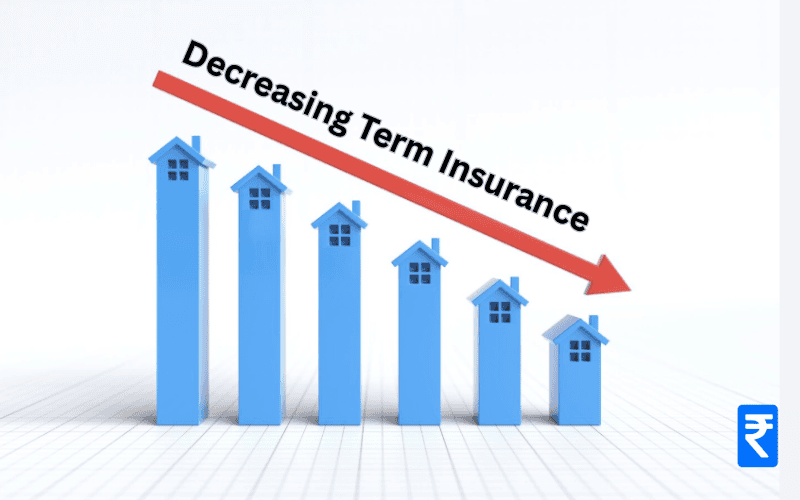
Decreasing term insurance works differently. The premium remains level (and is typically lower than a standard term plan), but the “Sum Assured” (payout) declines annually. For instance,
- Year 1: Death benefit is ₹75 Lakhs (matching your full loan).
- Year 10: Death benefit drops to approx. ₹45 Lakhs (matching your outstanding principal).
- Year 20: Death benefit is significantly lower (as your loan is fully paid off).
If you pass away at any point, the policy pays out exactly enough to settle the bank’s dues, leaving your family with the house and debt-free.
How Decreasing Term Insurance Works: The Mechanics
In India, these plans are frequently sold by banks as “Loan Protection Plans” (like SBI Life RiNn Raksha or HDFC Life Group Credit Protect) when you sign your loan agreement.
The Schedule
The insurer looks at your loan amortization table (interest rate + tenure). They structure the policy so the coverage drops annually, mirroring how your loan principal reduces with every EMI paid.
The Premium
You typically have two options:
- Single Premium: You pay a one-time lump sum upfront. Banks often offer to add this to your loan amount, which means you end up paying interest on your insurance premium.
- Regular Premium: You pay a smaller annual premium, just like a standard policy.
The Payout
In the unfortunate event of the borrower’s demise, the insurance company pays the outstanding loan amount directly to the Bank (Master Policyholder) or to the nominee, who then settles the debt.
The “Loan Insurance” Confusion: MRI vs. Term Insurance
In India, there is often confusion between home loan insurance or mortgage redemption insurance (MRI) and a regular term insurance policy.
| Feature | Decreasing Term (MRI/Loan Cover) | Standard Level Term Plan |
| Coverage | Reduces as you repay the loan. | Stays constant (e.g., ₹1 Cr) throughout. |
| Primary Goal | To clear a specific debt (House/Car). | To replace income & secure the family’s financial future. |
| Beneficiary | Usually, to the bank to settle dues. | The nominee (your spouse/children). |
| Cost | Generally more affordable (for pure risk cover). | Slightly higher (but offers more value). |
| Flexibility | Rigid. Tied to the loan schedule. | Flexible. Money can be used for anything. |
What to Do: If you are on a tight budget, a decreasing term plan can be a useful low-cost safety net. However, if affordability isn’t an issue, a standard term plan may be better because the surplus money (after paying the loan) can help your family with living expenses.
Pros and Cons of Decreasing Term Insurance
Here are the pros that make decreasing term insurance a consolable option:
- Cost Efficiency: Since the insurer’s risk drops every year, the premiums are generally lower than those of a level term plan.
- Surgical Protection: It can help prevent your family from being evicted or forced to sell the house to pay off debts.
- Easy Approval: These are often “Group Plans” offered by banks, so medical underwriting can be simpler or waived for younger applicants.
The following drawbacks must be kept in mind when deciding:
- Zero Maturity Value: Like most term insurance, if you survive the tenure, you get nothing back.
- Interest Rate Risk: If you have a floating rate home loan and interest rates spike (extending your tenure), your insurance coverage might reach zero before your loan is fully paid off, creating a coverage gap.
Tax Implications
Decreasing term insurance is treated like any other life insurance product by the Income Tax Department:
- Premiums: The premiums you pay are eligible for tax deductions under Section 80C of the Income Tax Act (up to ₹1.5 Lakhs annually).
- Payout: The death benefit is generally tax-free under Section 10(10D).
Who Should and Who Shouldn’t Opt for Decreasing Term Insurance
Decreasing term insurance can help cover certain debts, but it may not be suitable for everyone.
Who can consider it?
- Home loan borrowers should ensure they cover the debt in case of an untimely death
- Small business owners with bank loans to satisfy collateral requirements
- Those with time-limited obligations
- Budget-conscious individuals looking for a lower premium
Who may not need it?
- Those seeking long-term family income replacement
- People with inflation-linked expenses (tuition, rising costs)
- Anyone looking for investment or maturity benefits
- Individuals without major fixed debts
Conclusion
Decreasing term insurance is an efficient and economical way of covering existing debts, such as house loans and business loans. It covers your obligations while preventing you from paying for more than you need, making it ideal for budget-conscious borrowers or those with declining liabilities. That said, it’s not suitable if you want long-term coverage for your loved ones or protection against inflation.
The smart strategy would be to use decreasing term insurance to secure your debts, and pair it with a standard term plan to safeguard your family’s lifestyle and future expenses. By planning carefully and understanding your obligations, you can protect both your loans and your loved ones, giving you peace of mind without overpaying for insurance.
FAQs
Can I use this insurance to pay off my home loan early?
No. Term insurance (including decreasing term) covers only the risk of death. It has no cash value or savings component. You cannot cash it out to prepay your loan while you are alive.
What happens if I transfer my home loan to another bank?
If you bought a “Group Credit Protection” plan from Bank A, that policy usually terminates when you close the loan with them to move to Bank B. You would need to buy a new policy. However, if you bought a standalone decreasing term policy from an insurer directly, it stays with you, regardless of which bank holds your loan.
What happens if I sell my house?
Since the debt is cleared when you sell the house, you no longer need the coverage. You can simply stop paying premiums (policy lapses) or surrender it. If it were a single-premium policy, you might get a small refund of the “unexpired” premium value.