

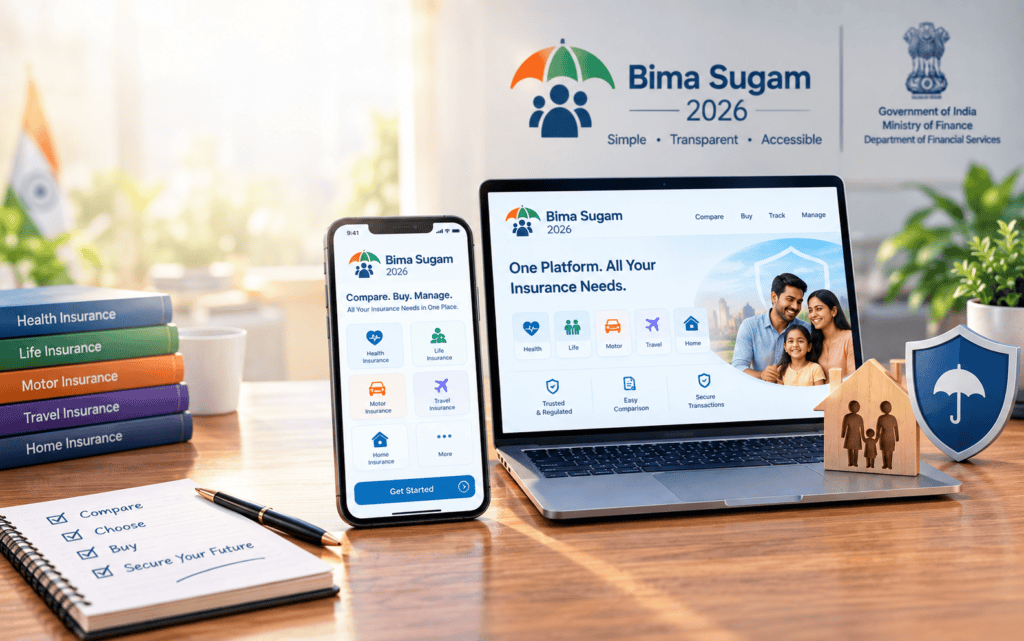
Buying insurance in India usually means checking quotes on one insurer’s app, comparing a few more on an aggregator site and calling an agent to confirm numbers. Each insurer runs its own login, claims process and paperwork.
Bima Sugam is IRDAI’s response to this fragmentation, built as shared digital infrastructure that brings insurers, intermediaries and policyholders onto one platform. The project has missed several deadlines since it was first proposed in 2022. On 30 June 2026, IRDAI Chairman Ajay Seth said he expects the first products to be available by the end of September 2026.
This article explains what the platform is, how it is expected to work, its launch timeline and what it could mean for how Indians buy and manage insurance.
What Is Bima Sugam?
Bima Sugam is an IRDAI-regulated digital insurance marketplace designed to let customers compare, buy, renew and service life, health and general insurance policies from participating insurers on one platform. It is established under the IRDAI (Bima Sugam – Insurance Electronic Marketplace) Regulations, 2024, notified on 20 March 2024. It is operated by the Bima Sugam India Federation (BSIF), a not-for-profit company formed under Section 8 of the Companies Act, 2013.
Former IRDAI Chairman Debasish Panda described the Bima Trinity, of which Bima Sugam is a part, as a UPI-like moment for insurance, since the platform is shared infrastructure rather than a product owned by one company. BSIF has an authorised capital of ₹500 crore and paid-up capital of around ₹310 crore. Its shareholding is spread across life, general and health insurers, and the regulations bar any single company from holding a controlling stake.
How Does Bima Sugam Work?
Once fully operational, Bima Sugam is designed to link insurers, intermediaries and policyholders through a shared digital identity and transaction layer. This would allow comparison, purchase, servicing and claims tracking through a single interface instead of separate insurer portals.
Expected stages:
- Registration: Users are expected to verify their identity via Aadhaar and PAN to generate a Bima Pehchaan ID, with KYC completed once and not repeated for future purchases.
- Comparison: Users filter by product type and compare premiums, claim settlement ratios and features across insurers.
- Purchase: The transaction is completed digitally, and the policy is stored against the ID. The regulations list DigiLocker among the government data sources the platform can draw on, with the user’s consent.
- Servicing: Renewals, nominee updates and address changes can be initiated from one dashboard.
- Claims: Claims are expected to be filed and tracked through one interface that connects the insurer and the intermediary.
The platform does not settle claims itself. The regulations require insurers to provide claim settlement and grievance redressal services through the marketplace, but claims are still verified and paid by the insurer or third-party administrator.
What Is Bima Pehchaan?
Bima Pehchaan is a lifelong digital insurance identity, linked to Aadhaar, PAN and a mobile number, that is intended to consolidate a person’s insurance policies under a single ID across participating insurers. It functions as a form of KYC for insurance.
With this ID, a policyholder is expected to view their policies from one dashboard, update nominee details and track claims without repeating documentation for each insurer. Intermediaries get a separate ID for verified transactions across insurers.
This matters for continuity. If a person changes insurers, jobs or cities, their insurance history stays attached to one ID rather than being scattered across records, which could simplify porting policies or verifying past claims. How completely this works will depend on insurer-side integration.
When Will It Launch in India?
Bima Sugam has missed several earlier deadlines, including an original January 2023 target and a December 2025 target for its first phase. As of mid-2026, IRDAI expects motor, health and term insurance to be the first products available, by September-end 2026, rolled out in phases.
| Milestone | Status/Date |
| Committee set up on the Bima Trinity | Oct 2022 |
| Original launch target | January 2023 |
| Marketplace regulations notified | 20 March 2024 |
| BSIF incorporated | 2024 |
| Official website launched (information hub) | September 2025 |
| Earlier Phase I target (e-KYC and initial products) | December 2025 (missed) |
| Motor insurance trials by insurers | Reported in August 2026 |
| Initial products: motor, health and term insurance | Expected by end-September 2026 |
| Distribution reforms consultation paper | Expected by end-July 2026, per IRDAI chairman (30 June 2026) |
IRDAI Chairman Ajay Seth has acknowledged the rollout is “behind schedule” while reaffirming the September 2026 target. Given this history, readers should treat published dates as indicative and use existing channels for any immediate purchase.
How Does It Fit Into the Bima Trinity?
Bima Sugam is one of three components of IRDAI’s Bima Trinity, alongside Bima Vistaar and Bima Vahaak. IRDAI set up a committee in October 2022 to coordinate the three, as part of its goal of “Insurance for All by 2047”.
The three components:
- Bima Sugam: An open digital marketplace for buying, comparing and claiming insurance from multiple insurers.
- Bima Vistaar: A bundled product that covers life, health, accident and property risk in one policy, aimed largely at rural households.
- Bima Vahak: A women-centric, local distribution channel that sells Bima Vistaar products and improves insurance awareness. IRDAI issued the Bima Vahak Guidelines on 9 October 2023.
Bima Vahaks are expected to sell Bima Vistaar products through the Bima Sugam platform. The stated goal is to raise India’s insurance penetration, which stood at 3.7% of GDP in 2024-25, against a global average of 7.3% in 2024.
What Products Will Be Available on Bima Sugam?
Bima Sugam is intended to eventually cover life, health, motor, travel, property and agriculture insurance, but the initial rollout is limited to a smaller set of products. The three products IRDAI has prioritised for the first phase are motor, health and term life insurance, all targeted by the end of September 2026.
- Motor Insurance: The first category to enter trials, with insurers reported to be testing their systems on the platform in August 2026.
- Health Insurance: Among the three priority products for the September 2026 target.
- Term Life Insurance: Among the three priority products for the September 2026 target, as a pure protection product.
- Property and Agriculture Insurance: No confirmed timeline as of mid-2026.
IRDAI has not announced a timeline for complex savings-linked products, such as ULIPs or endowment plans, which need more detailed comparison frameworks than straightforward term or motor covers.
How Will It Change Insurance Distribution?
Bima Sugam is expected to shift part of distribution away from high commission-based selling, which could reduce the cost built into premiums. IRDAI Chairman Ajay Seth said in June 2026 that the platform does not have to survive on a high commission, though it may require some fees. Media reports indicate a platform fee of 5-7% of the premium, compared with commissions that can reach 30% of the premium for some web aggregators and brokers. Under the regulations, consumers cannot be charged for using the marketplace, so any such fee would be paid by insurers.
What the fee difference could look like in practice: On a ₹15,000 annual health insurance premium, a commission of 25-30% would represent roughly ₹3,750-₹4,500 in distribution costs. At a reported platform fee of 5-7%, this would translate to ₹750-₹1,050. The illustrative difference is ₹2,700-₹3,750, although insurers may not pass the full difference on to customers.
Note: These are estimates, not guarantees; the rupee figures above are illustrative calculations based on the reported commission and fee percentages, not independently reported figures, and actual pricing and savings will vary by product and insurer.
Agents and brokers currently bring in a large share of new insurance business in India, largely through commission-linked incentives. In general insurance, for instance, brokers and agents together accounted for 56% of new business premium in FY2023, according to IRDAI data. A marketplace listing products without commission-linked placement could reduce the incentive to push higher-commission products, though the outcome depends on final rules.
Separately, IRDAI Chairman Ajay Seth said a consultation paper on distribution reforms was expected by the end of July 2026. Reports ahead of it suggested IRDAI was considering paying commissions over the policy term rather than largely upfront, and linking pay to the effort involved in selling and servicing a policy. Changes of this kind could affect agents in semi-urban and rural areas, who rely on commission income.
Bima Sugam vs Traditional Insurance Buying
Bima Sugam differs from traditional insurance buying mainly in how comparison, identity verification and claims tracking are handled, as it centralises functions that are currently spread across insurer websites, aggregator apps and agents.
| Basis | Bima Sugam | Traditional Buying |
| Comparison scope | Products from participating IRDAI-registered insurers on one screen | Limited to insurers presented by the chosen aggregator, agent or broker |
| KYC | One-time ID for all future transactions | Often repeated with each insurer |
| Policy storage | Centralised, linked to one digital ID via DigiLocker | Scattered across portals, emails, physical documents |
| Distribution cost | Free for consumers; reported 5-7% fee paid by insurers | Commissions of up to 30% of premium in some channels |
| Claims tracking | Single interface across insurer, intermediary, hospital | Insurer-specific processes |
| Availability | Limited; phased rollout from 2026 | Fully operational today |
| Verdict | More centralised once fully operational, but currently limited in product coverage | The more established route for most purchases today, with wider immediate choice |
Someone needing to buy or renew a policy today still needs to use existing channels, such as insurer websites, aggregators, agents or brokers, since transactional features are not yet live across all categories.
How Does It Compare to Existing Insurance Aggregators?
Bima Sugam is often described as a public digital alternative to private insurance aggregators, but the two operate on different models. Market commentary has flagged that private aggregators may face pressure on their commission models if the platform draws a large user base. The key structural difference is that private web aggregators are commercial intermediaries paid through the insurance distribution chain, while Bima Sugam’s regulations require a consent-based architecture and bar the platform from charging consumers.
This concern isn’t new. In August 2023, shares of PB Fintech, Policybazaar’s parent, fell over 5% in two days on worries about Bima Sugam, though analysts said the threat might be overstated.
For a buyer, the practical distinction is clear: aggregators offer product recommendations, dedicated support teams and, for now, a more established transaction flow across most product types. Bima Sugam is set to offer a no-charge service for consumers and one-time KYC across participating insurers, but as of mid-2026, its first phase is limited to motor, health and term products as part of its phased launch.
What Are the Risks of Bima Sugam?
Bima Sugam faces execution risks around data security, insurer technology integration and the effect of commission changes on the existing distribution network, alongside structural issues such as low rural digital literacy.
- Data Security: The platform will hold sensitive personal, medical and financial data for millions of users; insurers have raised concerns about data ownership.
- Technology Integration: Insurers must adapt legacy IT systems, requiring investment in technology and cybersecurity.
- Impact on Intermediaries: Lower commission-based incentives could disrupt agent and broker income in semi-urban and rural markets.
- Low Penetration and Digital Literacy: India’s insurance penetration remains below the global average, and rural digital literacy gaps could limit usage.
- Governance Continuity: A leadership gap at IRDAI in 2025 was cited by experts as a risk to the rollout.
- Repeated Delays: The project has missed several launch dates since 2022; published timelines should be treated as indicative.
These risks do not necessarily prevent success, but they are relevant when assessing how quickly the platform will change insurance buying in practice.
How Do You Register on Bima Sugam?
Full registration was not yet available to the public as of mid-2026, when the website worked mainly as an information hub. Once registration and transactional features are fully available, the expected process is as follows:
- Visit the official Bima Sugam website once transactional features go live.
- Choose the option to create an account and begin identity verification.
- Verify identity using Aadhaar, PAN and a mobile number to generate a Bima Pehchaan ID.
- Link an existing electronic insurance account or open a new one.
- Browse, compare and buy policies, or raise servicing and claims requests from the same login.
Until the platform is fully operational, existing channels, including direct purchases from insurers, repositories such as CAMSRep’s Bima Central, and licensed agents and brokers, remain the practical ways to buy and manage insurance.
Conclusion
Bima Sugam is a structural change in how insurance is expected to be bought, compared and serviced in India, built around a shared digital identity rather than insurer-specific systems. Its potential benefits, including centralised comparison, reduced paperwork and lower distribution costs, remain partly theoretical until the phased rollout is complete.
The project’s history of delays, along with open questions on data security and technology integration, means the transition is likely to be gradual. Existing insurer websites, aggregators and licensed intermediaries remain the functional routes today, with this marketplace expected to expand alongside them through 2026.
Frequently Asked Questions
Q1. Is Bima Sugam live for buying insurance policies right now?
Not fully. As of mid-2026, the Bima Sugam website functions mainly as an information hub, with motor insurance trials reported in August 2026. Transactional access to motor, health and term insurance is expected by the end of September 2026, per IRDAI’s stated timeline.
Q2. Does Bima Sugam replace the need for an insurance agent?
Not necessarily. It reduces dependence on multiple platforms and repeated paperwork, but the regulations name intermediaries and insurance agents as marketplace stakeholders, so they can still assist customers, particularly with complex products.
Q3. Will Bima Sugam make insurance premiums cheaper?
It could, since the reported fee is lower than some existing commission models and consumers cannot be charged for using the platform. The extent of any premium reduction depends on how much of that saving individual insurers choose to pass on.
Q4. Is personal data safe on Bima Sugam?
Data security is one of the most discussed concerns, since the platform will store sensitive personal, medical and financial information centrally. The regulations require consent-based access to data and a high degree of security and privacy standards, but independent evidence on how the live platform performs is not yet available.
Q5. Can existing policies be managed through Bima Sugam?
Once integration is complete, existing policies are expected to link to a Bima Pehchaan ID for unified viewing. This depends on insurers completing technical integration, still in progress as of mid-2026.