

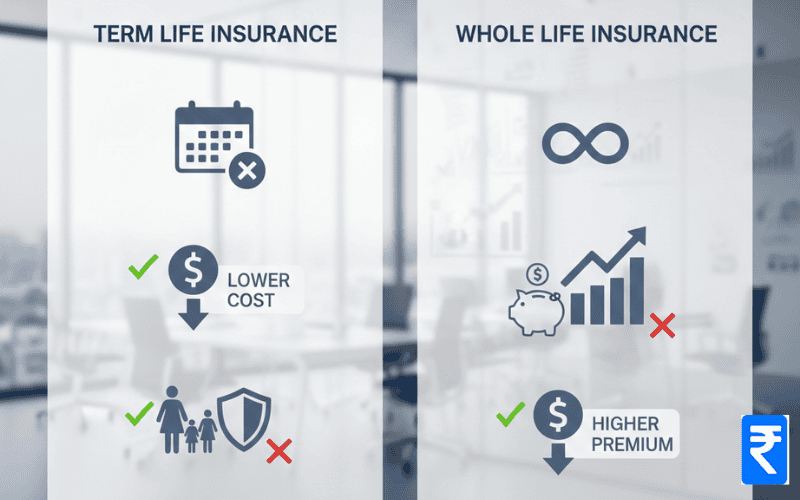
Choosing the right life insurance policy means understanding the key differences between term life and whole life insurance. The decision impacts your financial protection and long-term planning goals. This article provides a comprehensive guide comparing term vs whole life insurance, covering costs, cash-value components, benefits, and common use cases.
Table Of Content
- What is Term Life Insurance
- What is Whole Life Insurance
- Comparing Term vs Whole Life Insurance (Pros and Cons)
- Cash Value and Investment Considerations
- Coverage Duration and Financial Needs
- Policy Flexibility and Long-Term Planning
- Tax Treatment Considerations
- Common Misconceptions
- How to Decide Between Term and Whole Life Insurance
- Conclusion
- FAQs
What is Term Life Insurance?
Term life insurance covers you for a specific period, such as 10, 20, or 30 years. If you pass away during the policy term, the insurer pays a death benefit to your beneficiaries. If you outlive the term, the policy expires and pays no benefits unless you add riders or optional features. Many term policies also offer conversion options, allowing you to convert to a permanent policy without a medical exam, usually within a specified age or time limit.
- Temporary Coverage: Provides protection for a fixed period, such as 10, 20, or 30 years, to meet short- to medium-term financial obligations.
- Lower Premiums: Generally more affordable than whole life insurance for the same coverage amount, making it ideal for budget-conscious individuals.
- Convertible Options: Some policies allow you to convert your term coverage into a permanent (whole life) policy without a medical exam, usually within a specified age or time frame.
- High Coverage Amounts: Term policies often allow larger death benefits relative to premiums, helping protect dependents effectively.
- Simple Structure: Focused solely on providing a death benefit, without cash-value or investment components, making it straightforward to understand.
What is Whole Life Insurance?
Whole Life insurance has a cash-value component that accumulates and is available for loans or withdrawals made against the cash value when needed. These insurance products are typically used to keep a person covered for their entire life as long as they pay premiums. These policies also come with a guaranteed death benefit.
Whole Life Insurance Characteristics:
- Permanent Coverage: Provides lifelong protection, as long as premiums are paid, ensuring a guaranteed death benefit.
- Cash-Value Component: Builds cash value over time on a tax-deferred basis, which can be borrowed against or withdrawn during the insured’s lifetime.
- Fixed Premiums: Premiums typically remain level throughout the policyholder’s life, offering predictability in long-term planning.
- Potential Dividends: Some participating policies may pay dividends, providing additional financial benefits depending on the insurer’s performance.
- Comprehensive Protection: Combines risk coverage with a savings component, suitable for long-term financial and estate planning goals.
Comparing Costs: Term vs Whole Life Insurance Pros and Cons
Term Life Insurance
Term life insurance provides coverage for a specific period, making it suitable for temporary financial needs.
| Parameter | Advantages | Disadvantages |
| Premium Cost | Lower initial premiums; affordable for temporary coverage. | Costs can increase if the term is extended; it only provides protection, no cash value. |
| Coverage Duration | Can buy high coverage for a lower cost during the term. | Coverage ends when the term expires; no payout if you outlive the term. |
| Financial Planning | Allows focus on short- to medium-term obligations (mortgage, children). | Does not contribute to long-term wealth or savings. |
Whole Life Insurance
Whole life insurance offers lifelong coverage and a cash-value component, but comes with higher premiums.
| Parameter | Advantages | Disadvantages |
| Premium Cost | Fixed premiums; predictable long-term budgeting. | Premiums are significantly higher than term life; they may strain budgets. |
| Coverage Duration | Lifelong coverage as long as premiums are paid. | Higher cost may be unnecessary if permanent coverage isn’t needed. |
| Cash Value | Accumulates tax-deferred cash value over time. | Growth is slower than other investment options; access may reduce the death benefit. |
Cost implications: The dramatic difference in premiums is a core piece of the term vs whole life insurance pros and cons comparison; term insurance often costs a fraction of what whole life does for the same face value.
Cash Value and Investment Considerations
Term Insurance
The purpose of term insurance is to provide a death benefit only (protection). It does not have an additional component that allows for savings and investment; therefore, it does not provide the potential for long-term savings or investment growth.
- No Cash Value: All premium payment goes into a death benefit.
- No Investment Component: Policies do not provide a savings or investment vehicle.
Whole Life Policy
Whole Life Insurance provides a lifelong policy for protection as well as a savings component that provides the opportunity to accumulate cash value over time.
- Cash Value Growth: Grows a cash value over time on a tax-deferred basis.
- Access to Cash Value: Policyholders can borrow or withdraw from the cash value based on fees and interest charges.
- Lower Growth Potential: Cash values may have lower rates of growth than other investments, such as stocks and bonds.
Investment Decision: Many consumers decide between term and whole life insurance by comparing the forced savings of whole life policies with the option to invest the premium difference independently.
Coverage Duration and Financial Needs
Here are the term vs whole life insurance pros and cons to consider:
Purpose and Duration of Coverage
Term life insurance provides coverage for a fixed number of years and helps meet temporary needs, such as covering mortgage payments, supporting dependent children until adulthood, and replacing lost income during working years. Term life insurance allows you to choose a coverage length that fits your specific financial needs, offering flexibility for temporary obligations.
Permanent Coverage and Legacy Planning
Whole life insurance offers lifelong protection and guarantees a death benefit to the named beneficiary as long as you pay the premiums. People often use whole life insurance for estate planning and legacy planning.
Term life insurance provides a temporary death benefit and is suitable for meeting short-to-medium range financial objectives. Whole life insurance may be for long-term financial and estate/legacy objectives.
Policy Flexibility and Long-Term Planning
When selecting a life insurance policy, it is necessary to be aware of not only your current needs but also your anticipated financial goals. Every type of life insurance provides specific benefits; some have varying term lengths available for you to select based on your individual needs or planning objectives.
Policy Flexibility
A term life insurance policy gives clients flexibility and allows them to choose a coverage period that is consistent with their financial commitments, whether it’s the repayment of a mortgage, replacement of their income, or for all of their dependents. Due to its flexible nature, this type of insurance policy can serve the short to medium-term needs of clients and their changing life circumstances.
Long-Term Planning
Those who have a long-term outlook on their financial planning may benefit from whole life insurance because it is intended to provide lifetime protection. As long as premiums are paid, whole life insurance also ensures that your beneficiaries will be provided with a death benefit and will therefore have financial security in your absent.
Tax Treatment Considerations: Term vs Whole Life Insurance Pros and Cons
Understanding the tax implications of term and whole life insurance is crucial, as it affects both the death benefits paid out to beneficiaries and the potential growth of any cash value during the policyholder’s lifetime.
Term Life Insurance
Most term insurance plans do not have a maturity payout; therefore, taxation issues beyond the death benefit are usually not relevant. Here is the applicable taxation:
- Premium Deduction: Premiums paid for term insurance are typically eligible for a deduction under Section 80C up to ₹1.5 lakh per year.
- Other Considerations: Term plans that return premiums or offer maturity values may qualify for tax exemption if they meet conditions under Section 10(10D).
Whole Life Insurance
Here’s how taxation applies:
- Maturity/Cash‑value Payout: If the policy has cash value or matures (as in many whole life products), the payout may be tax‑exempt provided the policy meets criteria under Section 10(10D), such as limits on premium relative to sum assured.
- Aggregate Premium Limits: For policies issued on or after 1 April 2023, the total annual premium across all eligible life insurance policies should generally not exceed ₹5 lakh in any year to maintain the exemption for maturity or cash value proceeds.
- Premium Deduction: Like term insurance, premiums paid for whole life insurance may also be eligible for a deduction under Section 80C up to ₹1.5 lakh annually.
Note: Both term and whole life insurance death benefits are typically exempt under Section 10(10D).
Common Misconceptions in Term vs Whole Life Insurance Pros and Cons
It is important to separate the facts from the myths to pick suitable insurance.
Term Life Insurance: Protection Over Investment
It’s a misconception that term life insurance is wasted money if the policy expires without a payout. Term life protects against risk, offering peace of mind even without investment returns.
Whole Life Insurance: Limited Investment Growth
Whole life insurance is a good investment, but the cash value growth isn’t as high as it might be compared with numerous other types of investment vehicles. Therefore, insurance should be considered more as a risk management tool than a return investment.
How to Decide Between Term and Whole Life Insurance
Insurance Options and Suitable Requirements
| Profile | Likely Better Fit |
| Young couples with families looking for short-term, affordable insurance | Term life insurance |
| Individuals who want coverage for life and are willing to pay more for it | Whole life insurance |
| Customers who want to spend less and have flexibility in their options | Term life insurance |
| Individuals who want to build a cash value through estate planning. | Whole life insurance |
Suitability varies based on financial goals, age, health, and risk tolerance. There’s no universal answer; decisions should be based on individual needs and financial planning objectives.
Conclusion
The type of life insurance you choose should depend on the financial goals and protection you are seeking. While a term life policy can provide low-cost, flexible coverage for shorter-term or intermediate-term needs, a whole life insurance policy will provide you with lifetime protection along with potential cash value to help you fulfill your long-term financial goals. Understanding the policy’s cost, the duration of the term, and the tax treatment on your policy(s) can help ensure that it meets your ongoing financial requirements.
FAQs
1. What’s the main difference between term and whole life insurance?
Term vs whole life insurance differs in coverage length and value. Term life is affordable and time-bound, while whole life offers lifelong coverage with cash value.
2. Does term life insurance have the option to convert to whole life?
Some term policies allow conversion to permanent insurance without a new medical exam if done before a certain age.
3. Can whole life insurance be right for me?
Whole life suits those wanting lifelong coverage and cash value, but it may not be cost-effective for people seeking simple, affordable protection.
4. Is term life insurance less expensive than whole life?
Term life insurance is cheaper than whole life because it offers only death benefit protection, with no savings or investment component, resulting in lower premiums.
5. What should I think about as I make decisions about term vs whole life?
Assess your financial goals, budget, coverage duration, and need for cash value; a financial consultant can help guide the decision.