

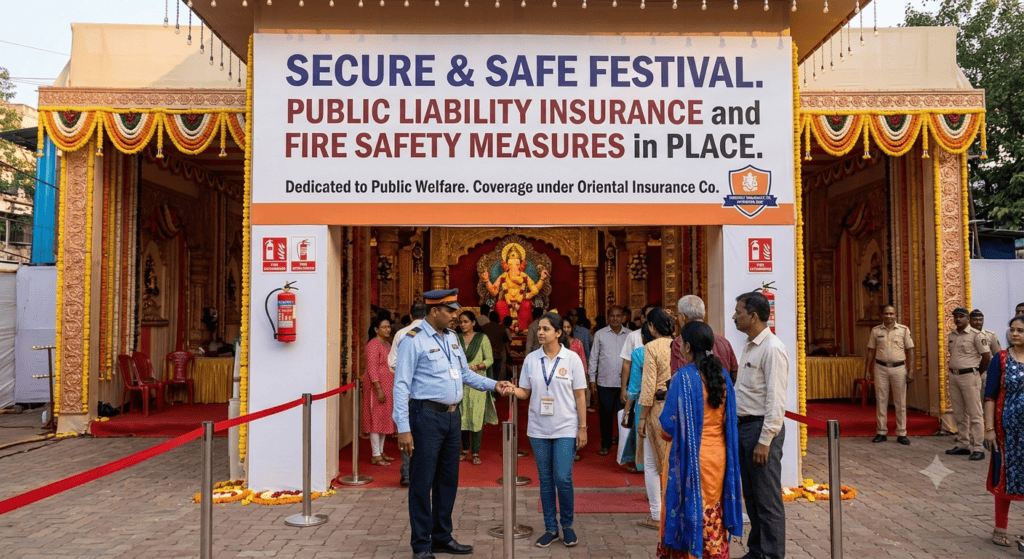
Ganesh Chaturthi draws lakhs of devotees to pandals across Maharashtra, Karnataka and other states, creating significant financial risk for organisers. A fire, a collapsed structure, a crowd injury or theft of a gold-plated idol can cost a mandal far more than the cost of setting up a pandal. With so many people, temporary structures and valuable assets involved, insurance becomes an important part of planning and hosting celebrations.
What does event insurance cover in India? And how much does it actually cost to insure a Ganpati pandal? This guide explains the details.
What Is Ganpati Pandal Insurance?
Ganpati pandal insurance is a short-term commercial policy that protects a festival mandal’s structure, idol, valuables and visitors against defined risks during the celebration. Organisers typically combine fire, burglary, liability and personal accident cover into one package, and insurers consider the festival duration when underwriting the risk. Business Standard’s 2026 festival reporting names Oriental Insurance and New India Assurance as leading providers of this cover in Maharashtra.
The policy is not a single standardised product priced by the IRDAI. Each insurer combines existing covers, and the mandal’s size, idol value and expected crowd influence what gets included.
What Does Event Insurance Cover in India?
Event insurance India typically combines four components: event cancellation, property damage, public liability and money insurance, following IRDAI’s model Event Insurance Policy wording. For a pandal, these sections can provide cover for the structure, decor and lighting, the idol and its ornaments, donation cash and third-party injury or property claims from visitors, depending on the policy selected.
Insurers issue event insurance India policies for the exact festival duration rather than a full year, since the risk exists only while the pandal is occupied. In practice, add-on sections can include personal accident cover for volunteers, priests, cooks and security staff, plus separate all-risk cover for jewellery on the idol.
Most policies exclude gradual wear, pre-existing structural defects and losses from illegal electrical wiring. Event cancellation cover is a separate section that can be selected according to the organiser’s requirements.
How Much Does It Cost to Insure a Ganpati Pandal?
Premiums for a typical neighbourhood pandal have ranged from roughly ₹3,000 to ₹7,500 for a sum insured of around ₹7 lakh, based on Oriental Insurance’s pricing as reported by Business Standard. This illustrates how premiums can vary with the sum insured, idol value and expected footfall for short-duration event insurance India policies.
| Pandal/Mandal Size | Reported Sum Insured | Approximate Premium |
| Small neighbourhood pandal | ~₹7 lakh | ₹3,000-₹7,500 |
| Mid-sized mandal | ₹3.5 crore-₹25 crore | Not publicly disclosed |
| Very large mandal (GSB Seva Mandal) | ₹474.46 crore (2025), ₹703.27 crore (2026) | Not publicly disclosed |
| Dahi Handi participant (Comparable cover) | ₹10 lakh per person | ₹75 per person |
Note: Premiums do not necessarily increase in direct proportion to the sum insured. Small mandals have reported premiums in the low thousands, while large mandals may have customised covers whose exact premiums are rarely disclosed.
What Factors Affect Pandal Insurance Premiums?
Several factors can affect the premium, including the sum insured, the value of gold and silver, expected footfall, festival duration, location risk and the add-on sections chosen. A pandal in a higher-risk location with valuable ornaments may cost more to insure than one with lower-value assets and lower exposure.
- Sum insured for the structure, decor and idol
- Declared value of gold, silver and gemstones
- Expected footfall over the festival
- Festival duration
- Location risk, including traffic and electrical load
- Number of volunteers and staff needing accident cover
The final premium also depends on the sections of cover and add-ons selected by the mandal.
What Is a Standard Fire and Special Perils Policy?
A standard fire and special perils policy is a commercial property insurance product that provides cover for material damage caused by fire, lightning, explosion, storm, flood, riot and similar listed perils. Within pandal insurance, this section protects the structure, decor, lighting and sound systems against physical loss during the festival.
GSB Seva Mandal’s 2025 cover, reported by Deccan Herald, included a standard fire and special perils policy with an earthquake extension worth ₹2 crore for furniture and installations such as CCTV cameras, alongside a second, smaller property section worth ₹43 lakh for the venue itself.
IRDAI records show that a standard fire and special perils policy was historically priced under the All India Fire Tariff, 2001. Since April 2021, IRDAI’s Bharat Sookshma and Laghu Udyam Suraksha products have replaced it for most small commercial risks. This 2025 cover, which included an SFSP section with an earthquake extension, shows this structure being used in a large, customised pandal insurance programme.
What Is Public Liability Insurance for a Pandal?
Public liability insurance covers a mandal’s legal liability to pay compensation for accidental injury to visitors or damage to third-party property arising from the pandal’s operation. If a barricade fails, a fire spreads to a neighbouring shop or a visitor is hurt in a crowd crush, this section covers the resulting claims and legal costs.
For GSB Seva Mandal’s 2025 festival, public liability insurance formed a distinct ₹30 crore component of its total cover, separate from property and personal accident sections, per Deccan Herald’s reporting. IRDAI’s public liability policy wordings confirm such cover typically excludes liabilities already insured elsewhere and applies only within the sum insured stated in the schedule.
For a crowded public pandal, this section can be particularly important because visitor injury claims may be larger and harder to predict than damage to the structure itself.
How Much Have Real Mumbai Mandals Paid for Cover?
Reported figures show that Mumbai mandals have insurance cover ranging from around ₹3.5 crore to more than ₹700 crore. These figures are the sums insured, not the premiums. Most large mandals do not disclose their premiums.
Andhericha Raja carries a cover of around ₹3.5 crore, and Lalbaugcha Raja around ₹25 crore, per Quartz. The insurance coverage for GSB Seva Mandal reportedly increased from ₹400.58 crore in 2024 to ₹474.46 crore in 2025 and ₹703.27 crore in 2026, driven largely by rising gold and silver prices on its idol.
Deccan Herald’s breakdown of GSB’s 2025 policy shows the ₹474.46 crore cover is split into roughly ₹67.03 crore for gold, silver and jewellery, ₹2.43 crore across two property sections, ₹30 crore for liability and ₹375 crore for personal accident cover for volunteers, cooks and staff. This shows how one large policy combines several sections within a single overall sum insured.
Is Insurance Mandatory for Ganpati Pandals?
Insurance is not a uniform national legal requirement for every Ganpati pandal. However, mandals must comply with the applicable civic, police and fire-safety requirements for organising a public pandal. In Mumbai, the BMC’s 2026 single-window system covers civic permission, police NOC and fire-safety compliance for organising a public pandal.
The permission process is separate from the decision to purchase insurance. Larger mandals have also been reported to sponsor insurance cover for smaller pandals. Requirements can vary by location, so mandals should check the applicable local permissions and safety requirements before organising the event.
How Can a Mandal Buy Pandal Insurance?
Mandals typically approach a public sector or private insurer directly or work through an agent handling event insurance India cases, sharing pandal size, idol value, footfall and festival duration to get a quote. Oriental Insurance and New India Assurance have historically underwritten much of Maharashtra’s pandal risk.
- Decide the sum insured for structure, idol and valuables separately.
- Choose the sections needed: fire, burglary, liability, accident and jewellery.
- Share footfall estimates and location details for underwriting.
- Declare gold and silver values accurately to avoid disputes.
- Review exclusions, especially illegal wiring and pre-existing defects.
- Complete the policy before the pandal is erected and confirm the policy’s coverage period and start date with the insurer.
Note: A sum insured that is too high or too low can affect claim settlement, so mandals should value the idol’s ornaments and structure as accurately as possible before finalising the policy.
Conclusion
The cost of insuring a Ganpati pandal in India can be a few thousand rupees for a modest neighbourhood mandal, while large mandals may have sums insured running into hundreds of crores, with their exact premiums often not publicly disclosed. What stays consistent is the policy structure: fire and property cover, public liability insurance and personal accident protection, combined within the broader category of event insurance India. Understanding what event insurance covers in India helps organisers compare quotes and be precise about the sum insured for both the structure and the idol’s valuables.
FAQs
1. Does a small residential society pandal need insurance cover?
It is not legally compulsory for most small pandals, but even modest gatherings carry fire and liability risk. Basic cover for a small pandal has cost as little as ₹3,000-₹7,500 in recent seasons.
2. What is the difference between the sum insured and the premium for pandal cover?
The sum insured is the maximum an insurer will pay for a covered loss, while the premium is what the mandal pays to buy that cover. Large mandals publicise their sum insured figures but rarely disclose the premiums they pay.
3. Does pandal insurance cover the idol during immersion?
Coverage for immersion depends on specific policy wording and whether cover has been extended beyond the pandal premises. Organisers should confirm with the insurer whether transit and immersion are included or if a separate add-on is needed.
4. Can a mandal insure only the idol’s gold and silver, without also covering the structure?
Yes, insurers offer standalone all-risk cover for jewellery and valuables, as seen in mandals that carry a distinct sum insured just for gold, silver and gemstones. Most still combine this coverage with structural cover, which is part of what event insurance covers in India for larger festivals.
5. Who pays for the personal accident cover of pandal volunteers and staff?
Personal accident cover can form part of the overall pandal insurance policy for volunteers and staff. At GSB Seva Mandal, personal accident cover accounted for ₹375 crore of the 2025 sum insured across volunteers, cooks and staff.